Reading Theme:
Change: Meanings, Examples, and Common Uses (2 meaning)
Meaning 1:alter (change)
change
/tʃeɪndʒ/
v., n.
To make something different, or to become different.

alter
➕
/ˈɔːltər/
v., n.
To cause something to become different from what it was, or to undergo a transformation.
📘 Details & Usage
📖 Root Explanation
From Latin 'cambiare' via Old French, meaning exchange. Evolved from barter to any alteration.
💡 Mnemonic
When you change, you rearrange. Associate with 'exchange' — swap old for new.
📖 Example
Seeing her friends start their own business inspired her to change her career path.
Seeing her friends start their own business inspired her to change her career path.
🔗 Collocations
change one's mind – to alter a decision or opinion
change the subject – to switch the topic of conversation
change direction – to modify the course or path
🔄 Synonyms
🚫 Antonyms
🌱 Derivatives
changeable (adj.) – able to be changed or likely to change
changer (n.) – someone or something that changes
unchanged (adj.) – not altered or different
📖 Cultural Story
The word 'change' entered English via Old French from Latin 'cambiare', meaning 'to exchange'. In medieval times, it referred to currency exchange and trading, later broadening to any alteration.
Meaning 2:spare change (change)
change
/tʃeɪndʒ/
v., n.
1. To replace one thing with another. 2. The money you get back when you pay more than the price of something.
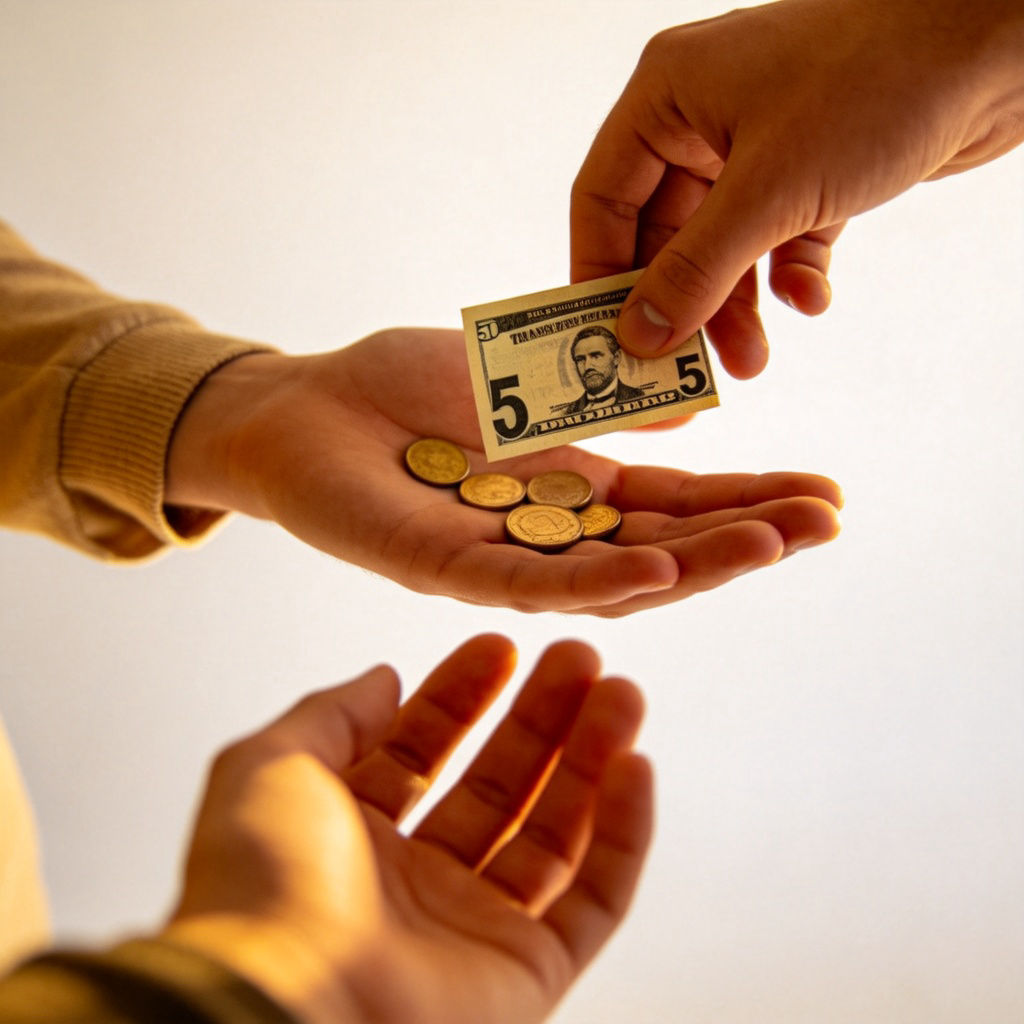
spare change
➕
/ˈspɛr tʃeɪndʒ/
v., n.
The money returned when the amount paid exceeds the cost, or coins of low denomination used in transactions.
📘 Details & Usage
📖 Example
At the supermarket checkout, I gave the cashier a 20-dollar bill for my 15-dollar groceries, and she gave me 5 dollars in change.
At the supermarket checkout, I gave the cashier a 20-dollar bill for my 15-dollar groceries, and she gave me 5 dollars in change.
🔗 Collocations
make change – to exchange a larger bill for smaller denominations
get change – to receive the difference after payment
small change – coins or paper money of low value
🔄 Synonyms
coins (n.) – metallic money, often of small value
small change (n.) – low-value coins or bills used for minor transactions
spare cash (n.) – extra money, often in small amounts
🚫 Antonyms
large bill (n.) – a high-denomination banknote
fixed price (n.) – an amount that does not require change
exact amount (n.) – a payment that matches the price exactly
🌱 Derivatives
changer (n.) – a person or machine that exchanges money
changeover (n.) – a switch from one system or thing to another
changeless (adj.) – never changing; constant
Wordbook
Your data is saved in this browser