Reading Theme:
Unpaid Leave: Definition, Examples & Usage
Meaning 1:Leave without pay (Unpaid leave)
Unpaid leave
/ʌnˈpeɪd liːv/
n.
Time off from work where the employee does not receive any salary.
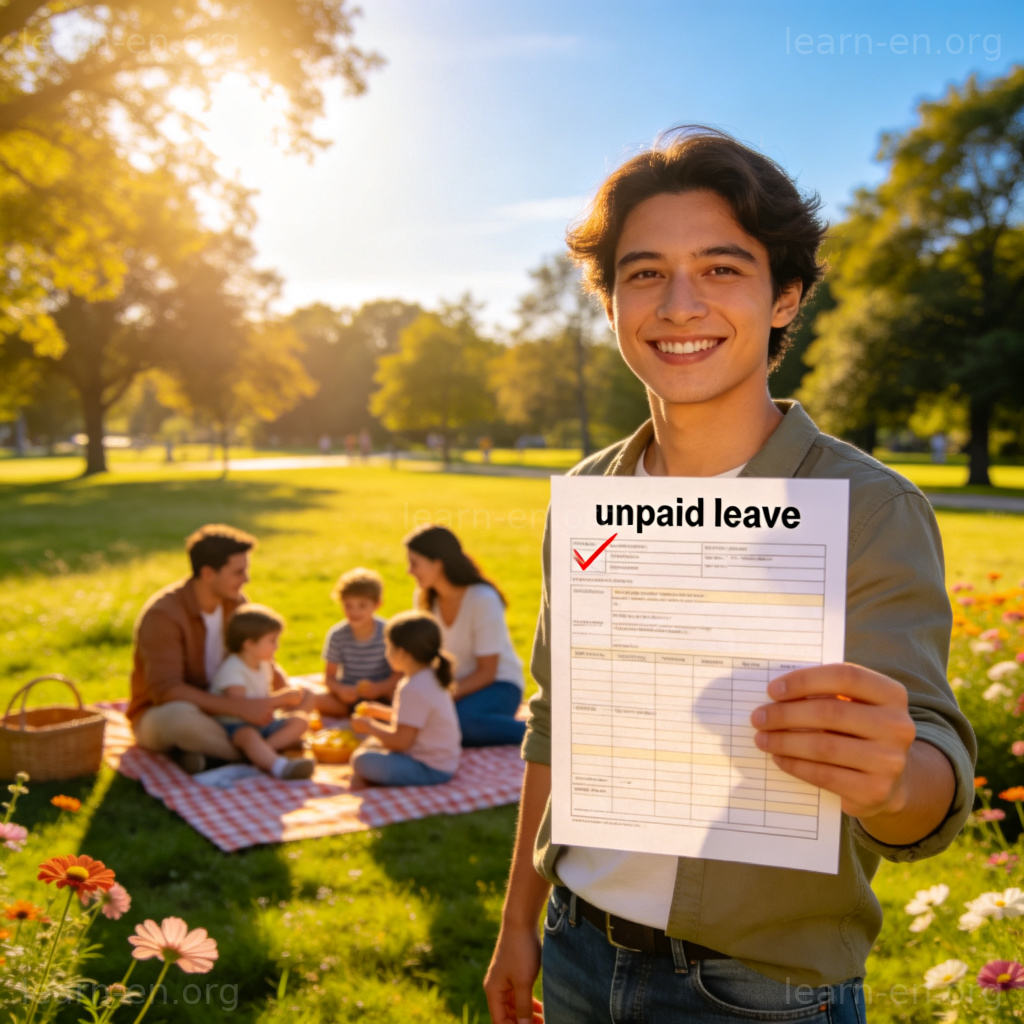
Leave without pay
➕
/liːv wɪˈðaʊt peɪ/
n.
A period of time when an employee is allowed to be away from work but does not receive their usual salary.
📘 Details & Usage
📖 Root Explanation
Un- (not) + paid (past of pay) + leave (permission to be absent); a period off work without salary.
💡 Mnemonic
Think: If you 'leave' your 'pay' behind, you're on unpaid leave.
📖 Example
She decided to take an unpaid leave for three months to travel and learn about different cultures.
She decided to take an unpaid leave for three months to travel and learn about different cultures.
🔗 Collocations
take unpaid leave – to use the option of being absent from work without pay
request unpaid leave – to formally ask for permission to take time off without salary
grant unpaid leave – to officially allow an employee to take leave without pay
🔄 Synonyms
leave of absence (n.) – A formal permission to be away from work, often unpaid
sabbatical (n.) – A prolonged break from work, sometimes paid or unpaid, for rest or study
time off without pay (n.) – A period away from work with no salary
🚫 Antonyms
paid leave (n.) – Time off from work that is compensated with salary
sick leave (n.) – Paid time off for illness
vacation (n.) – Paid time off for rest or travel
🌱 Derivatives
📖 Cultural Story
Unpaid leave is common in many companies as a flexible option for employees needing extended time off for personal reasons, travel, or study, without employer obligation to pay.
Wordbook
Your data is saved in this browser