Reading Theme:
How to Use Summarise: Definition & Examples
Meaning 1:give a concise overview (summarise)
summarise
/ˈsʌməraɪz/
v.
To give the main information or ideas of something longer in a much shorter form.
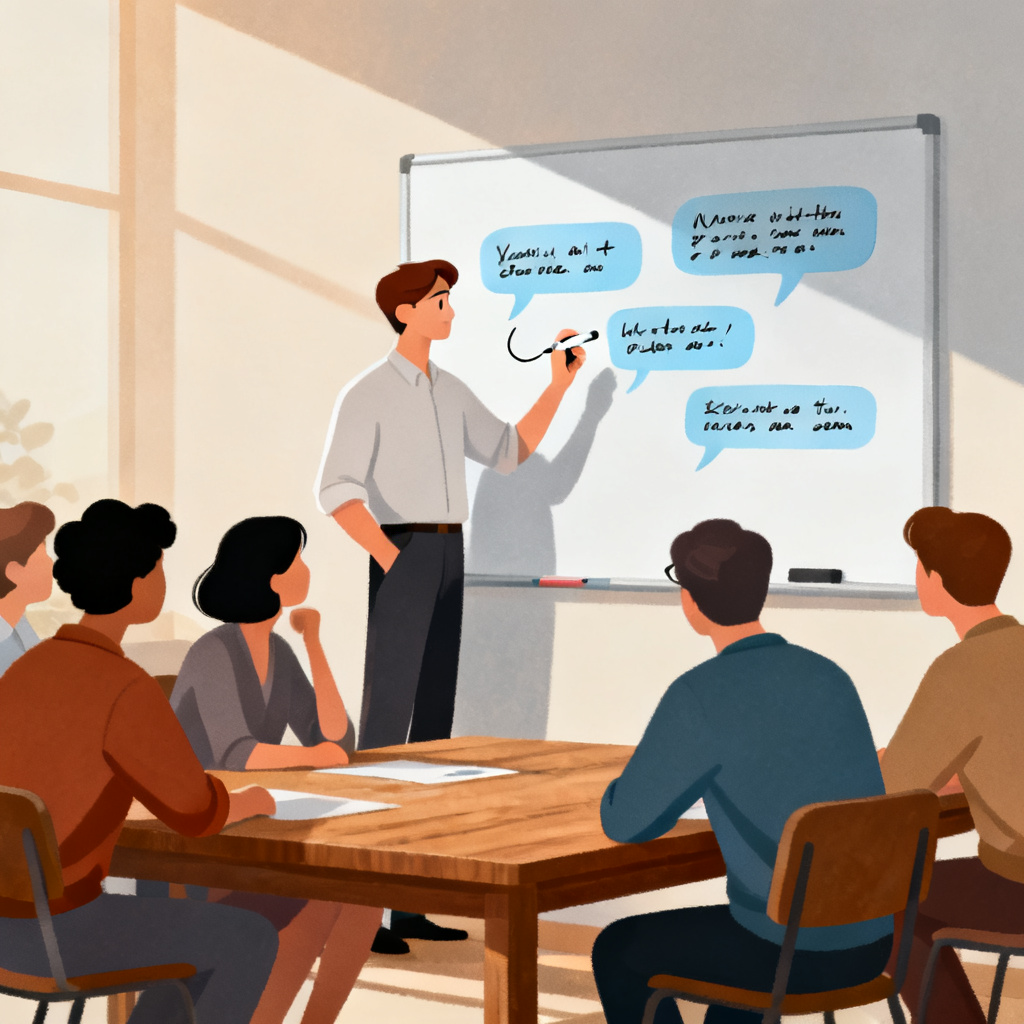
give a concise overview
➕
/ɡɪv ə kənˈsaɪs ˈəʊvəvjuː/
v.
To express the most important facts or ideas about something in a brief and clear form, omitting minor details.
📘 Details & Usage
📖 Root Explanation
From Latin 'summa' (total, whole) + '-ise' (verb-forming suffix), meaning 'to make into a total or whole account'.
💡 Mnemonic
SUMMARISE sounds like 'SUM it up' and make it 'RISE' to the top, keeping only the essential points.
📖 Example
After reading the long report, she was able to summarise its key findings in just three sentences for the team meeting.
Following her review of the extensive report, she successfully condensed its primary conclusions into merely three sentences for presentation at the team meeting.
🔗 Collocations
summarise the main points – to give a brief account of the key arguments or ideas
summarise a document – to provide a shortened version capturing the essence of a text
summarise findings – to concisely present the results or conclusions of research
🔄 Synonyms
outline (v.) – To describe the main facts or ideas in a general way, often without details.
encapsulate (v.) – To express the essential features of something succinctly.
recapitulate (v.) – To state again or summarize the main points of something.
🚫 Antonyms
🌱 Derivatives
summary (n.) – A brief statement or account of the main points of something.
summation (n.) – The process of adding things together; a concluding summary.
summarisation (n.) – The act or process of making a summary.
📖 Cultural Story
Originates from the Latin 'summarius' (of or pertaining to the sum or substance). It entered English via Medieval Latin 'summarizare'. In modern Anglophone academia and business, 'summarise' is a core skill, crucial for condensing research papers, legal briefs, and meeting minutes into digestible key points.
Wordbook
Your data is saved in this browser