1. Introduction
English dominates global academic, professional, and social communication, yet millions of English as a Foreign Language (EFL) readers struggle with comprehension due to complex vocabulary, grammar, and cultural references. Traditional solutions like formal education are costly and limited, while tools like electronic dictionaries and full-text translators (e.g., Google Translate) can foster dependency and hinder active learning. This paper introduces Reading.help, an intelligent reading assistant designed to bridge this gap. It leverages Natural Language Processing (NLP) and Large Language Models (LLMs) to provide proactive (system-initiated) and on-demand (user-initiated) explanations, aiming to support independent interpretation and learning for EFL readers with university-level proficiency.
2. System Design & Methodology
2.1. The Reading.help Interface
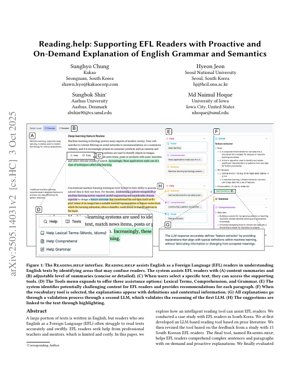
The user interface (Fig. 1) is central to the user experience. Key components include: (A) Content summaries, (B) Adjustable summary levels (concise/detailed), (C) Supporting tools activated by text selection, (D) A Tools menu offering Lexical Terms, Comprehension, and Grammar assistance, (E) Proactive identification of challenging content per paragraph, (F) Vocabulary explanations with definitions and context, and (H) Visual highlighting linking suggestions to the text.
2.2. Dual-Module Architecture
Reading.help is built on two specialized modules:
- Identification Module: Detects words, phrases, and sentences an EFL reader is likely to find difficult. This likely involves a model trained on learner corpora or difficulty metrics.
- Explanation Module: Generates clarifications for vocabulary, grammar, and overall text context. This is powered by LLMs, fine-tuned for pedagogical explanations.
2.3. Dual-LLM Validation Process
A critical technical innovation is the dual-LLM validation pipeline (Component G in Fig. 1). The primary LLM generates an explanation. A second, separate LLM then validates the reasoning and correctness of the first LLM's output. This acts as a reliability check, aiming to reduce hallucinations and improve explanation quality—a significant concern in educational applications of LLMs.
3. Case Study & Evaluation
3.1. Study with South Korean EFL Readers
The system was developed iteratively. An initial LLM-based prototype was created based on prior literature. This prototype was then tested and refined using feedback from a case study involving 15 South Korean EFL readers. This human-centered design phase was crucial for aligning the tool's functionality with real user needs and reading behaviors.
3.2. Final Evaluation Results
The final version of Reading.help was evaluated with 5 EFL readers and 2 EFL education professionals. The findings suggest that the tool has the potential to help EFL readers engage in self-directed learning when external support (e.g., teachers) is unavailable. The proactive and on-demand assistance model was positively received for supporting comprehension without encouraging passive translation of entire passages.
Key Insights
- Proactive + On-Demand: Combining system suggestions with user control balances guidance and autonomy.
- Dual-LLM Validation: A simple yet pragmatic approach to enhancing output reliability in educational AI.
- Targeted Audience: Focus on university-level EFL readers addresses a specific, motivated niche.
- Human-Centered Design: Iterative development with real users was key to functional relevance.
4. Technical Details & Analysis
4.1. Core Insight & Logical Flow
Core Insight: The paper's fundamental bet is that the biggest bottleneck for advanced EFL readers isn't vocabulary lookup, but contextual disambiguation and syntactic parsing. Tools like dictionaries solve the "what" (definition); Reading.help aims to solve the "why" and "how"—why this word here, how this clause modifies that noun. The logical flow is elegant: 1) Identify potential pain points (Identification Module), 2) Generate pedagogical explanations (Primary LLM), 3) Sanity-check those explanations (Secondary LLM), 4) Present them through a non-intrusive, highlight-linked UI. This creates a closed-loop system focused on comprehension scaffolding rather than translation.
4.2. Strengths & Critical Flaws
Strengths:
- Novel Validation Mechanism: The dual-LLM setup is a clever, low-cost hack for quality control. It acknowledges the "stochastic parrot" problem head-on, unlike many LLM applications that treat output as gospel.
- Right-Sized Problem Scope: Targeting university-level readers avoids the immense complexity of adapting to all proficiency levels. It's a viable beachhead market.
- UI Fidelity: The interface components (A-H) show thoughtful integration of assistance tools directly into the reading workflow, reducing cognitive load switching.
- Black Box Evaluation: The paper's major weakness is the evaluation. N=5 users and 2 professionals is anecdotal, not empirical. Where are the quantitative metrics? Comprehension gain scores? Speed-accuracy trade-offs? Compared to a baseline (e.g., using a dictionary)? This lack of rigorous validation severely undermines the claimed efficacy.
- Ambiguous "Difficulty" Detection: The Identification Module is described in vague terms. How is "potentially challenging content" defined and modeled? Without transparency, it's impossible to assess its accuracy or bias.
- Scalability & Cost: Running two LLMs per explanation request doubles inference cost and latency. For a real-time reading assistant, this could be a prohibitive bottleneck for scaling.
4.3. Actionable Insights & Strategic Implications
For Researchers: This work is a blueprint for responsible, assistive LLM design. The dual-LLM pattern should be standardized for educational AI. Future work must replace the flimsy evaluation with robust, comparative user studies (A/B tests against established tools) and standardized EFL assessment metrics (e.g., adapted from TOEFL or IELTS reading sections).
For Product Developers: The proactive highlight feature is the killer app. It transforms the tool from reactive to anticipatory. The immediate product roadmap should focus on: 1) Optimizing the dual-LLM pipeline for speed (perhaps using a small, fast model for validation), 2) Personalizing the "difficulty" detection based on individual user interaction history, and 3) Exploring a freemium model where basic highlights are free, but detailed grammar explanations are premium.
Broader Implication: Reading.help represents a shift from Machine Translation to Machine Tutoring. The goal isn't to replace the source text but to equip the reader to conquer it. This aligns with broader trends in "AI for Augmentation" over "AI for Automation," as discussed in research from the Stanford Human-Centered AI Institute. If successful, this approach could be applied to other complex document types like legal contracts or scientific papers for non-specialists.
5. Original Analysis: Beyond the Interface
Reading.help sits at a fascinating intersection of three major trends: the democratization of language learning, the maturation of task-specific LLMs, and the growing emphasis on human-AI collaboration. While the paper presents a compelling case study, its true significance lies in the methodological framework it implies for building trustworthy educational AI. The dual-LLM validation mechanism, though computationally expensive, is a direct response to one of the most cited limitations of generative AI in education: its propensity for confident inaccuracy. This echoes concerns raised in studies on LLM hallucination, such as those documented by OpenAI and in surveys like "On the Dangers of Stochastic Parrots" (Bender et al., 2021). By implementing a validation step, the authors are essentially building a crude form of "constitutional AI," where one model's output is constrained by another's review, a concept gaining traction for alignment research.
However, the research falls short in defining its core metric: what constitutes "successful" reading assistance? Is it faster reading speed, deeper comprehension, increased vocabulary retention, or simply user confidence? The field of intelligent tutoring systems (ITS) has long grappled with this, often using pre-post test gains as a gold standard. A tool like Reading.help could benefit from integrating with established reading comprehension assessment frameworks. Furthermore, the focus on South Korean EFL readers, while providing valuable cultural context, invites questions about generalizability. English grammatical challenges differ significantly between speakers of a subject-object-verb (SOV) language like Korean and a subject-verb-object (SVO) language like Spanish. Future iterations need a more nuanced, linguistically-aware difficulty detection model, perhaps informed by contrastive analysis from second language acquisition research.
Compared to other augmented reading tools, such as the now-defunct Google's "Read Along" or research prototypes like "Lingolette," Reading.help's strength is its granularity—offering help at the word, clause, and paragraph level. Yet, it risks creating a "crutch" effect if the explanations are too readily available. The next evolution should incorporate adaptive fading, where the system gradually reduces proactive hints as a user demonstrates mastery of certain grammatical constructs or lexical items, a principle drawn from cognitive tutor design. Ultimately, Reading.help is a promising proof-of-concept that highlights both the immense potential and the non-trivial challenges of deploying LLMs as personalized reading coaches.
6. Technical Framework & Mathematical Model
While the PDF does not detail specific algorithms, the described system implies several underlying technical components. We can formalize the core process.
1. Difficulty Score Estimation: The Identification Module likely assigns a difficulty score $d_i$ to a text unit (word, phrase, sentence) $t_i$. This could be based on a composite model: $$d_i = \alpha \cdot \text{Freq}(t_i) + \beta \cdot \text{SyntacticComplexity}(t_i) + \gamma \cdot \text{Ambiguity}(t_i)$$ where $\text{Freq}$ is inverse document frequency or learner corpus frequency, $\text{SyntacticComplexity}$ could be parse tree depth, and $\text{Ambiguity}$ might be the number of possible part-of-speech tags or senses. Coefficients $\alpha, \beta, \gamma$ are weights tuned on EFL learner data.
2. Dual-LLM Validation Logic: Let $\text{LLM}_G$ be the generator and $\text{LLM}_V$ be the validator. For an input query $q$ (e.g., "Explain this sentence"), the process is: $$e = \text{LLM}_G(q; \theta_G)$$ $$v = \text{LLM}_V(\text{concat}(q, e); \theta_V)$$ where $e$ is the explanation, $v$ is a validation output (e.g., "Correct", "Incorrect", "Partially correct with note"). The final explanation shown to the user is conditioned on $v$, potentially triggering a re-generation if $v$ indicates serious issues.
7. Experimental Results & Chart Description
The provided PDF text does not include detailed quantitative results or charts. The evaluation is described qualitatively:
- Sample: Final evaluation with 5 EFL readers and 2 professionals.
- Method: Likely qualitative interviews or usability tests following interaction with the tool.
- Implied Chart/Figure: Figure 1 in the paper is the system interface diagram, showing components (A) through (H) as labeled in the PDF content. It visually demonstrates the integration of summary panels, tool menus, highlighting, and explanation pop-ups within a single reading pane.
- Reported Outcome: Findings suggest the tool could potentially help EFL readers self-learn when external support is lacking. No statistical measures of improvement (e.g., comprehension test scores, time-on-task reduction) are reported.
8. Analysis Framework: A Non-Code Use Case
Consider an EFL researcher or product manager who wants to analyze the effectiveness of a feature like "proactive highlighting." Without access to the code, they can employ this analytical framework:
Case: Evaluating the "Difficulty Detection" module.
- Define Success Metrics: What does a "good" highlight mean? Possible operational definitions:
- Precision: Of all text highlighted by the system, what percentage did users actually click on for help? (High precision means highlights are relevant).
- Recall: Of all the text segments users manually selected for help, what percentage had been proactively highlighted? (High recall means the system anticipates most needs).
- User Satisfaction: Post-session survey rating (1-5) on the statement "The highlights drew my attention to areas I found challenging."
- Data Collection: Log all user interactions: system highlights (with their $d_i$ score), user clicks on highlights, user manual text selections outside of highlights.
- Analysis: Calculate Precision and Recall for different $d_i$ thresholds. For example, if the system only highlights items with $d_i > 0.7$, does precision improve? Plot a Precision-Recall curve to find the optimal threshold that balances relevance and coverage.
- Iterate: Use findings to retune the coefficients ($\alpha, \beta, \gamma$) in the difficulty score model, or to add new features (e.g., highlighting cultural references).
9. Future Applications & Development Directions
The Reading.help paradigm opens several promising avenues:
- Vertical-Specific Assistants: Adapt the core engine for reading scientific papers, legal documents, or technical manuals for non-native expert readers. The identification module would need domain-specific difficulty corpora.
- Multimodal Integration: Combine text analysis with speech synthesis to create a read-aloud assistant that explains difficult passages as it narrates, aiding listening comprehension.
- Long-Term Learner Modeling: Transform the tool from a session-based assistant to a lifelong learning companion. Track which grammatical concepts a user consistently seeks help on and generate personalized review exercises, creating a closed learning loop.
- Cross-Linguistic Transfer: For languages with similar resources, apply the same architecture to assist readers of Chinese, Arabic, or Spanish texts. The dual-LLM validation would be equally critical.
- Integration with Formal Learning: Partner with online learning platforms (Coursera, EdX) or digital textbook publishers to embed Reading.help's functionality directly into course materials, providing just-in-time support for enrolled students.
- Advanced Validation Techniques: Replace or supplement the secondary LLM validator with more efficient methods: rule-based checkers for grammar, knowledge graph lookups for factual consistency, or a smaller, distilled "critic" model fine-tuned specifically for explanation validation.
10. References
- Chung, S., Jeon, H., Shin, S., & Hoque, M. N. (2025). Reading.help: Supporting EFL Readers with Proactive and On-Demand Explanation of English Grammar and Semantics. arXiv preprint arXiv:2505.14031v2.
- Bender, E. M., Gebru, T., McMillan-Major, A., & Shmitchell, S. (2021). On the Dangers of Stochastic Parrots: Can Language Models Be Too Big? 🦜. In Proceedings of the 2021 ACM Conference on Fairness, Accountability, and Transparency (pp. 610–623).
- Anderson, J. R., Corbett, A. T., Koedinger, K. R., & Pelletier, R. (1995). Cognitive Tutors: Lessons Learned. The Journal of the Learning Sciences, 4(2), 167–207.
- Stanford Institute for Human-Centered Artificial Intelligence (HAI). (2023). The AI Index 2023 Annual Report. Retrieved from https://hai.stanford.edu/research/ai-index-2023
- Nation, I. S. P. (2001). Learning Vocabulary in Another Language. Cambridge University Press.
- Google. (n.d.). Google Translate. Retrieved from https://translate.google.com
- Council of Europe. (2001). Common European Framework of Reference for Languages: Learning, teaching, assessment. Cambridge University Press.