Core Insight
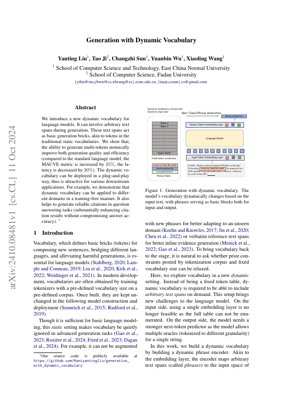
This paper isn't just an incremental tweak; it's a foundational challenge to a core assumption in modern NLP. For years, we've treated the tokenizer as a fixed, pre-processing step—a necessary evil that segments text into a static, finite set of units. Liu et al. correctly identify this as a bottleneck. The static vocabulary is a straitjacket, limiting a model's ability to fluidly adopt new terminology or efficiently generate common multi-word concepts. Their dynamic vocabulary proposal is akin to giving a model a "macro" capability, allowing it to treat frequent or context-critical phrases as atomic operations. This directly attacks two chronic pain points: the inefficiency of autoregressive decoding and the brittleness of LMs outside their training domain. The results—a 25% quality boost paired with a 20% speedup—are not mere optimizations; they signal a potential paradigm shift where vocabulary becomes a live, contextual component of the model itself.
Logical Flow
The argument is compelling and well-structured. It starts by diagnosing the problem: static vocabularies fail in advanced generation tasks like domain adaptation and precise citation. The proposed solution—a dynamic vocabulary—logically follows but immediately surfaces the technical hurdles: how to represent infinite possible phrases (solved by the phrase encoder) and how to train it effectively (solved by interleaved data and negative sampling). The experiments then validate the solution across the very use cases initially posed, creating a tight, closed loop. The plug-and-play deployment claim is critical; it suggests the approach can be retrofitted to existing models like GPT or LLaMA, massively increasing its practical impact. The flow from problem identification to technical innovation to empirical validation is exemplary.
Strengths & Flaws
Strengths: The dual benefit of improved quality and efficiency is rare and highly valuable. The training-free domain adaptation is a killer feature for enterprise applications. The focus on citation generation aligns perfectly with the industry's push towards trustworthy, verifiable AI. The technical design, particularly the negative sampling strategies, shows deep insight into representation learning challenges.
Flaws & Open Questions: The paper is light on the computational overhead of the phrase encoder and the real-time retrieval of dynamic phrases. In a high-throughput scenario, constantly encoding new phrases could negate the latency gains. There's also a risk of the model becoming overly reliant on provided phrases, potentially harming its compositional generalization—its ability to construct novel phrases not in the dynamic set. Furthermore, the safety implications are unexplored: could malicious actors inject biased or harmful phrases into the dynamic vocabulary? The approach, while powerful, potentially moves some of the control problem from the model's weights to its runtime vocabulary input.
Actionable Insights
For AI product teams, this research is a mandate to re-evaluate your text generation stack. Prioritize experiments integrating a dynamic vocabulary layer for use cases involving repetitive terminology (legal, medical, technical support) or requiring source attribution. The training-free adaptation is a low-risk, high-reward testing ground.
For researchers, the immediate next step is to benchmark this approach against other efficiency methods like speculative decoding or mixture-of-experts. A hybrid approach might be optimal. Also, explore integration with retrieval-augmented generation (RAG) systems; dynamic vocabulary could be the missing link that allows RAG to move beyond appending context to actually generating with it fluently.
For practitioners, treat the dynamic vocabulary as a new hyperparameter—a "contextual dictionary" that can be curated and optimized for specific tasks. Start building pipelines to automatically extract key phrases from knowledge bases relevant to your query. The future of efficient, accurate generation lies not just in bigger models, but in smarter, more adaptive vocabularies.
In conclusion, this work, reminiscent of the pivotal shift brought by the Transformer architecture's attention mechanism (Vaswani et al., 2017), moves us from thinking of vocabulary as a fixed pre-process to considering it as a dynamic, integral part of the reasoning and generation process. It's a significant step towards more efficient, adaptable, and grounded language models.