Select language

Working Memory and Language Comprehension: A Meta-Analysis (1996)

A meta-analysis of 77 studies (6,179 participants) comparing the predictive validity of different working memory measures for language comprehension ability.
learn-en.org | PDF Size: 1.5 MB
Ukadiriaji: 4.5/5
Your rating
You have already rated this document
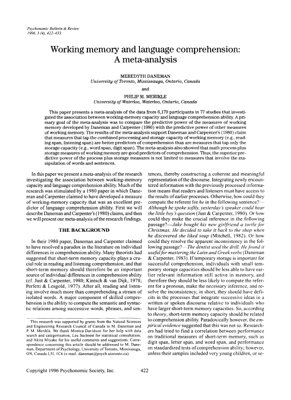
PDF Document Cover - Working Memory and Language Comprehension: A Meta-Analysis (1996)

1. Introduction and Overview

This paper presents a comprehensive meta-analysis aimed at investigating the critical association between working memory capacity and language comprehension ability. This analysis synthesizes data from 77 independent studies, involving a total of 6,179 participants. Its primary objective is to rigorously examine and compare the predictive validity of different types of working memory measurement methods, with a particular focus on evaluating the claims proposed by Daneman and Carpenter in their seminal 1980 paper.

The core hypothesis of this study is that, compared to measures that primarily assess onlyStorage CapacityCompared to traditional measurement methods (such as digit span, word span), those that assess working memoryProcessing and Storage CompositeAre measures of function (such as reading span, listening span) better predictors of complex comprehension tasks.

2. Theoretical Background and Paradox

本研究基于20世纪末期普遍存在的一个理论悖论。语言理解的认知理论(例如,Just & Carpenter, 1980; Kintsch & van Dijk, 1978)认为,短时记忆容量对于跨句子信息整合、代词消解和推理至关重要。因此,个体在短时记忆上的差异应与理解能力高度相关。

However, empirical evidence has consistently failed to support this view. In typical adult populations, the correlation between simple short-term memory span tasks (such as digit span) and standardized comprehension tests is weak or even non-existent. Daneman and Carpenter (1980) argued that this paradox stems from a flawed measurement theory. Traditional span tasks measurepure storagecapacity, whereas real-time language comprehension is aprocessing-storage compositeActivity. The brain must maintain the results of previous processing in an active state for integration while handling new linguistic input (syntactic parsing, semantic extraction).

3. Meta-Analysis Methodology

This meta-analysis employs a systematic approach to aggregate findings from a large body of literature.

3.1 Study Screening and Data Sources

We conducted a comprehensive literature search to identify studies published between 1980 and the mid-1990s that reported correlations between any working memory/short-term memory measure and a language comprehension (reading or listening) measure. The final sample comprised 77 studies involving 6,179 participants, ensuring the robustness and representativeness of the data pool.

3.2 Classification of Working Memory Measurement Methods

Working memory measurement methods are divided into two main categories:

  • Pure storage measurement: Require simple recall of task items (e.g., Digit Span, Word Span, Letter Span).
  • Processing-Storage Composite Measurement: Require dual-task paradigms involving simultaneous processing and storage.
    • Speech category: Reading span, listening span.
    • Non-speech category: Mathematical breadth (e.g., operation span).

3.3 Statistical Analysis

The effect size (correlation coefficient,r) for each study was transformed using Fisher'szTransformation was performed to normalize its distribution. Subsequently, weighted by sample size, the weighted average effect size for each type of working memory measure was calculated. Confidence intervals were calculated to assess the reliability of the average effect.

4. Key Results and Findings

4.1 Comparison of Working Memory Measurement Types

Meta-analysis reveals a clear and significant hierarchy in predictive validity. Processing-storage composite measures (e.g., reading span) consistently correlate more strongly with comprehension outcomes than pure storage measures (e.g., digit span).

4.2 Superiority of Processing-Storage Composite Measures

The results strongly support Daneman and Carpenter's (1980) original claim. The reading span task (which requires participants to read sentences aloud while remembering the final word of each sentence) proved to be a particularly effective predictor. This validates the theoretical view that the ability to manage concurrent processing and storage demands is a core component of language comprehension skill.

4.3 Universaliteti ya kazi za usemi

A key and more general finding is the superiority of processing-storage composite measuresis not confined to verbal contentKamar ma'aunin fa'ida (tunawa da lambobi yayin warware ma'auni na lissafi), an kuma tabbatar da cewa su ne kyakkyawan ma'auni na fahimtar magana. Wannan yana nuna cewa tsarin da ake auna shi ne ikon gudanarwa na gama-gari, ba kawai fasaha ta musamman ta harshe ba.

5. Muhtasari wa takwimu

Yawan binciken da aka yi nazari

77

Total number of participants

6,179

Key Working Memory Measurement Types

Pure Storage vs. Processing-Storage Composite

Core Findings

Processing-Storage Composite measurement is a superior predictor.

6. Core Insights and Implications

  • Measurement methods are crucial: The choice of working memory task fundamentally alters what is measured and its relevance to complex cognition.
  • Executive function is key: Language comprehension relies heavily on domain-general executive control (managing attention, switching, updating), not just passive storage buffers.
  • Resolved a theoretical paradox: By highlighting the inadequacies of pure storage measurement methods, it explains why early studies failed to discover a strong association between short-term memory and comprehension.
  • Laying the foundation for future research: Established reading span and its variants as the gold standard measurement for studying individual differences in higher-order cognition related to working memory.

7. Conclusion

This meta-analysis provides strong quantitative support for understanding a key transition in working memory. It confirms thatthe ability to simultaneously process and store informationis a critical determinant of language comprehension, with its importance surpassing that of simple storage capacity. Furthermore, it demonstrates that this principle extends beyond the verbal domain, suggesting a core, domain-general executive component in working memory. These findings solidify the theoretical and methodological legacy of the work by Daneman and Carpenter (1980).

8. Original Analysis and Expert Commentary

Core Insights: Daneman & Merikle 1996年的元分析不仅仅是对数据的总结;它正式加冕了“工作记忆”作为一个Active, executive system, and ultimately buried its predecessor—the passive "short-term store." The true contribution of the paper lies in shifting the paradigm fromCapacity(How much can you accommodate) SteeringControl efficiency(How well do you manage cognitive traffic). This reflects the evolution of AI from models with large static repositories to architectures with dynamic attention and gating mechanisms, as exemplified by the Transformer's self-attention mechanism, which prioritizes relevant information over mere storage.

Logical thread: Its argumentation process is elegant and precise. It first acknowledges the historical paradox (the theory posits the importance of short-term memory, yet data suggests otherwise), identifies the flawed tool (pure storage span), introduces the correct tool (processing-storage composite span), and leverages the power of meta-analysis to demonstrate the new tool's universality. The inclusion of mathematically-based span tasks (operation span) is the masterstroke—it proves the construct is a domain-general executive function, not merely a language module. This logic foreshadows modern frameworks, such as Engle's (2002) model which primarily views working memory as "controlled attention."

Strengths and Weaknesses: Its strength lies in the methodological rigor and the clear, influential conclusions. It resolved a debate. However, from a modern perspective, its weakness lies in its reliance on correlations. It excellently demonstrates that complex span tasks canPredictionUnderstanding ability, but meta-analysis itself cannot proveCausalityOr clarifyPrecise mechanism. Did greater reading breadth lead to better comprehension, or did stronger language skills free up storage resources? Later research using latent variable analysis (e.g., Miyake et al., 2000) and neuroimaging techniques had to dissect this. Furthermore, it focused on individual differences, leaving open questions about the within-individual, real-time working memory processes during comprehension.

Actionable insights: For researchers, this paper is a timeless directive: if you are studying the role of working memory in complex cognition, use complex span tasks, not digit span. For educators and clinicians, it indicates that training focused on executive control and dual-task processing (e.g., working memory training programs like Cogmed) may be more effective at improving comprehension than rote rehearsal exercises. For AI/ML practitioners, it is a blueprint: to simulate human-like language comprehension, a system needs an active, resource-managing component capable of handling parsing, reasoning, and memory simultaneously—this remains a frontier challenge for developing more robust and efficient language models.

In essence, this meta-analysis transformed working memory from a theoretical concept into a measurable, powerful predictor of real-world cognitive performance, setting the agenda for research in cognitive psychology, neuroscience, and education for the subsequent decades.

9. Technical Details and Mathematical Framework

The core statistical engine of this meta-analysis is the synthesis of correlation coefficients (r). To combine results from multiple studies, the correlation coefficient reported in each study is firstritransformed to Fisher'szscale to stabilize the variance:

$$ z_i = \frac{1}{2} \ln\left(\frac{1 + r_i}{1 - r_i}\right) $$

ziThe variance is approximately $ \sigma^2_{z_i} = \frac{1}{n_i - 3} $, whereniis the studyi's sample size. The overall weighted average effect size\bar{z}Calculate as follows:

$$ \bar{z} = \frac{\sum_{i=1}^{k} w_i z_i}{\sum_{i=1}^{k} w_i} $$

Among them, the weightwiis the reciprocal of the variance: $ w_i = n_i - 3 $.\bar{z}The standard error is $ SE_{\bar{z}} = \sqrt{\frac{1}{\sum w_i}} $. Finally, transform the averagezvalue and its confidence interval back to the correlation coefficientrfor interpretation:

$$ \bar{r} = \frac{e^{2\bar{z}} - 1}{e^{2\bar{z}} + 1} $$

This procedure allows for precise, sample-size-weighted comparisons of the average correlation strength across different categories of working memory measures (e.g., pure storage vs. reading span).

10. Experimental Results and Chart Descriptions

Hypothetical Summary Chart (Based on Report Results):

Chart Title: Average Correlation (r) Between Working Memory Measurement Methods and Language Comprehension

Chart Type: Forest Plot or Grouped Bar Chart.

Description: This chart will visually compare the average effect sizes (with 95% confidence intervals) across different working memory measurement categories. We anticipate observing:

  • Pure storage measures (digit/word span): A set of bars or dots showing lower average correlations (e.g., $ r \approx .20$ to $.30$), whose confidence intervals may cross or approach zero in some subsets.
  • Verbal processing-storage composite measure (reading/listening span): Bars show significantly higher average correlations (e.g., $ r \approx .40$ to $.55$), with narrower confidence intervals above zero, indicating robust predictive validity.
  • Nonverbal processing-storage composite measure (operation/math span): The average correlation for bar displays is significantly higher than that for pure storage measures, comparable to or slightly lower than verbal complex span (e.g., $ r \approx .35$ to $.50$), demonstrating its generality.

The clear separation between the "pure storage" category and the two "processing-storage composite" categories will graphically summarize the main conclusion of this paper.

11. Analytical Framework: Example Cases

Scenario: A researcher wants to investigate why some students have difficulty understanding complex science textbooks.

Application Framework Based on This Meta-Analysis:

  1. Hypothesis: Difficulties are more related to limitations in executive working memory (managing multiple concepts simultaneously) rather than simple memory span.
  2. Key predictor variables (independent variables): Simultaneous administrationDigit SpanTask (pure storage) andReading spanTask (processing-storage composite).
  3. Outcome variable (dependent variable): Alama ya mtihani maalum unaopima uelewa wa makala ya kisayansi yenye msongamano, ukilenga mantiki, ujumuishaji wa maoni kwenye aya mbalimbali, na utatuzi wa migogoro ya dhana.
  4. Muundo wa utabiri: Kulingana na meta-uchambuzi,Reading spanThe correlation with comprehension test scores will be significantly stronger thanDigit Spanthe correlation with comprehension scores. Researchers will conduct a statistical test on the difference between these two correlations.
  5. Explanation: If the predicted pattern holds, it supports the view that students' comprehension challenges are rooted in the executive control aspects of working memory, thereby guiding interventions toward strategies aimed at reducing concurrent cognitive load or improving information management, rather than merely engaging in repetitive memory practice.

12. Future Applications and Research Directions

The findings of this meta-analysis pave the way for numerous advanced research avenues and practical applications:

  • Neuroscience Correlation Studies: Using fMRI and EEG to identify brain networks (e.g., the frontoparietal network) that support processing-storage composite functions, and investigating how their efficiency correlates with individual span scores and comprehension abilities.
  • Development and Aging Research: Tracking the changes in the relationship between complex working memory span and comprehension abilities across the lifespan, to inform educational strategies and cognitive aging interventions.
  • Clinical Assessment: Improving diagnostic tools for learning disorders (e.g., dyslexia, specific language impairment) and neurological disorders (e.g., ADHD, aphasia) by incorporating complex span tasks as more sensitive markers of cognitive-linguistic deficits.
  • Artificial Intelligence and Natural Language Processing: To inform the development of more cognitively plausible language models. Modern architectures like the Transformer implicitly handle some "processing-storage composite" functions through self-attention mechanisms, but explicitly modeling resource constraints and executive control remains a frontier in creating AI for language understanding with human-like depth and robustness.
  • Personalized Learning and Educational Technology: Integrate adaptive software to estimate a learner's working memory capacity through gamified complex-span tasks, thereby dynamically adjusting the pacing, chunking, and scaffolding support of instructional materials.
  • Training and Intervention: Design and evaluate cognitive training programs specifically aimed at enhancing the executive control component of working memory, with the goal of improving academic and professional comprehension skills.

13. References

  1. Daneman, M., & Carpenter, P. A. (1980). Individual differences in working memory and reading. Journal of Verbal Learning and Verbal Behavior, 19(4), 450-466.
  2. Daneman, M., & Merikle, P. M. (1996). Working memory and language comprehension: A meta-analysis. Psychonomic Bulletin & Review, 3(4), 422-433.
  3. Engle, R. W. (2002). Working memory capacity as executive attention. Current Directions in Psychological Science, 11(1), 19-23.
  4. Just, M. A., & Carpenter, P. A. (1980). A theory of reading: from eye fixations to comprehension. Psychological Review, 87(4), 329.
  5. Kintsch, W., & van Dijk, T. A. (1978). Toward a model of text comprehension and production. Psychological Review, 85(5), 363.
  6. Miyake, A., Friedman, N. P., Emerson, M. J., Witzki, A. H., Howerter, A., & Wager, T. D. (2000). The unity and diversity of executive functions and their contributions to complex “frontal lobe” tasks: A latent variable analysis. Cognitive Psychology, 41(1), 49-100.
  7. Vaswani, A., Shazeer, N., Parmar, N., Uszkoreit, J., Jones, L., Gomez, A. N., ... & Polosukhin, I. (2017). Attention is all you need. Advances in Neural Information Processing Systems, 30.