1 Introduction
This paper critically examines the growing trend of using neural language models as theoretical proxies for human language acquisition. Although language models have achieved remarkable success in various natural language processing tasks, their relevance as cognitive models is questioned due to fundamental differences in the scale and nature of their training data compared to child language learning.
The authors argue that popular syntactic evaluation benchmarks (e.g., BLiMP, SyntaxGym) may lack the structural diversity and psychological validity needed to assess whether language models acquire language in a human-like manner. They advocate for the use of more rigorous, linguistically curated datasets, such as the LI-Adger dataset, which incorporates gradient acceptability judgments from native speakers.
1.1 Implications for Language Acquisition Research?
This section highlights a significant data disparity: models like BERT are trained on tens of billions of tokens, while children receive only about ten million words per year. Recent research attempts to bridge this gap by training models on child-directed corpora that are closer to human scale (e.g., 5 million tokens). The core question is whether models trained on such "reduced" input can still perform well on behavioral benchmarks and thus serve as effective cognitive models.
2 Core Insight: The Illusion of Benchmarking
The paper's central argument directly challenges complacency in the field of natural language processing. Impressive performance on templated, synthetic benchmarks like BLiMP creates an illusion of grammatical competence. The authors expose this as a methodological artifact. When language models are tested on the LI-Adger dataset—a set of minimal pairs meticulously constructed by theoretical linguists to probe specific syntactic principles—their evaluations diverge significantly from human judgments. This is not merely a performance gap; it is evidence of a fundamental representational mismatch. Language models may be learning superficial statistical patterns that coincidentally align with simple syntactic templates, rather than the abstract, hierarchical structures that underpin human grammar.
3 Logical Thread: From Data Discrepancy to Methodological Critique
论证过程如外科手术般精确。首先,它确立了语言模型训练与儿童习得之间不可否认的数据规模鸿沟,将“小规模训练”研究框定为必要但不足的纠正措施。其次,它证明即使在这个公平的竞争环境(小数据)下,语言模型的性能也可能被更简单的基线模型匹配,从而质疑其附加的认知价值。逻辑的转折点在于对基准设计的批判:模板化任务缺乏真实语言探究的“结构多样性”。最终的、决定性的证据来自 LI-Adger 测试,其中语言模型的性能与人类语言直觉完全相悖。脉络如下:问题陈述(数据不匹配)-> 尝试的解决方案(小规模训练)-> 揭示更深层问题(有缺陷的评估)-> 结论性的反证。
4 Strengths and Weaknesses: A Critical Analysis
Strengths: The paper's greatest strength lies in its methodological rigor and interdisciplinary grounding. It does not merely criticize but offers a superior alternative (LI-Adger). By tying evaluation to core theoretical linguistics and psycholinguistics, it raises the bar for what constitutes evidence of "human-like" knowledge. Its focus on data scale is also prescient, aligning with broader trends in efficient machine learning.
Flaws and Omissions: While incisive, the analysis may overstate the extent of failure. Does divergence on LI-Adger negate all parallels between language model learning and language acquisition? Perhaps not entirely. The paper could have engaged more with language modelsLalleAbin da aka yi daidai da dalilin haka. Bugu da ƙari, ya dogara sosai akan ilimin nahawu; cikakkiyar samfurin fahimta dole ne kuma ta yi la'akari da fannoni na ma'ana, aikace-aikace da kuma ilmantarwa na zamantakewa. Kira na "ƙarin bayanai na gaskiya" yana da ma'ana, amma bai cika ba – ta yaya za mu tsara yanayin shigar da yara ke jagoranta mai yawa, hulɗa da cike da kurakurai?
5 Feasible Suggestions: The Way Forward
Ga masu bincike, buƙatu a bayyane yake: a watsar da dogaro akan ma'auni mai sauƙi. Haɗa albarkatu daga ilimin harshe na ka'idar (misali tsarin LI-Adger) da ilimin halayyar ci gaba cikin kayan aikin tantancewa. Ba da fifiko ga ƙirƙirar "ma'auni na fahimta," don gwada alamomin koyon harshe na ɗan adam: ƙaddarawa daga ƙarancin bayanai, jurewa ga hayaniya da bin ƙa'idodin nahawu na zahiri. Ga masu haɓaka samfura, manufa ya kamata ta karkata daga haɓaka maki na ma'auni zuwa ƙira na tsari da hanyoyin horarwa masu ingancin bayanai kuma waɗanda za su iya koyo daga shigarwa mai kama da na ɗan adam (misali, haɗa tsarin koyon darasi ko koyo mai ƙwazo waɗanda aka yi wahayi daga ci gaba). Hikimar ƙarshe ita ce: Gina cikakkiyar samfurin fahimta, matsala ce daban kuma mafi wahala fiye da gina tsarin sarrafa harshe na halitta mai inganci.
6 Original Analysis: The Cognitive Gap in Language Modeling
Wannan takarda daga Vázquez Martínez et al. ta gabatar da muhimmiyar kuma mai tunatarwa a wani zamani da girman ke yawan ruɗar da hankali. Ta nuna daidai wani tashin hankali na asali: duk da cewa samfuran harshe na zamani, musamman manyan samfuran harshe, suna nuna ƙwarewar harshe a zahiri mai ban sha'awa, hanyar da suke samun wannan ƙwarewar ta bambanta sosai da ta yaro. Kulawar marubutan ga rashin isasshen ma'auni ta kasance mai hankali sosai. Wannan yana daidaitawa da damuwa a wasu fannonin AI, inda aikin ma'auni ya kasa fassara zuwa hankali mai ƙarfi, mai ƙaddarawa. Misali, a fagen hangen nesa na kwamfuta, samfuran da suka yi fice akan ImageNet na iya yin ruɗi da sauƙaƙan tasirin adawa, suna bayyana rashin fahimtar gani na gaske – bincike daga cibiyoyi kamar MIT da Google Brain sun yi cikakken bayani kan wannan al'amari. Hakazalika, wannan takarda ta nuna cewa, nasarar samfuran harshe akan BLiMP na iya zama irin wannan tasirin "Hans mai wayo," inda samfurin yayi amfani da ka'idojin ƙididdiga a cikin ginin ma'auni, maimakon koyon ƙa'idodin nahawu na asali.
Ba da shawarar bayanan LI-Adger shine mafi girman gudunmawar wannan takarda. Ta hanyar kafa tantancewa akan mafi ƙanƙanta kwatancen biyu da yanke hukunci na karɓuwa mai gradient – ma'aunin zinariya na nahawu na ka'idar – yana tilasta wa samfurin nuna fahimta gaGrammaticalityof knowledge, not merely possibility. The results of language models failing in this regard are compelling. This indicates that the probability distribution learned from vast text corpora ($P(w_n | w_{1:n-1})$) does not necessarily converge to the categorical or gradient judgments that characterize human grammatical knowledge. This aligns with the arguments of linguists like Noam Chomsky, who have long maintained that statistical learning from surface forms is insufficient to account for the poverty of the stimulus and the abstract nature of syntactic rules.
However, the conclusion of this paper should not be that language models are irrelevant to cognitive science. On the contrary, it redefines the challenge. The future lies in "cognitively-architecture-inspired" modeling. This may involve incorporating inductive biases inspired by linguistic theory (e.g., a predisposition for hierarchical structure), as seen in some neuro-symbolic approaches, or designing training objectives that go beyond next-word prediction. The work of researchers like Brenden Lake and Marco Baroni on few-shot learning and compositionality points in this direction. The way forward is not to discard language models, but to rigorously test them against the right cognitive benchmarks and iteratively redesign them based on their failures, much like the cycle of theory and experiment in other sciences.
7 Technical Details and Mathematical Framework
The core evaluation method discussed involves using a language model's output probabilities to predict human acceptability judgments. For a sentence $S = w_1, w_2, ..., w_n$, a standard autoregressive language model assigns a probability:
本文还提到了在儿童导向语料上训练的模型。这里的关键技术挑战是从非常小的数据集(约 $5\times10^6$ 个词元)中学习,这与标准的语言模型语料库($>10^9$ 个词元)相比相去甚远。这需要高效的架构和训练技术,以避免过拟合并从稀疏数据中提取可泛化的模式。
8 Experimental Results and Chart Analysis
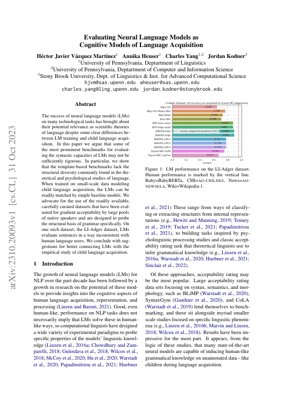
This paper presents a key result in Figure 1 (described in the PDF content). This chart compares the performance of different language models (BabyBERTa, AO-CHILDES, AO-NEWSELA, Wikipedia-1) against the human performance baseline on the LI-Adger dataset.
Chart Interpretation: The vertical line representing human performance serves as the benchmark. The chart likely displays the correlation coefficient (e.g., Spearman's $\rho$) between the surprisal of each language model and human acceptability ratings. The key finding is that the bars for all language models are significantly lower than the human baseline. This visually demonstrates the paper's core claim: even models specifically trained on child-like data (BabyBERTa, AO-CHILDES) cannot match human judgments on this syntactically nuanced dataset. The performance gap indicates that, as measured by this stringent test, the training objectives of current language models do not lead to the acquisition of human-like grammatical knowledge.
9 Analytical Framework: LI-Adger Case Study
Framework: Assessing language models as cognitive models through minimal pair acceptability.
Objective: Determine whether the internal probability distribution of a language model aligns with human grammatical intuitions regarding structurally contrastive sentences.
Steps:
- Stimulus Selection: Use a dataset like LI-Adger, which consists of minimal contrastive pairs (e.g., "Who do you think that John saw?" vs. "Who do you think John saw?"), where based on specific syntactic principles (e.g., the "that-trace" filter), one variant is grammatical and the other is less acceptable or ungrammatical.
- Model Query: For each sentence $S$ in a minimal contrastive pair, compute the model's average token surprisal: $\text{Surprisal}(S) = -\frac{1}{|S|} \sum \log P(w_i | context)$.
- Prediction Generation: 模型“偏好”惊奇度较低的句子。对于一个最小对比对 (A, B),如果 $\text{Surprisal}(A) < \text{Surprisal}(B)$,则模型预测 A 更可接受。
- Comparison with human data: Compare the model's preference patterns across hundreds of such minimal pairs with aggregated acceptability judgments from human participants. Calculate the correlation coefficient (e.g., Spearman's $\rho$) between model surprisal and human ratings.
- Interpretation: A high, statistically significant positive correlation would indicate that the language model's knowledge aligns with human syntactic judgments. A low or non-significant correlation (as found in this paper) indicates a divergence.
Non-code example: 考虑测试跨干扰从句的主谓一致知识:“The key to the cabinets *are/*is on the table.” 人类一致认为“is”是正确的。一个习得了抽象一致规则(主语‘key’ -> 动词‘is’)的语言模型应该为正确的句子分配更高的概率。一个依赖局部 n-gram 统计的语言模型可能会被“cabinets”的邻近性误导而偏好“are”。将上述框架应用于许多此类对比对,可以揭示语言模型所习得知识的本质。
10 Future Applications and Research Directions
1. Development of "Cognitive Benchmark Tests": One primary direction is the creation of standardized, multifaceted evaluation suites that go beyond syntax, encompassing semantics, pragmatics, and language acquisition milestones (e.g., vocabulary bursts, overgeneralization errors). These benchmarks should be co-designed by computational linguists, developmental psychologists, and cognitive scientists.
2. Architectures with Linguistic Inductive Biases: Future models may incorporate explicit structural priors. For instance, architectures that are innately built for hierarchical representations or enforce syntactic constraints during generation, bringing them closer to the Principles and Parameters framework in linguistics.
3. Interactive and Multimodal Training: To better simulate child learning, models could be trained on interactive, multimodal data streams (vision + speech + text) within embodied environments, as explored in embodied AI research, rather than on static text.
4. Data-Efficient and Curriculum Learning: Develop training algorithms capable of succeeding with orders of magnitude less data, potentially by implementing curriculum learning strategies that mirror the progression of complexity found in child-directed corpora.
5. The Bridge to Neurolinguistics: Comparing the internal representations and processing dynamics of language models with neural data from humans performing language tasks, such as fMRI and EEG, as pioneered by researchers at the MIT McGovern Institute for Brain Research, can provide a new level of validation for cognitive models.
11 References
- Linzen, T., & Baroni, M. (2021). Syntactic structure from deep learning. Annual Review of Linguistics.
- Warstadt, A., et al. (2020). BLiMP: The Benchmark of Linguistic Minimal Pairs. Proceedings of ACL.
- Huebner, P. A., et al. (2021). BabyBERTa: Learning More Grammar With Small-Scale Child-Directed Language. Proceedings of CoNLL.
- Chomsky, N. (1965). Aspects of the Theory of Syntax. MIT Press.
- Lake, B. M., & Baroni, M. (2023). Human-like systematic generalization through a meta-learning neural network. Nature.
- Hewitt, J., & Manning, C. D. (2019). A Structural Probe for Finding Syntax in Word Representations. Proceedings of NAACL.
- Warstadt, A., & Bowman, S. R. (2022). What Artificial Neural Networks Can Tell Us About Human Language Acquisition. Algebraic Structures in Natural Language.
- Fenson, L., et al. (1994). Variability in early communicative development. Monographs of the Society for Research in Child Development.