1. Introduction and Overview
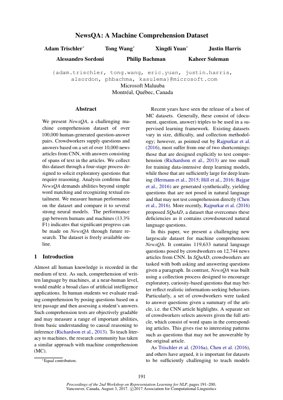
This document analyzes the paper "NewsQA: A Machine Comprehension Dataset" presented at the Second Workshop on Representation Learning for NLP in 2017. The paper introduces a novel, large-scale dataset designed to push the boundaries of Machine Reading Comprehension (MRC). Its core premise is that existing datasets are either too small for modern deep learning or synthetically generated, failing to capture the complexity of human natural questioning. NewsQA, created to fill this gap, contains over 100,000 human-generated question-answer pairs based on CNN news articles, explicitly focusing on questions that require reasoning beyond simple lexical matching.
2. NewsQA Dataset
NewsQA is a supervised learning corpus consisting of (document, question, answer) triples. The answers are contiguous text spans from the source article.
2.1 Ƙirƙirar Dataset da Hanyoyi
The dataset was constructed using a meticulously designed four-stage crowdsourcing process, aimed at elicitingexploratory和reasoning-intensivequestions:
- Question Generation: Workers were shown only the bullet points/summary of a CNN article and were asked to pose questions they were interested in.
- Answer Span Selection: Another group of workers, after obtaining the full article, identifies the text span that answers the question (if it exists).
- This decoupled design encourages questions that differ lexically and syntactically from the answer text.
- It naturally leads to a subset of questions beingunanswerable, which adds another layer of difficulty.
2.2 Muhimman Siffofi da Bayanan Ƙididdiga
Scale
119,633 pairs of questions and answers
Source
12,744 CNN articles
Article length
The average length is approximately 6 times that of SQuAD articles
Answer type
Text fragment (not an entity or multiple-choice question)
Salient features: Longer contextual documents, lexical differences between questions and answers, a higher proportion of reasoning questions, and the presence of unanswerable questions.
3. Nazarin Fasaha da Ƙira
3.1 Tsarin Ka'idodin Ƙira
The author's goal is clear: to build aRequires similar reasoning behaviorCorpus, such as integrating information from different parts of long articles. This is a direct response to the criticism that many MC datasets (e.g., those generated byCNN/Daily Mailcloze-style methods) primarily test pattern matching rather than deep understanding. [Chen et al., 2016]。
3.2 Kwatanta da SQuAD
Although both are based on text snippets and generated via crowdsourcing, NewsQA has its unique characteristics:
- Domain and Length: News article vs. Wikipedia paragraph; document length significantly longer.
- Collection process: Decoupled QA generation (NewsQA) vs. generated by the same annotator (SQuAD), leading to greater diversity.
- Question nature: Designed for "exploratory, curiosity-based" questions vs. questions generated directly from text.
- Unanswerable questions: NewsQA explicitly includes questions with no answer, a realistic and challenging scenario.
4. Sakamakon Gwaji da Aiki
4.1 Kwatanta Aikin Dan Adam da Na'ura
The paper established a human performance baseline on this dataset. The key result was a13.3% F1 score gapbetween the best neural model tested at the time and human performance. This significant gap was not seen as a failure, but as evidence that NewsQA is a challenging benchmark on which "significant progress can be made."
4.2 Binciken Aikin Model
The authors evaluated several strong neural baseline models (architectures such as Attentive Reader, Stanford Attentive Reader, and AS Reader). These models performed particularly poorly in the following aspects:
- Long-range dependencies in lengthy articles.
- Questions that require synthesizing multiple facts.
- Correctly identify unanswerable questions.
Chart meaning: A hypothetical performance chart would show human F1 scores at the top (around 80-90%), followed by a cluster of neural models significantly lower, with the gap between them visually emphasizing the dataset's difficulty.
5. Critical Analysis and Expert Insights
Core Insights: NewsQA is not just another dataset; it is a strategic intervention. The authors correctly recognize that progress in the field is being constrained by the quality of benchmarks. While SQuAD [Rajpurkar et al., 2016]Yana warware matsalar girma/yanayi, amma NewsQA an yi niyyar warwarewa.Zurfin tunaniTambaya. Tsarinta ta hanyoyi hudu, da rabuwa, wata dabara ce ta wayo, wadda ta tilasta ma'aikatan taron jama'a su shiga cikin yanayin tunanin neman bayanai, kwaikwayon yadda mutum yake karanta taƙaitaccen labarai sannan ya zurfafa cikin cikakken rubutu don samun cikakkun bayanai. Wannan hanyar ta kai hari kai tsaye ga karkatar da kalmomin da ke damun samfuran farko.
Tsarin ma'ana: Hujjar takardar bincike ta kasance mai tsauri: 1) Bayanan da suka gabata suna da lahani (girma kadan ko kuma an ƙirƙira su). 2) SQuAD ya fi kyau, amma tambayoyin sun yi yawa a zahiri. 3) Don haka, mun tsara wani tsari (duba taƙaitaccen bayani kafin ƙirƙirar tambayoyi) don ƙirƙirar tambayoyi masu wahala da bambanci. 4) Mun tabbatar da hakan ta hanyar nuna babban gibin tsakanin mutum da na'ura. Wannan tsarin ma'ana yana aiki don cimma manufar samfur a fili: ƙirƙirar ma'auni wanda zai kasance mai dacewa har tsawon shekaru masu zuwa kuma ba a warware shi gaba ɗaya ba, don haka yana jawo bincike da ambato.
Fa'idodi da Rashi: Babban fa'ida shine tsawon wahalar bayanan da kuma mai da hankali ga rikitarwar duniyar gaske (dogayen takardu, tambayoyin da ba za a iya amsawa ba). Rashinsa (wanda ya zama ruwan dare a lokacin) shine rashin tambayoyin tunani na tsalle-tsalle ko na haɗaɗɗu a fili, waɗanda HotpotQA daga baya [Yang et al., 2018]Datasets such as these were introduced. Furthermore, while the news domain is rich in content, it also introduces biases in style and structure, which may not generalize well to other text types. The 13.3% F1 gap is an attention-grabbing headline, but it reflects more the limitations of models from the 2017 era rather than the intrinsic properties of the data.
Actionable Insights: For practitioners, the legacy of NewsQA is a benchmark in dataset design. If you want to advance a field, don't just create a larger dataset; design its creation process to target specific model weaknesses. For model builders, NewsQA foreshadowed the need for architectures with better long-context reasoning capabilities (a need later addressed by Transformer models) and robust handling of "unanswerable" scenarios. The dataset effectively forced the community to move from bag-of-words similarity models to models capable of genuine discourse-level understanding.
6. Technical Details and Mathematical Framework
The core task is defined as: Given a document $D$ consisting of tokens $[d_1, d_2, ..., d_m]$ and a question $Q$ consisting of tokens $[q_1, q_2, ..., q_n]$, the model must predict the start index $s$ and end index $e$ of the answer span within $D$ (where $1 \leq s \leq e \leq m$), or indicate that no answer exists.
The standard evaluation metric is the F1 score, which measures the harmonic mean of precision and recall at the word level between the predicted span and the ground truth span. For unanswerable questions, predicting "no answer" is considered correct only if the question indeed has no answer.
A zamanin na'urorin jijiyoyi na yau da kullun (misali, Attentive Reader) suna aiwatar da matakai masu zuwa:
- Yi rikodin tambaya a matsayin vector $\mathbf{q}$.
- Yi rikodin kowane alamar takarda $d_i$ a matsayin wakilci mai fahimtar mahallin $\mathbf{d}_i$, yawanci ta amfani da cibiyar sadarwar ƙwaƙwalwar ajiya na dogon da gajeren lokaci mai biyu: $\overrightarrow{\mathbf{h}_i} = \text{LSTM}(\overrightarrow{\mathbf{h}_{i-1}}, \mathbf{E}[d_i])$, $\overleftarrow{\mathbf{h}_i} = \text{LSTM}(\overleftarrow{\mathbf{h}_{i+1}}, \mathbf{E}[d_i])$, $\mathbf{d}_i = [\overrightarrow{\mathbf{h}_i}; \overleftarrow{\mathbf{h}_i}]$.
- Lissafta rarraba hankali na alamar takarda bisa sharadin tambaya: $\alpha_i \propto \exp(\mathbf{d}_i^\top \mathbf{W} \mathbf{q})$.
- Yi amfani da wannan hankali don lissafta wakilcin takarda mai fahimtar tambaya, kuma a hango farawa/ƙarshe ta hanyar mai rarraba softmax.
7. Analytical Framework and Case Studies
Case Study: Analyzing Model Failures on NewsQA
Scenario: A model that performs strongly on SQuAD is applied to NewsQA and shows a significant performance drop.
Diagnostic Framework:
- Examine Lexical Overlap Bias: Extract failure cases where the question shares few keywords with the correct answer. A high failure rate here indicates the model relies on surface-level matching, which NewsQA is designed to penalize.
- Analyze context length: Plot model accuracy (F1) against document token length. For longer articles, the sharp drop in accuracy indicates the model's inability to handle long-range dependencies, a key characteristic of NewsQA.
- Evaluate unanswerable questions: Measure model precision/recall on the subset of unanswerable questions. Does it hallucinate answers? This tests the model's calibration and its ability to know what it does not know.
- Reasoning type classification: Manually categorize failed sample questions into: "Multi-sentence synthesis", "Coreference resolution", "Temporal reasoning", "Causal reasoning". This can pinpoint specific cognitive skills the model lacks.
Example findings: Applying this framework might reveal: "Model X fails on 60% of questions requiring cross-paragraph synthesis (Category 1) and has a 95% false positive rate on unanswerable questions. Its performance degrades linearly after document length exceeds 300 tokens." Such precise diagnosis directs improvements toward better cross-paragraph attention mechanisms and confidence threshold setting.
8. Future Applications and Research Directions
Kalubalen da NewsQA ya gabatar ya shafi kai tsaye wasu manyan hanyoyin bincike:
- Tsarin Mahallin Dogon Lokaci: Dogayen labaran NewsQA sun nuna iyakokin RNN/LSTM. Wannan bukatar ta motsa amfani da inganta samfuran da suka dogara da Transformer (kamar Longformer [Beltagy et al., 2020] da BigBird) waɗanda ke amfani da ingantacciyar hanyar kulawa don sarrafa takardu masu alama dubu.
- Amintaccen Amsa da Kiyasin Rashin Tabbaci: Questions that cannot be answered force the community to develop models capable of refusing to answer, thereby enhancing the safety and reliability of real-world question-answering systems such as customer service or legal document review.
- Multi-Source & Open-Domain Question Answering: The "information-seeking" nature of NewsQA questions serves as a stepping stone towards open-domain question answering, where a system must retrieve relevant documents from a large corpus (e.g., the web) and then answer complex questions based on them, as demonstrated by systems like RAG (Retrieval-Augmented Generation)[Lewis et al., 2020]and others.
- Explainability & Chain-of-Thought: To address the reasoning challenges in NewsQA, future work has shifted towards models that can generate explicit reasoning steps or highlight supporting sentences, making the model's decisions more interpretable.
The core challenge of the dataset—understanding lengthy real-world narratives to answer nuanced questions—remains central to applications such as automated news analysis, academic literature review, and enterprise knowledge base querying.
9. References
- Trischler, A., Wang, T., Yuan, X., Harris, J., Sordoni, A., Bachman, P., & Suleman, K. (2017). NewsQA: A Machine Comprehension Dataset. Proceedings of the 2nd Workshop on Representation Learning for NLP.
- Rajpurkar, P., Zhang, J., Lopyrev, K., & Liang, P. (2016). SQuAD: 100,000+ Questions for Machine Comprehension of Text. Proceedings of the 2016 Conference on Empirical Methods in Natural Language Processing (EMNLP).
- Chen, D., Bolton, J., & Manning, C. D. (2016). A Thorough Examination of the CNN/Daily Mail Reading Comprehension Task. Proceedings of the 54th Annual Meeting of the Association for Computational Linguistics (ACL).
- Hermann, K. M., Kocisky, T., Grefenstette, E., Espeholt, L., Kay, W., Suleyman, M., & Blunsom, P. (2015). Teaching Machines to Read and Comprehend. Advances in Neural Information Processing Systems (NeurIPS).
- Richardson, M., Burges, C. J., & Renshaw, E. (2013). MCTest: A Challenge Dataset for the Open-Domain Machine Comprehension of Text. Proceedings of the 2013 Conference on Empirical Methods in Natural Language Processing (EMNLP).