1. Introduction & Overview
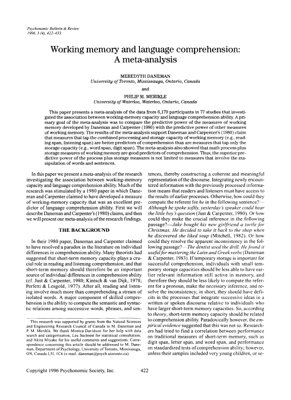
This paper presents a comprehensive meta-analysis investigating the critical association between working memory (WM) capacity and language comprehension ability. The analysis synthesizes data from 77 independent studies, encompassing a total of 6,179 participants. The primary objective was to rigorously test and compare the predictive validity of different types of working memory measures, with a specific focus on evaluating the claims made by Daneman and Carpenter in their seminal 1980 paper.
The central hypothesis under scrutiny was whether measures that assess the combined processing and storage functions of working memory (e.g., reading span, listening span) are superior predictors of complex comprehension tasks compared to traditional measures that primarily tap storage capacity alone (e.g., digit span, word span).
2. Theoretical Background & The Paradox
The research is grounded in a theoretical paradox prevalent in the late 20th century. Cognitive theories of language comprehension (e.g., Just & Carpenter, 1980; Kintsch & van Dijk, 1978) posited that short-term memory (STM) capacity is crucial for integrating information across sentences, resolving pronouns, and making inferences. Therefore, individual differences in STM should correlate strongly with comprehension ability.
However, empirical evidence consistently failed to support this. Correlations between simple STM span tasks (like digit span) and standardized comprehension tests were weak to non-existent in typical adult populations. Daneman and Carpenter (1980) argued this paradox stemmed from a flawed measurement theory. Traditional span tasks measured storage-only capacity, whereas real-time language comprehension is a process-plus-storage activity. The brain must simultaneously process new linguistic input (parsing, semantic access) while holding the results of prior processing active for integration.
3. Meta-Analysis Methodology
The meta-analysis employed a systematic approach to aggregate findings across a wide body of literature.
3.1 Study Selection & Data Sources
A comprehensive literature search was conducted to identify studies published between 1980 and the mid-1990s that reported a correlation between any measure of working memory/short-term memory and a measure of language comprehension (reading or listening). The final sample included 77 studies with 6,179 participants, ensuring a robust and representative data pool.
3.2 Categorization of Working Memory Measures
WM measures were classified into two primary categories:
- Storage-Only Measures: Tasks requiring simple recall of items (e.g., digit span, word span, letter span).
- Process-Plus-Storage Measures: Dual-task paradigms requiring simultaneous processing and storage.
- Verbal: Reading span, listening span.
- Non-Verbal: Math span (e.g., operation span).
3.3 Statistical Analysis
Effect sizes (correlation coefficients, r) from each study were transformed using Fisher's z transformation to normalize their distribution. Weighted mean effect sizes were then calculated for each category of WM measure, with weights based on sample size. Confidence intervals were computed to assess the reliability of the mean effects.
4. Key Results & Findings
4.1 Comparison of WM Measure Types
The meta-analysis revealed a clear and significant hierarchy in predictive power. Process-plus-storage measures (like reading span) consistently showed stronger correlations with comprehension outcomes than storage-only measures (like digit span).
4.2 The Superiority of Process-Plus-Storage Measures
The results strongly supported Daneman and Carpenter's (1980) original claim. The reading span task, which requires participants to read sentences aloud while remembering the last word of each, emerged as a particularly potent predictor. This validates the theoretical notion that the ability to manage concurrent processing and storage demands is a core component of language comprehension skill.
4.3 Generalizability Beyond Verbal Tasks
A crucial and broader finding was that the superiority of process-plus-storage measures was not limited to verbal content. Measures like operation span (solving math equations while remembering numbers) also proved to be good predictors of verbal comprehension ability. This suggests the underlying construct being measured is a domain-general executive control capability, not merely a language-specific skill.
5. Statistical Summary
Total Studies Analyzed
77
Key WM Measure Types
Storage-only vs. Process-plus-Storage
Core Finding
Process-plus-storage measures are superior predictors.
6. Core Insights & Implications
- Measurement Matters: The choice of WM task fundamentally changes what is measured and its relevance to complex cognition.
- Executive Function is Key: Language comprehension relies heavily on domain-general executive control (managing attention, switching, updating), not just a passive storage buffer.
- Resolves a Theoretical Paradox: Explains why earlier research failed to find strong STM-comprehension links by highlighting the inadequacy of storage-only measures.
- Foundation for Future Research: Established reading span and its variants as the gold-standard measure for investigating individual differences in higher-order cognition linked to WM.
7. Conclusion
This meta-analysis provided robust, quantitative support for a pivotal shift in understanding working memory. It confirmed that the capacity to simultaneously process and store information is a critical determinant of language comprehension ability, more so than simple storage capacity. Furthermore, it demonstrated that this principle extends beyond verbal domains, implicating a central, domain-general executive component of working memory. The findings cemented the theoretical and methodological legacy of Daneman and Carpenter's (1980) work.
8. Original Analysis & Expert Commentary
Core Insight: Daneman & Merikle's 1996 meta-analysis isn't just a data summary; it's the formal coronation of "working memory" as an active, executive system and the definitive burial of its predecessor, the passive "short-term store." The paper's real contribution is shifting the paradigm from capacity (how much you can hold) to efficiency of control (how well you can manage cognitive traffic). This mirrors the evolution in AI from models with large, static memory banks to architectures with dynamic attention and gating mechanisms, as seen in Transformers' self-attention, which prioritizes relevant information over mere storage.
Logical Flow: The argument is elegantly surgical. It starts by acknowledging the historical paradox (theory says STM matters, data says it doesn't), identifies the flawed instrument (storage-only spans), introduces the correct tool (process-plus-storage spans), and uses meta-analytic force to prove the new tool works universally. The inclusion of math-based spans (operation span) is the masterstroke—it proves the construct is domain-general executive function, not a language module. This logic prefigures modern frameworks like Engle's (2002) model of WM as primarily about "controlled attention."
Strengths & Flaws: Its strength is its methodological rigor and clear, impactful conclusion. It settled a debate. However, viewed through a modern lens, its flaw is its reliance on correlation. It brilliantly shows that complex span tasks predict comprehension, but the meta-analysis itself cannot prove causation or specify the precise mechanisms. Does a larger reading span cause better comprehension, or does greater language skill free up resources for storage? Later research using latent variable analysis (e.g., Miyake et al., 2000) and neuroimaging has had to unpack this. Furthermore, it focuses on individual differences, leaving open questions about within-subject, moment-to-moment WM processes during comprehension.
Actionable Insights: For researchers, this paper is a permanent mandate: if you're studying WM's role in complex cognition, use complex span tasks, not digit span. For educators and clinicians, it suggests that training focused on executive control and dual-tasking (e.g., working memory training protocols like Cogmed) might have more leverage on improving comprehension than rote memory drills. For AI/ML practitioners, it's a blueprint: to model human-like language understanding, systems need an active, resource-managing component that can juggle parsing, inference, and memory—a challenge still at the forefront of developing more robust and efficient language models.
In essence, this meta-analysis transformed WM from a theoretical concept into a measurable, powerful predictor of real-world cognitive performance, setting the agenda for decades of subsequent research in cognitive psychology, neuroscience, and education.
9. Technical Details & Mathematical Framework
The core statistical engine of the meta-analysis was the synthesis of correlation coefficients (r). To combine results from multiple studies, each reported correlation ri was first transformed into Fisher's z scale to stabilize variance:
$$ z_i = \frac{1}{2} \ln\left(\frac{1 + r_i}{1 - r_i}\right) $$
The variance of zi is approximated by $ \sigma^2_{z_i} = \frac{1}{n_i - 3} $, where ni is the sample size of study i. The overall weighted mean effect size \bar{z} was calculated as:
$$ \bar{z} = \frac{\sum_{i=1}^{k} w_i z_i}{\sum_{i=1}^{k} w_i} $$
where the weight wi is the inverse variance: $ w_i = n_i - 3 $. The standard error of \bar{z} is $ SE_{\bar{z}} = \sqrt{\frac{1}{\sum w_i}} $. Finally, the mean z and its confidence interval were back-transformed to the correlation metric r for interpretation:
$$ \bar{r} = \frac{e^{2\bar{z}} - 1}{e^{2\bar{z}} + 1} $$
This procedure allowed for a precise, sample-size-weighted comparison of the average correlation strength for different categories of WM measures (e.g., storage-only vs. reading span).
10. Experimental Results & Chart Description
Hypothetical Summary Chart (Based on Reported Findings):
Chart Title: Mean Correlation (r) of Working Memory Measures with Language Comprehension
Chart Type: Forest plot or grouped bar chart.
Description: The chart would visually contrast the mean effect sizes (with 95% confidence intervals) for different WM measure categories. We would expect to see:
- Storage-Only Measures (Digit/Word Span): A cluster of bars or points showing a low mean correlation (e.g., $ r \approx .20$ to $.30$), with confidence intervals potentially crossing or near zero in some subsets.
- Verbal Process-Plus-Storage Measures (Reading/Listening Span): Bars showing a significantly higher mean correlation (e.g., $ r \approx .40$ to $.55$), with tighter confidence intervals above zero, indicating robust predictive power.
- Non-Verbal Process-Plus-Storage Measures (Operation/Math Span): Bars showing a mean correlation notably higher than storage-only measures and comparable to or slightly below verbal complex spans (e.g., $ r \approx .35$ to $.50$), demonstrating generalizability.
The clear separation between the "Storage-Only" cluster and the two "Process-Plus-Storage" clusters would graphically encapsulate the paper's main conclusion.
11. Analysis Framework: Example Case
Scenario: A researcher wants to investigate why some students struggle with understanding complex scientific textbooks.
Framework Application Based on this Meta-Analysis:
- Hypothesis: Difficulties are linked more to limitations in executive working memory (managing multiple ideas simultaneously) than to simple memory span.
- Key Predictor Variable (Independent): Administer both a Digit Span task (storage-only) and a Reading Span task (process-plus-storage).
- Outcome Variable (Dependent): Score on a customized test measuring comprehension of a dense scientific passage, focusing on inference, integration of ideas across paragraphs, and resolution of conceptual conflicts.
- Predicted Pattern: Based on the meta-analysis, the correlation between Reading Span and the comprehension test score will be significantly stronger than the correlation between Digit Span and the comprehension score. The researcher would statistically test this difference between correlations.
- Interpretation: If the predicted pattern holds, it supports the view that the students' comprehension challenges are rooted in executive control aspects of working memory, guiding interventions towards strategies that reduce concurrent cognitive load or improve information management, rather than mere memory repetition exercises.
12. Future Applications & Research Directions
The findings of this meta-analysis have paved the way for numerous advanced research avenues and practical applications:
- Neuroscientific Correlates: Using fMRI and EEG to identify the brain networks (e.g., fronto-parietal network) that support the process-plus-storage functions and how their efficiency correlates with individual span scores and comprehension.
- Developmental & Aging Studies: Tracking how the relationship between complex WM spans and comprehension changes across the lifespan, informing educational strategies and cognitive aging interventions.
- Clinical Assessment: Refining diagnostic tools for learning disabilities (e.g., dyslexia, specific language impairment) and neurological disorders (e.g., ADHD, aphasia) by incorporating complex span tasks as more sensitive markers of cognitive-linguistic deficits.
- AI & Natural Language Processing (NLP): Informing the development of more cognitively plausible language models. Modern architectures like Transformers implicitly handle some "process-plus-storage" via self-attention, but explicitly modeling resource constraints and executive control remains a frontier for creating AI that understands language with human-like depth and robustness.
- Personalized Learning & EdTech: Integrating adaptive software that estimates a learner's WM capacity via gamified complex span tasks to dynamically adjust the pacing, chunking, and scaffolding of instructional material.
- Training & Intervention: Designing and evaluating cognitive training protocols specifically aimed at enhancing the executive control component of WM to potentially boost academic and professional comprehension skills.
13. References
- Daneman, M., & Carpenter, P. A. (1980). Individual differences in working memory and reading. Journal of Verbal Learning and Verbal Behavior, 19(4), 450-466.
- Daneman, M., & Merikle, P. M. (1996). Working memory and language comprehension: A meta-analysis. Psychonomic Bulletin & Review, 3(4), 422-433.
- Engle, R. W. (2002). Working memory capacity as executive attention. Current Directions in Psychological Science, 11(1), 19-23.
- Just, M. A., & Carpenter, P. A. (1980). A theory of reading: from eye fixations to comprehension. Psychological Review, 87(4), 329.
- Kintsch, W., & van Dijk, T. A. (1978). Toward a model of text comprehension and production. Psychological Review, 85(5), 363.
- Miyake, A., Friedman, N. P., Emerson, M. J., Witzki, A. H., Howerter, A., & Wager, T. D. (2000). The unity and diversity of executive functions and their contributions to complex “frontal lobe” tasks: A latent variable analysis. Cognitive Psychology, 41(1), 49-100.
- Vaswani, A., Shazeer, N., Parmar, N., Uszkoreit, J., Jones, L., Gomez, A. N., ... & Polosukhin, I. (2017). Attention is all you need. Advances in Neural Information Processing Systems, 30.