Reading Theme:
Voltage Definition: Meaning, Examples, and Usage
Meaning 1:electric potential difference (voltage)
voltage
/ˈvoʊltɪdʒ/
n.
The pushing force or pressure that makes electricity move through a wire or circuit. It is measured in units called volts.
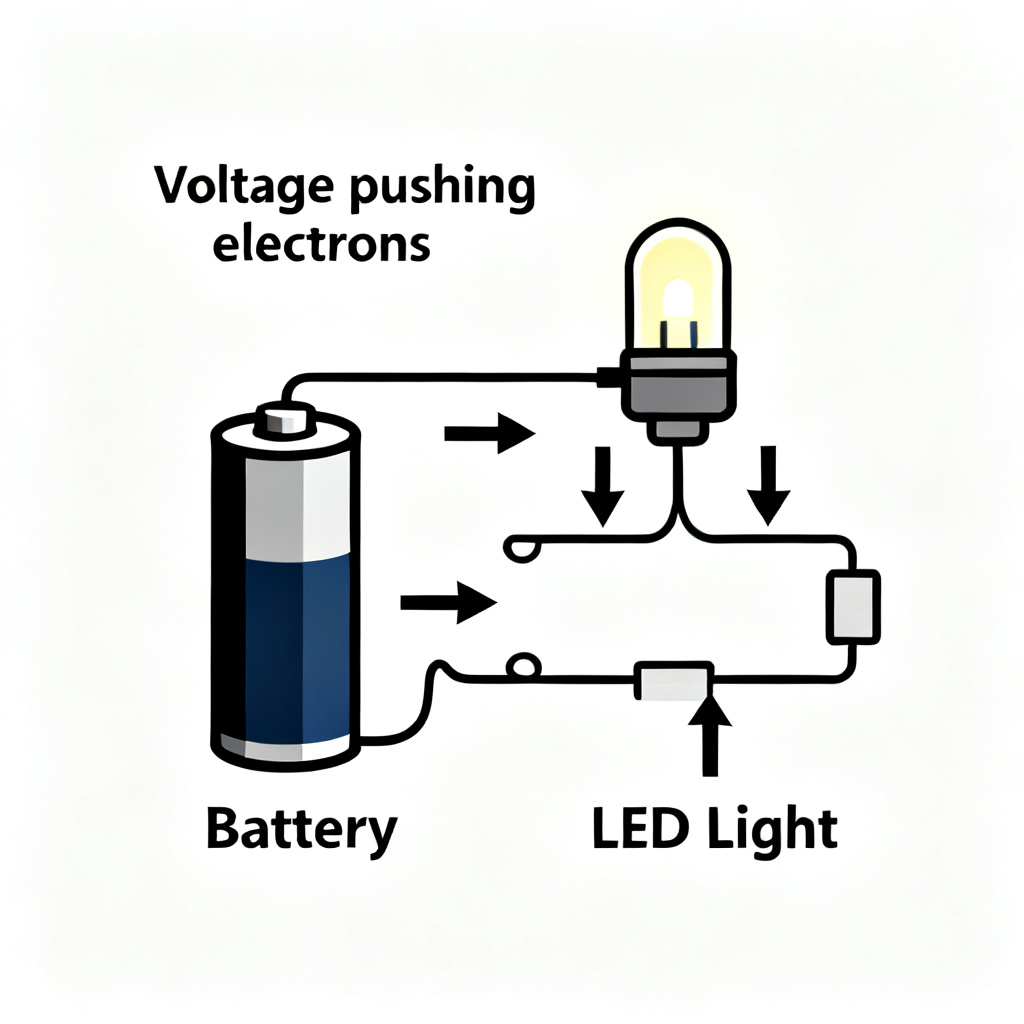
electric potential difference
➕
/ɪˈlɛktrɪk pəˈtɛnʃəl ˈdɪfərəns/
n.
Voltage is the electrical force that pushes charged particles through a conductor. It is measured in volts (V) and represents the potential energy difference between two points in a circuit.
📘 Details & Usage
📖 Root Explanation
volt (Alessandro Volta) + -age (noun suffix for a quantity)
💡 Mnemonic
Visualize 'volt' as electrical pressure; adding 'age' reminds you it's the measurement of that pressure.
📖 Example
Before plugging in the new game console, always check that the power supply matches the local voltage to avoid damaging it.
Before plugging in the new game console, always check that the power supply matches the local voltage to avoid damaging it.
🔗 Collocations
high voltage – a high level of electric potential difference
low voltage – a low level of electric potential difference
voltage drop – a decrease in electric potential along a conductor
🔄 Synonyms
electromotive force (n.) – the force that causes electric current to flow, measured in volts
potential difference (n.) – the difference in electric potential between two points
electric potential (n.) – the amount of electric potential energy per unit charge at a point
🌱 Derivatives
📖 Cultural Story
From 'volt', named after Italian physicist Alessandro Volta (inventor of the electric battery), plus the suffix '-age' to denote a measurement or condition.
Wordbook
Your data is saved in this browser