Reading Theme:
High-speed railway Definition, Examples & Usage
Meaning 1:very fast train system (High-speed railway)
High-speed railway
/ˈhaɪ spiːd ˈreɪlweɪ/
n.
A railway system made for trains to run at very high speeds, much faster than normal trains.
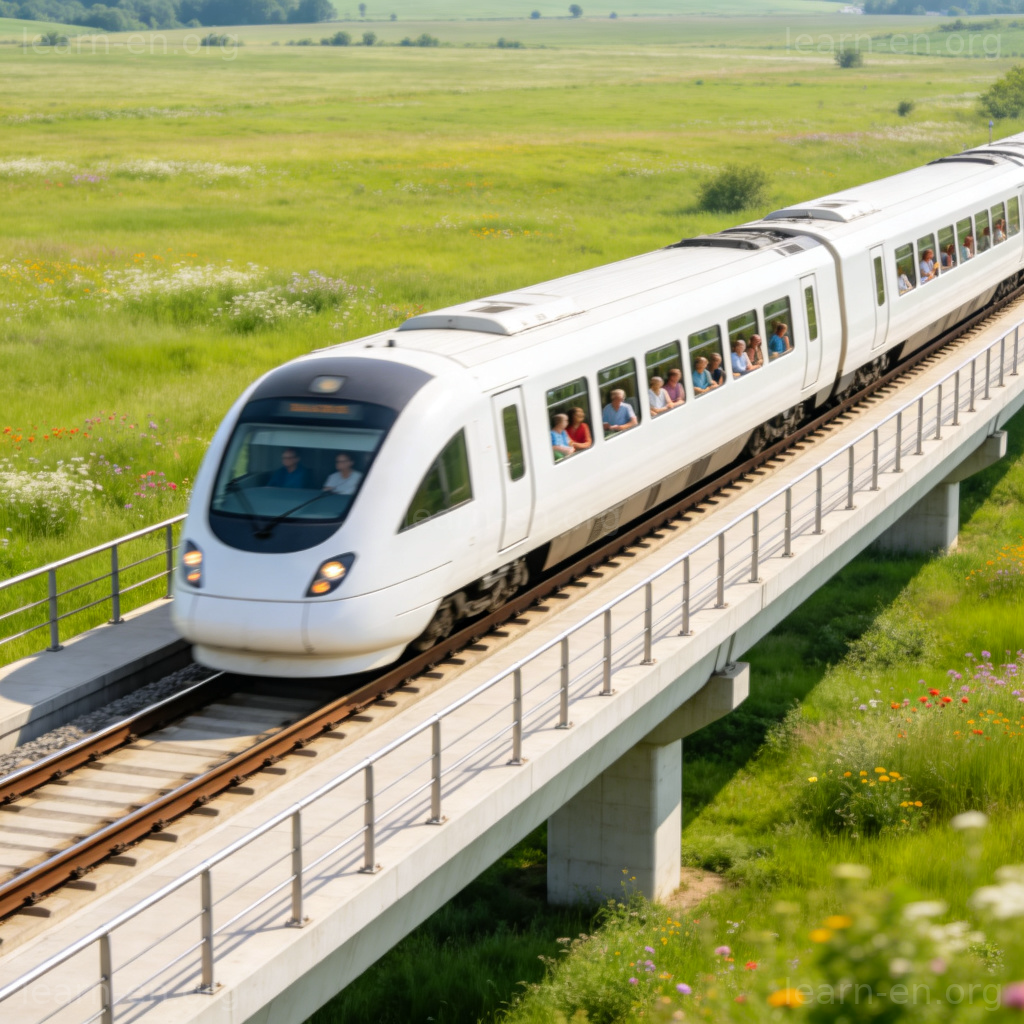
very fast train system
➕
/ˈveri fæst treɪn ˈsɪstəm/
n.
A railway system designed for trains to travel at speeds significantly higher than conventional railways, typically over 250 km/h (155 mph).
📘 Details & Usage
📖 Root Explanation
High-speed (high + speed) + railway (rail + way): a compound noun describing a rail system designed for fast travel.
💡 Mnemonic
Picture a bullet train flashing past—'high-speed' is like a 'high' leap in 'speed' on a 'railway'.
📖 Example
Taking the high-speed railway from Beijing to Shanghai saves hours compared to driving.
Taking the high-speed railway from Beijing to Shanghai saves hours compared to driving.
🔗 Collocations
high-speed railway network – A system of connected high-speed rail lines across a region or country.
high-speed railway station – A station built specifically to serve high-speed trains.
high-speed railway ticket – A ticket for travelling on a high-speed train.
🔄 Synonyms
bullet train (n.) – A very fast train, especially the Shinkansen in Japan.
express railway (n.) – A railway line where trains run quickly with few stops.
fast train (n.) – A general term for a train that travels at a high speed.
🚫 Antonyms
local railway (n.) – A railway line serving many stops at lower speeds.
slow train (n.) – A train that operates at low speed, often stopping frequently.
conventional railway (n.) – A standard railway system not designed for high speeds.
🌱 Derivatives
high-speed rail (n.) – The technology or system of high-speed railways.
high-speed train (n.) – A train that runs on a high-speed railway.
high-speed line (n.) – A specific track or route designed for high-speed travel.
📖 Cultural Story
The first modern high-speed railway, Japan's Shinkansen (1964), revolutionised travel. The term spread globally as countries like France (TGV) and China (CRH) adopted similar systems.
Wordbook
Your data is saved in this browser