Reading Theme:
Galaxy: Definition, Usage, and Examples
Meaning 1:vast collection of stars (galaxy)
galaxy
/ˈɡæləksi/
n.
A huge system of stars, gas, and dust held together by gravity, like the Milky Way.
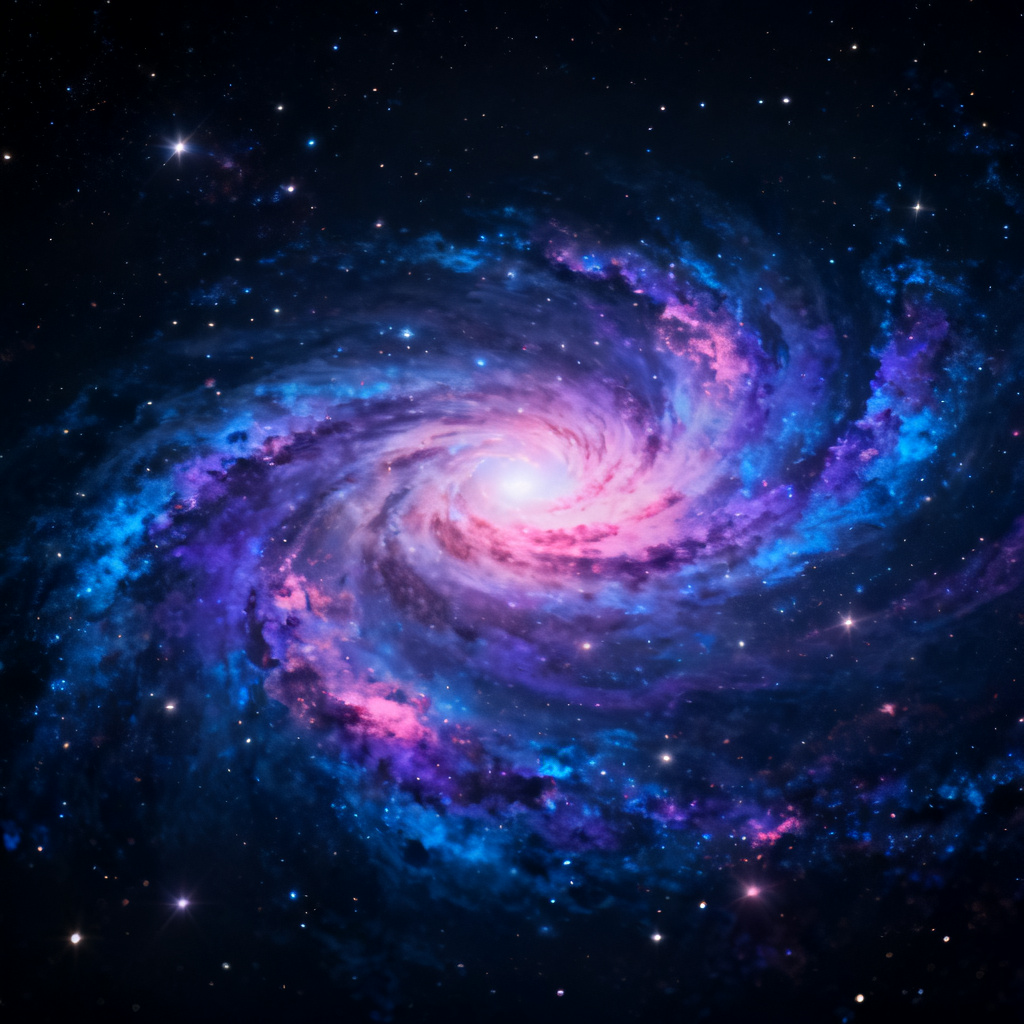
vast collection of stars
➕
/væst kəˈlɛkʃən əv stɑːrz/
n.
A galaxy is a massive system consisting of billions of stars, along with interstellar gas, dust, and dark matter, all held together by gravitational forces.
📘 Details & Usage
📖 Root Explanation
From Greek 'galaxias', meaning 'milky', derived from 'gala' (milk).
💡 Mnemonic
Think 'Galactic system' to recall that a galaxy is a vast system of stars in space.
📖 Example
Using a high-powered telescope, the astronomy class marveled at a distant galaxy with bright spiral arms.
In this sentence, an astronomy class uses a telescope to observe a faraway galaxy featuring bright spiral arms.
🔗 Collocations
spiral galaxy – a galaxy characterized by spiral-shaped arms
distant galaxy – a galaxy located far from Earth
galaxy cluster – a group of galaxies bound together by gravity
🔄 Synonyms
star system (n.) – a system of stars, though often on a smaller scale than a galaxy
cosmos (n.) – the universe viewed as an orderly and interconnected whole
nebula (n.) – a cloud of gas and dust in space, sometimes a component of galaxies
🌱 Derivatives
galactic (adj.) – relating to or characteristic of a galaxy
intergalactic (adj.) – existing or occurring between galaxies
📖 Cultural Story
The term 'galaxy' originates from Greek 'galaxias', referring to the Milky Way. In modern English, it's used metaphorically, such as in 'a galaxy of stars' to describe a group of celebrities.
Wordbook
Your data is saved in this browser