Reading Theme:
Embankment: Definition, Usage & Key Examples (2 meaning)
Meaning 1:raised river bank (embankment)
embankment
/ɪmˈbæŋkmənt/
n.
A long, raised strip of land built beside a river or sea to stop water from flooding the land.

raised river bank
➕
/reɪzd ˈrɪvər bæŋk/
n.
A human-made structure, typically a long mound of earth or stone, constructed alongside a river, lake, or sea. Its primary purpose is to act as a barrier, holding back water to prevent flooding of the adjacent lower-lying land.
📘 Details & Usage
📖 Root Explanation
From the prefix 'em-' (a variant of 'en-', meaning 'to put into or onto') + 'bank' (meaning a mound or ridge) + the noun-forming suffix '-ment'. Thus, literally 'something that forms or creates a bank or mound'.
💡 Mnemonic
Think of a BANK (financial institution) built up high (EM-powered) with a protective wall (the -MENT). An EMBANKMENT is like a raised, protective 'bank' of earth for a river or road.
📖 Example
Families often enjoy cycling along the grassy river embankment on sunny weekends.
On pleasant weekend days, it is common for families to go for bike rides on the paved path atop the grassy, raised bank of the river.
🔗 Collocations
river embankment – an embankment specifically built along a river
grassy embankment – an embankment covered with grass
to build an embankment – the action of constructing a raised bank
🔄 Synonyms
🚫 Antonyms
🌱 Derivatives
embank (v.) – To protect, bound, or confine with a bank or mound (archaic).
📖 Cultural Story
The word 'embankment' entered English in the late 16th century from the French 'en-'(in) and 'banc' (bench or bank), which itself has Germanic origins. Its use became prominent during the Industrial Revolution with the large-scale construction of railways and canals, requiring extensive earthworks to support tracks and control waterways. This reflects the era's engineering focus on shaping the landscape for transportation and flood defense.
Meaning 2:raised road or rail support (embankment)
embankment
/ɪmˈbæŋkmənt/
n.
The raised ground or wall at the side of a railway or road, supporting it and separating it from the lower land around.
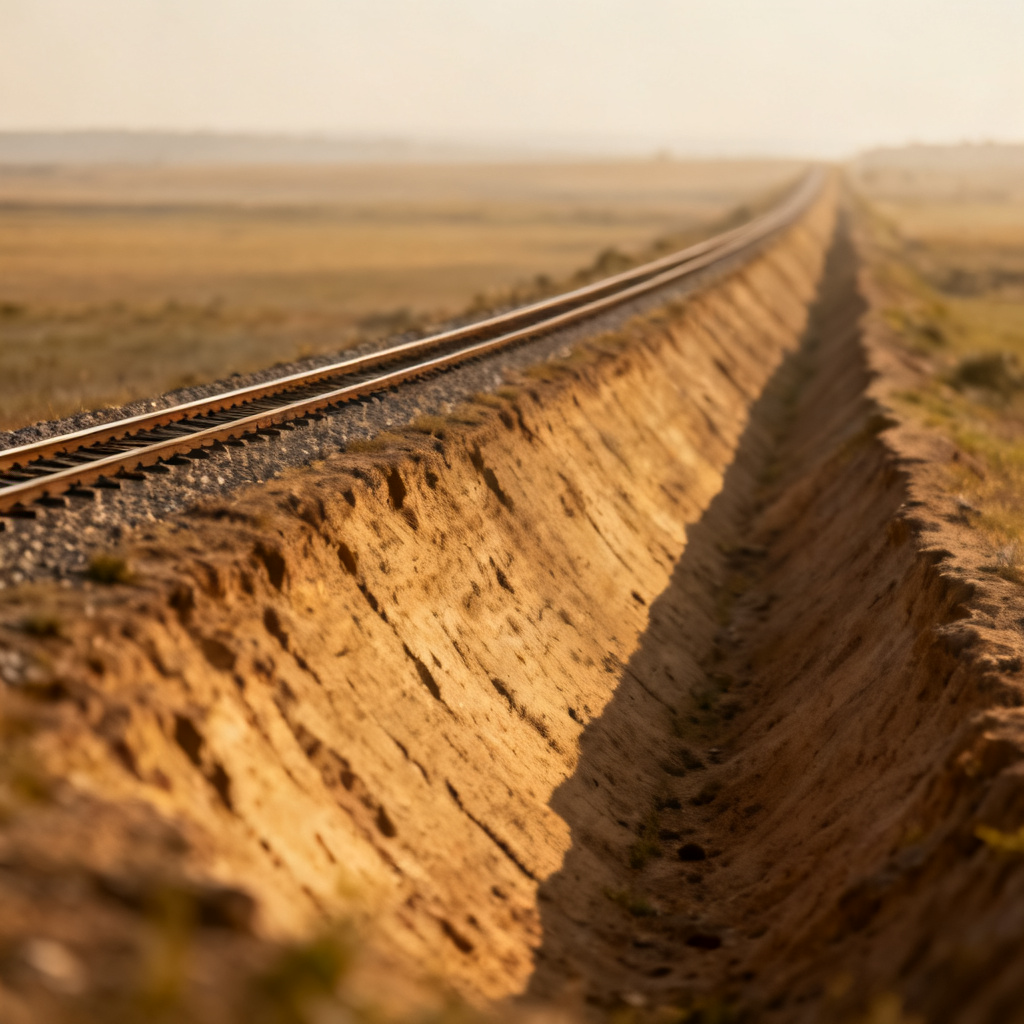
raised road or rail support
➕
/reɪzd roʊd ɔːr reɪl səˈpɔːrt/
n.
A constructed mound of earth, stone, or other material that elevates a roadway or railway line above the natural ground level. It provides a stable, level foundation for the transport route and often acts as a visual and physical separator from the surrounding area.
📘 Details & Usage
📖 Example
The train sped along the high embankment, offering passengers a panoramic view of the countryside below.
As the train moved quickly on the elevated track support, the people inside could see a wide, beautiful view of the rural landscape stretching out beneath them.
🔗 Collocations
railway embankment – an embankment that supports and elevates a railway line
road embankment – a raised foundation supporting a road
steep embankment – an embankment with a sharp incline
🔄 Synonyms
Wordbook
Your data is saved in this browser