Reading Theme:
Correlation: Definition, Usage & Examples
Meaning 1:mutual connection (correlation)
correlation
/ˌkɒr.əˈleɪ.ʃən/
n.
A statistical measure that describes how two things change together. It shows a connection, but not necessarily that one causes the other.
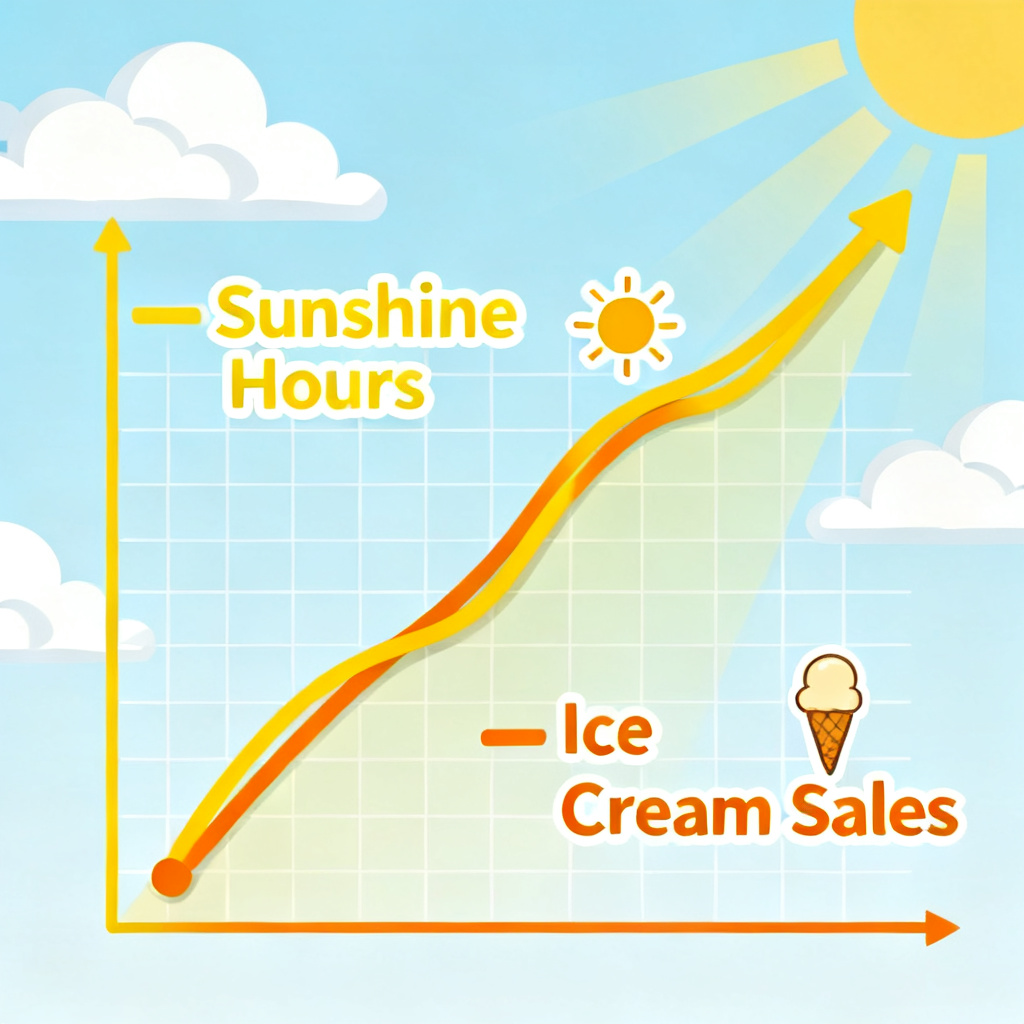
mutual connection
➕
/ˈmjuːtʃuəl kəˈnɛkʃən/
n.
A mutual relationship or connection between two or more variables where they tend to vary together.
📘 Details & Usage
📖 Root Explanation
From Latin 'cor-' (together) + 'relatio' (relation), meaning 'a relating together'.
💡 Mnemonic
Think CO-Relatives: things that CO-exist and are RELATED, but one didn't necessarily cause the other.
📖 Example
The botanist found a strong correlation between warmer weather and faster plant growth in her experiment.
The botanist discovered a significant mutual connection between increased temperatures and accelerated plant growth in her study.
🔗 Collocations
positive correlation – a relationship where both variables increase or decrease together
correlation coefficient – a numerical measure of the strength and direction of a linear relationship
strong correlation – a very clear and consistent mutual relationship between variables
🔄 Synonyms
association (n.) – a connection or relationship between things
connection (n.) – a relationship in which one thing is linked or related to another
link (n.) – a relationship between two things or situations
🚫 Antonyms
dissociation (n.) – a lack of connection or relationship between things
independence (n.) – the state of not being connected or influenced by something else
🌱 Derivatives
correlate (v./n.) – to have a mutual relationship or connection; something that correlates
correlative (adj.) – having a mutual relationship; corresponding
📖 Cultural Story
The term 'correlation' entered scientific discourse in the 18th century from Latin, emphasizing a mutual relationship rather than a one-way cause. Its precise statistical definition was formalized by Sir Francis Galton in the 1880s while studying heredity, leading to the Pearson correlation coefficient developed by Karl Pearson.
Wordbook
Your data is saved in this browser