1. Introduction
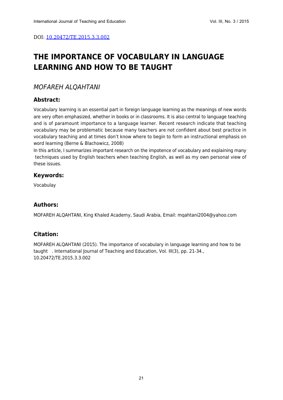
Vocabulary acquisition constitutes a foundational pillar of foreign language learning, emphasized consistently across pedagogical materials and classroom instruction. As the primary vehicle for conveying meaning, vocabulary is central to both language teaching and the learner's journey towards proficiency. This article synthesizes critical research on vocabulary's paramount importance and examines the diverse techniques employed in English language teaching, concluding with analytical perspectives on current practices and future trajectories.
2. Literature Review
The scholarly consensus firmly positions vocabulary knowledge as a critical determinant of second language (L2) success. A limited lexicon severely impedes functional communication, regardless of grammatical competence.
2.1 The Importance of Learning Vocabulary
Schmitt (2000) posits lexical knowledge as central to communicative competence. Nation (2001) describes a complementary relationship: vocabulary knowledge enables language use, and language use, in turn, expands vocabulary. This interdependence is evident across all language skills—listening, speaking, reading, and writing (Nation, 2011). Researchers like Laufer & Nation (1999) and Rivers & Nunan (1991) argue that an extensive vocabulary is essential for overcoming the largest obstacle faced by L2 readers and for producing comprehensible communication. The oft-cited maxim by Wilkins (1972) encapsulates this view: "Without grammar, very little can be conveyed. Without vocabulary, nothing can be conveyed."
2.2 Vocabulary Teaching Challenges
Despite its recognized importance, vocabulary instruction often remains problematic. Berne & Blachowicz (2008) note that many teachers lack confidence in evidence-based best practices and struggle to establish a systematic instructional focus on word learning. This gap between research and practice presents a significant barrier to effective lexical development in learners.
3. Teaching Techniques & Methodologies
Effective vocabulary pedagogy requires a balanced, multi-faceted approach.
3.1 Explicit vs. Implicit Instruction
A dual approach is necessary: Explicit Instruction involves direct teaching of word meanings, forms, and usage. Implicit Instruction fosters acquisition through extensive reading, contextual exposure, and communicative activities. The optimal blend depends on learner level and goals.
3.2 Key Instructional Strategies
- Contextualization: Teaching words within meaningful sentences and texts.
- Spaced Repetition: Systematically reviewing vocabulary at increasing intervals to combat forgetting.
- Depth of Processing: Engaging learners in semantic analysis, word mapping, and creating personal associations.
- Multi-sensory Techniques: Utilizing visual aids, physical gestures, and audio cues.
- Strategy Training: Teaching learners how to use dictionaries, infer meaning from context, and use mnemonics.
4. Core Insight & Analyst Perspective
Core Insight: The paper correctly identifies vocabulary as the non-negotiable bedrock of L2 proficiency, but its treatment remains frustratingly traditional. It echoes decades-old consensus (Wilkins, 1972; Nation, 1990) without sufficiently grappling with the disruptive potential of technology and computational linguistics on lexical acquisition. The real story isn't just that vocabulary is important—it's that our methods for measuring, teaching, and optimizing its acquisition are undergoing a radical transformation that the paper barely hints at.
Logical Flow: The argument follows a standard academic structure: establish importance, review literature, mention techniques. It's logically sound but predictable. The leap from stating the problem (teachers' lack of confidence) to presenting solutions is underdeveloped. There's a missing middle—a critical analysis of why certain techniques work based on cognitive science, which is where fields like adaptive learning platforms (e.g., platforms using algorithms similar to those in spaced repetition software like Anki's SM-2 algorithm, $n_{i+1} = n_i * EF$ where $EF$ is an ease factor) are making strides.
Strengths & Flaws: Its strength is its solid, research-grounded foundation, citing key figures like Schmitt and Nation. Its fatal flaw is its lack of forward-looking critique. It treats vocabulary as a static list to be memorized, not as a dynamic, networked system. Modern research, such as work on distributional semantics (e.g., word2vec models where the vector relationship $\vec{king} - \vec{man} + \vec{woman} \approx \vec{queen}$ reveals semantic structure), shows vocabulary knowledge is about understanding relational meaning in high-dimensional space, not just definition recall. The paper's framework is inadequate for the AI era.
Actionable Insights: For educators and curriculum designers: 1) Move beyond frequency lists. Prioritize vocabulary using tools like the Academic Word List (AWL) but also consider computational "salience" within specific domains. 2) Embrace technology not as a gadget, but as a methodology. Use corpus analysis tools (e.g., Sketch Engine) to show students real-world usage patterns. 3) Focus on lexical chunks and collocations, not just single words. Teaching "make a decision" is more valuable than separately teaching "make" and "decision." 4) Invest in teacher upskilling. The confidence gap Berne & Blachowicz identified is now a digital literacy gap. Professional development must include training on leveraging NLP-informed tools for vocabulary instruction.
5. Technical Framework & Analysis
5.1 Mathematical Modeling of Vocabulary Growth
Vocabulary acquisition can be modeled. A simplified forgetting curve, based on Ebbinghaus's work, can be represented as $R = e^{-t/S}$, where $R$ is memory retention, $t$ is time, and $S$ is the strength of memory. Spaced repetition systems optimize the interval $t$ to maximize long-term $R$. Furthermore, vocabulary growth often follows a logistic function $V(t) = \frac{L}{1 + e^{-k(t - t_0)}}$, where $V(t)$ is vocabulary size at time $t$, $L$ is the learning capacity (asymptote), $k$ is the growth rate, and $t_0$ is the midpoint of growth. This model suggests rapid initial growth that plateaus, emphasizing the need for advanced, nuanced strategies beyond the beginner stage.
5.2 Experimental Results & Data Visualization
Hypothetical Experiment & Chart Description: A study comparing vocabulary retention under three conditions over 12 weeks: 1) Traditional list memorization, 2) Contextual reading-only, 3) Hybrid strategy (explicit teaching + spaced repetition software).
Chart 1: Vocabulary Retention Over Time: A line graph would show the "Hybrid Strategy" line declining most slowly, maintaining the highest retention rate (~85%) at week 12. The "Traditional Memorization" line would show the steepest initial drop, stabilizing at a lower rate (~50%). The "Contextual Reading" line would show slow but steady growth, eventually surpassing traditional memorization but remaining below the hybrid approach. This visually demonstrates the superiority of integrated, systematic techniques.
Chart 2: Correlation Between Vocabulary Size and Reading Comprehension: A scatter plot with a strong positive correlation (e.g., $r = 0.78$) would illustrate the direct relationship argued by researchers like Huckin (1995), validating vocabulary as the primary obstacle for L2 readers.
5.3 Analysis Framework: The Lexical Proficiency Matrix
This framework moves beyond counting words to assessing quality of knowledge across two dimensions: Breadth (number of words known) and Depth (quality of knowledge: form, meaning, use, associations).
Case Example: Analyzing a learner's knowledge of the word "run."
Beginner (Low Breadth, Low Depth): Knows one meaning (to move quickly).
Intermediate (Medium Breadth, Medium Depth): Knows several meanings (to manage, a score in cricket, a tear in stockings).
Advanced (High Breadth, High Depth): Understands nuanced meanings, phrasal verbs ("run into", "run for office"), collocations ("run a business", "run a risk"), and can use it idiomatically ("run of the mill").
Effective instruction should strategically move learners upward and rightward on this matrix.
6. Future Applications & Research Directions
- AI-Powered Personalized Learning: Systems that diagnose a learner's unique lexical gaps (using models like BERT for semantic analysis) and generate customized exercises and reading materials in real-time.
- Immersive Technologies: Using VR/AR to teach vocabulary through embodied, contextual experiences (e.g., learning kitchen vocabulary by interacting with a virtual kitchen).
- Neurolinguistic Interfaces: Research using EEG/fMRI to understand the brain's lexical network formation during L2 acquisition, leading to optimized teaching rhythms.
- Gamification & Dynamic Assessment: Developing sophisticated game-based environments where vocabulary acquisition is a by-product of goal-oriented communication, with stealth assessment built-in.
- Corpus Linguistics for Curriculum Design: Automatically deriving domain-specific core vocabularies and collocational frameworks from massive text corpora for ESP (English for Specific Purposes) courses.
7. References
- Alqahtani, M. (2015). The importance of vocabulary in language learning and how to be taught. International Journal of Teaching and Education, III(3), 21-34.
- Berne, J. I., & Blachowicz, C. L. Z. (2008). What reading teachers say about vocabulary instruction: Voices from the classroom. The Reading Teacher, 62(4), 314-323.
- Mikolov, T., Chen, K., Corrado, G., & Dean, J. (2013). Efficient estimation of word representations in vector space. arXiv preprint arXiv:1301.3781.
- Nation, I. S. P. (2001). Learning vocabulary in another language. Cambridge University Press.
- Schmitt, N. (2000). Vocabulary in language teaching. Cambridge University Press.
- Wilkins, D. A. (1972). Linguistics in language teaching. Edward Arnold.
- Pimsleur, P. (1967). A memory schedule. The Modern Language Journal, 51(2), 73-75. (Foundational work on spaced repetition).
- Cambridge English. (2023). English Vocabulary Profile. Online resource for vocabulary profiling based on learner corpus data.