1. Introduction & Problem Statement
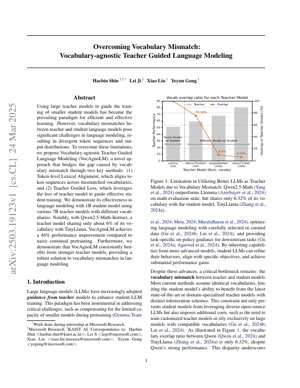
The prevailing paradigm for training efficient smaller language models (students) involves guidance from larger, more capable models (teachers). However, this approach hits a fundamental roadblock: vocabulary mismatch. When teacher and student models use different tokenizers—a common scenario when leveraging diverse open-source or specialized models—their token sequences and output probability distributions diverge, crippling effective knowledge transfer. As shown in the paper, a state-of-the-art model like Qwen2.5-Math may share as little as 6.32% of its vocabulary with a student like TinyLlama, creating a significant barrier to utilizing the best available models as teachers.
2. The VocAgnoLM Framework
Vocabulary-agnostic Teacher Guided Language Modeling (VocAgnoLM) proposes a two-pronged solution to bridge this gap, enabling vocabulary-agnostic knowledge distillation.
2.1 Core Insight & Logical Flow
Core Insight: The fundamental barrier isn't model architecture, but representation misalignment. You can't directly compare apples (Qwen tokens) to oranges (TinyLlama tokens). VocAgnoLM's genius lies in reframing the problem from "matching outputs" to "aligning semantic spaces and learning signals." It decouples the teacher's knowledge from its specific tokenization scheme.
Logical Flow: The process is elegantly sequential: 1) For a given input text, generate token sequences for both student and teacher models. 2) Use Token-level Lexical Alignment to create a mapping between the mismatched sequences. 3) Leverage this mapping to apply the Teacher Guided Loss, using the teacher's internal loss as a training signal for the student, bypassing direct token probability matching.
2.2 Token-level Lexical Alignment
This component addresses the sequence misalignment problem. It establishes a one-to-many mapping from each student token to a corresponding subsequence of teacher tokens. For instance, the student token "Pro" might map to the teacher tokens "Prob" and "ability". This is conceptually similar to alignment techniques in machine translation (like those used in statistical MT or early neural models) but applied at the subword level across different tokenization schemes. The goal is to create a bridge that allows the flow of information despite the lexical disconnect.
2.3 Teacher Guided Loss
Instead of forcing the student to mimic the teacher's next-token probability distribution—which is infeasible with different vocabularies—VocAgnoLM uses the teacher's own language modeling loss as a guide. The student is trained to minimize a combined objective: its standard language modeling loss and a loss that encourages its internal representations or predictions to lead to a low loss value for the teacher model on the aligned sequence. This is a more abstract, yet powerful, form of guidance.
3. Strengths & Critical Flaws
Strengths:
- Unlocks Model Diversity: This is the killer feature. It breaks the vendor/ecosystem lock-in, allowing teams to use the best available model (e.g., a math-specialized Qwen) to teach any student, regardless of its origin (e.g., TinyLlama).
- Pragmatic & Lightweight: It doesn't require retraining the teacher's tokenizer or the student's embedding layer, avoiding massive engineering overhead.
- Strong Empirical Results: A 46% performance lift over naive pretraining with a severe vocabulary mismatch is not trivial. It demonstrates the approach works in practice.
Critical Flaws & Open Questions:
- Alignment Heuristic is a Black Box: The paper glosses over the exact algorithm for "Token-level Lexical Alignment." Is it dynamic programming? A learned model? The robustness and computational cost of this alignment step are crucial unknowns. A poor alignment could propagate noise instead of knowledge.
- Loss of Fine-Grained Signal: Using the teacher's scalar loss sacrifices the rich, high-dimensional signal of its full output distribution. It's akin to learning from a final grade rather than detailed feedback on each answer. This may limit the fidelity of knowledge transfer for nuanced linguistic capabilities.
- Scalability to Extreme Mismatch: The tested mismatch (6% overlap) is severe, but what about near-zero overlap? The theoretical limits of this approach are untested.
4. Experimental Results & Analysis
4.1 Setup & Performance Metrics
The study uses a 1B parameter student model (TinyLlama) and various 7B teacher models (Llemma, Mistral, DeepSeek-Math, Qwen2.5-Math) with vocabulary sizes ranging from 32K to 150K. The key metric is performance on a math evaluation suite, comparing VocAgnoLM against a baseline of continual pretraining without teacher guidance.
4.2 Key Findings & Chart Interpretation
The central result is visualized in the paper's Figure 1. It shows two critical trends:
- The Vocabulary Mismatch Problem: The x-axis shows teacher models with increasing performance (from Llemma to Qwen2.5-Math). The bars show their vocabulary overlap with TinyLlama. There is a clear inverse relationship: the best-performing teacher (Qwen) has the smallest overlap (~6%). This starkly illustrates the problem VocAgnoLM aims to solve.
- VocAgnoLM's Effectiveness: The text states that with Qwen2.5-Math as teacher, VocAgnoLM achieves a 46% performance improvement over the baseline. This proves the framework successfully leverages a strong teacher despite minimal vocabulary commonality. The paper also notes consistent benefits from stronger teachers, validating the core premise.
Key Experimental Result
46% Performance Improvement achieved by VocAgnoLM using Qwen2.5-Math (6.32% vocab overlap) as teacher for TinyLlama, compared to standard continual pretraining.
5. Actionable Insights & Strategic Implications
For practitioners and leaders in AI:
- Immediate Tactic: If you're building a specialized model (e.g., for finance, law, biomedicine), stop limiting your teacher search to models with compatible tokenizers. Actively evaluate top-performing models in your domain, regardless of their tokenizer. VocAgnoLM provides a viable path to use them.
- Strategic Procurement: This research reduces the risk of "tokenizer lock-in." When choosing a base model for your organization, vocabulary compatibility becomes a less critical constraint, freeing you to select based purely on architecture, licensing, and performance.
- Research Investment: The alignment component is the linchpin. Investing in robust, efficient, and possibly learnable alignment methods will be key to industrializing this approach. Consider it the next frontier in model interoperability.
- Caution: This is not a silver bullet. For tasks requiring precise generation or style mimicry, the loss of fine-grained distribution matching may be a significant drawback. Pilot it for knowledge-intensive tasks (like math, reasoning) first.
6. Technical Deep Dive
6.1 Mathematical Formulation
While the full loss function is not explicitly detailed in the provided excerpt, the core idea can be formalized. Let $\mathcal{V}_s$ and $\mathcal{V}_t$ be the student and teacher vocabularies. For an input sequence $x$, the student produces a token sequence $\mathbf{s} = [s_1, ..., s_n]$ and the teacher produces $\mathbf{t} = [t_1, ..., t_m]$, with $n \neq m$ generally.
The Token-level Lexical Alignment function $\mathcal{A}$ maps each student token $s_i$ to a contiguous subsequence of teacher tokens: $\mathcal{A}(s_i) = \mathbf{t}_{[j:k]}$.
The Teacher Guided Loss $\mathcal{L}_{guide}$ likely involves feeding a representation or prediction derived from the student (aligned via $\mathcal{A}$) into the teacher's forward pass and computing the teacher's language modeling loss on it. The student's total training objective becomes:
$$\mathcal{L}_{total} = \mathcal{L}_{LM}(\theta_s; x) + \lambda \cdot \mathcal{L}_{guide}(\theta_s, \theta_t; x, \mathcal{A})$$
where $\theta_s$ and $\theta_t$ are student and teacher parameters, $\mathcal{L}_{LM}$ is the standard student language modeling loss, and $\lambda$ is a weighting hyperparameter. The key is that $\mathcal{L}_{guide}$ operates on aligned sequences, circumventing the direct vocabulary mismatch.
6.2 Analysis Framework: A Case Study
Scenario: A company wants to create a compact, efficient LLM for legal document analysis. The best available specialized teacher is `LexLaw-70B`, which uses a custom tokenizer trained on legal corpus. The target student is a `Llama-3-8B` model.
Framework Application:
- Problem Diagnosis: Analyze vocabulary overlap. It's likely below 20%. Direct knowledge distillation is impossible.
- Alignment Phase: Run a sample of legal texts through both models. Use VocAgnoLM's alignment module (e.g., a minimum edit-distance algorithm on byte-pair encodings) to build a mapping $\mathcal{A}$ between Llama-3 tokens and LexLaw token sequences for common legal terms (e.g., "force majeure").
- Training Phase: Train the Llama-3 student on a legal corpus. For each batch, compute its standard loss. In parallel, for each sequence, use $\mathcal{A}$ to construct a "teacher-view" of the student's predicted sequence, pass it to the frozen LexLaw teacher, and compute its loss. Backpropagate the combined loss to update only the student's parameters.
- Evaluation: Monitor performance on legal QA benchmarks against a baseline student trained without LexLaw guidance. The expected outcome is improved legal reasoning without changing the student's tokenizer.
7. Future Applications & Research Directions
- Cross-Modal & Cross-Lingual Transfer: The core principle of aligning disparate representation spaces is fundamental. Future work could extend this to use a vision-language teacher (like GPT-4V) to guide a text-only student via aligned caption-image pairs, or use a high-resource language teacher to guide a low-resource language student.
- Dynamic & Learned Alignment: Moving from heuristic alignment to a small, trainable alignment model that learns optimal mappings during training could improve robustness and efficiency.
- Industrial Model Pipelines: This enables the creation of "teacher marketplaces" where organizations can offer frozen, specialized teacher models as a service. Downstream users can distill these into their own architecture of choice, protecting IP (teachers are frozen) and ensuring compatibility.
- Federated Learning with Heterogeneous Clients: In federated scenarios, clients may use different base models. VocAgnoLM could provide a method to aggregate knowledge from these heterogeneous models into a global model without requiring standardization.
8. References
- Shin, H., Ji, L., Liu, X., & Gong, Y. (2025). Overcoming Vocabulary Mismatch: Vocabulary-agnostic Teacher Guided Language Modeling. arXiv preprint arXiv:2503.19123.
- Zhang, P., et al. (2024). TinyLlama: An Open-Source Small Language Model. GitHub repository.
- Yang, A., et al. (2024). Qwen2.5-Math: A Series of Large Language Models for Mathematical Problem Solving. Technical Report.
- Hinton, G., Vinyals, O., & Dean, J. (2015). Distilling the Knowledge in a Neural Network. arXiv preprint arXiv:1503.02531. (Seminal work on knowledge distillation).
- Zhu, J.-Y., Park, T., Isola, P., & Efros, A. A. (2017). Unpaired Image-to-Image Translation using Cycle-Consistent Adversarial Networks. Proceedings of the IEEE International Conference on Computer Vision (ICCV). (Influential work on aligning distributions across different domains, analogous to the alignment challenge here).
- Google AI. (2023). Gemma: Open Models Based on Google Research and Technology. https://ai.google.dev/gemma.
- Meta AI. (2024). Llama 3 Model Card. https://llama.meta.com/llama3/.