1. Introduction
This paper introduces STRUDEL (STRUctured DiaLoguE Summarization), a novel task and framework designed to enhance the dialogue comprehension capabilities of pre-trained language models (PLMs). Unlike traditional holistic abstractive summarization, STRUDEL decomposes dialogue understanding into a structured, multi-perspective process, mimicking human cognitive analysis. The core hypothesis is that this structured summarization can serve as an effective "meta-model" or upstream task to improve performance on downstream dialogue comprehension tasks like Question Answering (QA) and Response Prediction.
The authors argue that while abstractive dialogue summarization is a well-established standalone task, its potential as a tool to boost performance on other NLP tasks remains unexplored. STRUDEL aims to fill this gap by providing models with a more focused and instructive learning signal.
2. Related Work
2.1 Abstractive Text Summarization
The paper situates STRUDEL within the broader field of abstractive text summarization, which involves generating concise paraphrases of source text content rather than extracting sentences. It references key works like the pointer-generator network by See et al. (2017) and the sequence-to-sequence framework by Rush et al. (2015), highlighting the evolution from extractive to generative methods. The distinction for STRUDEL is its structured, multi-faceted approach specific to dialogue, moving beyond generating a single summary to producing a decomposed analysis.
3. The STRUDEL Framework
STRUDEL is proposed as a structured summarization task where a dialogue is summarized from multiple, predefined perspectives or aspects relevant to comprehension (e.g., key decisions, emotional shifts, action plans, conflicting viewpoints). This structure forces the model to analyze the dialogue hierarchically and systematically.
The authors created a human-annotated dataset of STRUDEL summaries for 400 dialogues sampled from the MuTual and DREAM datasets, providing a valuable resource for training and evaluation.
Key Insight
STRUDEL re-frames summarization not as an end goal, but as a structured reasoning scaffold. It acts as an intermediate representation that explicitly guides the model's attention to critical dialogue elements, much like how human analysts create outlines or bullet-point notes before answering complex questions about a text.
4. Methodology & Model Architecture
The proposed model integrates the STRUDEL task into a dialogue comprehension pipeline. It builds upon a transformer encoder language model (e.g., BERT, RoBERTa) for initial dialogue encoding.
Core Technical Detail: A Graph Neural Network (GNN)-based dialogue reasoning module is layered on top of the transformer encoder. The structured summaries (or their latent representations) are integrated into this graph to enrich the connections between dialogue utterances. The graph nodes represent utterances or summary aspects, and edges represent relational dependencies (e.g., follow-up, rebuttal, support). The GNN propagates information through this graph, enabling more nuanced reasoning. The combined representation from the transformer and GNN is then used for downstream tasks.
The training likely involves a multi-task objective: $L = L_{downstream} + \lambda L_{STRUDEL}$, where $L_{downstream}$ is the loss for QA or response prediction, $L_{STRUDEL}$ is the loss for generating the structured summary, and $\lambda$ is a weighting hyperparameter.
5. Experimental Results
The paper reports empirical evaluations on two downstream tasks:
- Dialogue Question Answering: Models must answer questions based on multi-turn dialogues.
- Dialogue Response Prediction: Models must select the most appropriate next response from multiple options.
Results: The STRUDEL-enhanced model demonstrated significant performance improvements over strong transformer encoder baselines on these tasks. The results validate the hypothesis that structured summarization provides a superior learning signal for comprehension compared to training on the downstream task alone or with an unstructured summarization objective. The paper likely includes tables comparing accuracy/F1 scores of the proposed model against baselines like vanilla BERT/RoBERTa and models trained with standard summarization.
Chart Interpretation (Inferred from Text)
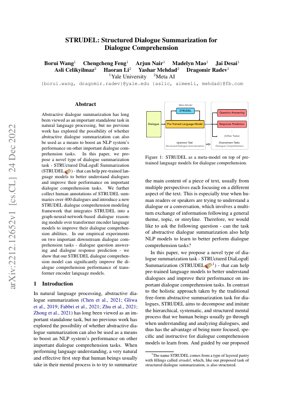
Figure 1 in the PDF conceptually illustrates STRUDEL as a meta-model. A bar chart comparing performance would likely show: 1) A baseline transformer (lowest bar), 2) The same transformer fine-tuned on a standard summarization task (moderate improvement), 3) The transformer + STRUDEL + GNN framework (highest bar), clearly outperforming the others. This visual would underscore the value of the structured approach.
6. Technical Analysis & Core Insights
Analyst's Perspective: Deconstructing STRUDEL's Value Proposition
Core Insight: STRUDEL isn't just another summarization model; it's a strategic architectural hack for injecting structured human-like reasoning priors into black-box transformers. The paper's real contribution is recognizing that the bottleneck in dialogue comprehension isn't raw linguistic knowledge—which PLMs have in abundance—but structured discourse reasoning. By forcing the model to produce a multi-faceted summary, they are essentially performing a form of "feature engineering" at the semantic level, creating interpretable intermediate variables that guide subsequent inference. This aligns with trends in neuro-symbolic AI, where neural networks are combined with structured, rule-like representations, as discussed in surveys from researchers at MIT and Stanford.
Logical Flow & Comparison: The authors correctly identify a gap: prior work like the CNN/Daily Mail summarization models (See et al., 2017) or even dialogue-specific summarizers treat the task as a monolithic sequence-to-sequence problem. STRUDEL breaks this mold. Its closest philosophical relative might be work on "Chain-of-Thought" prompting, where models are guided to generate intermediate reasoning steps. However, STRUDEL bakes this structure into the model architecture and training objective, making it more robust and less prompt-dependent. Compared to simply using a GNN over dialogue utterances (a technique seen in works like DialogueGCN), STRUDEL provides the GNN with semantically richer, pre-digested node features (the summary aspects), leading to more meaningful graph propagation.
Strengths & Flaws: The strength is its elegant simplicity and strong empirical results. The multi-task setup with a GNN is a powerful combination. However, the paper's flaw is its dependency on human-defined summary structures. What are the "right" aspects to summarize? This requires costly annotation and may not generalize across all dialogue domains (e.g., customer service vs. psychotherapy). The model's performance is tied to the quality and relevance of this predefined schema. Furthermore, while the GNN adds relational reasoning, it also increases complexity. The ablation study (which the paper should include) would be critical to see if the gains come from the structure, the GNN, or their synergy.
Actionable Insights: For practitioners, this research suggests that adding a structured intermediate task can be a more effective way to fine-tune PLMs for complex NLP problems than direct fine-tuning alone. When building a dialogue AI, consider what a "structured summary" for your domain would look like (e.g., for tech support: "problem stated," "troubleshooting steps," "resolution") and use it as an auxiliary training signal. For researchers, the next step is to automate or learn the summary structure itself, perhaps through unsupervised methods or reinforcement learning, moving beyond human annotation to create truly adaptive structured reasoning models.
7. Analysis Framework Example
Scenario: Analyzing a project meeting dialogue to predict the next action item.
STRUDEL-like Structured Analysis (No Code):
- Aspect 1 - Decisions Made: "Team decided to postpone Feature X launch by two weeks."
- Aspect 2 - Action Items Assigned: "Alice to finalize API docs. Bob to run security audit."
- Aspect 3 - Open Issues/Risks: "Budget for additional testing is unresolved. Dependency on Team Y is a critical risk."
- Aspect 4 - Next Steps Discussed: "Schedule follow-up with Team Y. Draft communication plan for delay."
Comprehension Task (Response Prediction): Given the dialogue and the above structured summary, a model can more reliably predict that the manager's next utterance will be: "I'll set up a meeting with Team Y's lead for tomorrow." The structure directly highlights the relevant "Open Issue" and "Next Step," reducing ambiguity.
8. Future Applications & Directions
- Domain-Specific Dialogue Assistants: In legal, medical, or customer service dialogues, STRUDEL frameworks can be tailored to extract structured case notes, symptom summaries, or issue trees, directly improving decision-support systems.
- Automatic Meeting Minuting: Beyond generic summaries, generate structured minutes with sections for Attendees, Goals, Decisions, Action Items (Owner/Deadline), and Key Discussion Points.
- Interactive Tutoring Systems: Structure student-tutor dialogues to track conceptual understanding, misconceptions, and learning progress, enabling more adaptive tutoring.
- Research Direction - Self-Structuring Models: The major future direction is moving from human-defined summary aspects to learned or emergent structures. Techniques from topic modeling, clustering of latent representations, or reinforcement learning could allow the model to discover the most useful facets of summarization for a given task autonomously.
- Multimodal Dialogue Comprehension: Extending the STRUDEL concept to video conferences or embodied dialogues, where structure must be derived from speech, text, and visual cues.
9. References
- Chen, J., et al. (2021). Recent Advances in Dialogue Summarization. arXiv preprint.
- Cui, C., et al. (2020). MuTual: A Dataset for Multi-Turn Dialogue Reasoning. Proceedings of ACL.
- Fabbri, A., et al. (2021). ConvoSumm: Conversation Summarization Benchmark and Dataset. Proceedings of EMNLP.
- Gliwa, B., et al. (2019). SAMSum Corpus: A Human-annotated Dialogue Dataset for Abstractive Summarization. Proceedings of the 2nd Workshop on New Frontiers in Summarization.
- Rush, A. M., et al. (2015). A Neural Attention Model for Abstractive Sentence Summarization. Proceedings of EMNLP.
- See, A., et al. (2017). Get To The Point: Summarization with Pointer-Generator Networks. Proceedings of ACL.
- Sun, K., et al. (2019). DREAM: A Challenge Dataset and Models for Dialogue-Based Reading Comprehension. Transactions of the Association for Computational Linguistics.
- Zhang, J., et al. (2020). PEGASUS: Pre-training with Extracted Gap-sentences for Abstractive Summarization. Proceedings of ICML.
- Zhong, M., et al. (2021). DialoGPT: Large-Scale Generative Pre-training for Conversational Response Generation. arXiv preprint.
- Zhu, C., et al. (2021). Enhancing Dialogue Summarization with Topic-Aware Multi-View Comprehension. Findings of ACL-IJCNLP.