1. Introduction & Overview
This paper introduces STRUDEL (STRUctured DiaLoguE Summarization), a novel approach that repositions abstractive dialogue summarization from a standalone task to a meta-model for enhancing dialogue comprehension. The core hypothesis is that forcing a model to generate structured, multi-perspective summaries of a dialogue—mimicking human analytical processes—improves its underlying understanding, thereby boosting performance on downstream tasks like Dialogue Question Answering and Response Prediction.
The authors argue that traditional holistic summarization is insufficient for deep comprehension. STRUDEL decomposes dialogue understanding into structured components, providing a more instructive learning signal for pre-trained language models (LMs). The framework is integrated with a Graph Neural Network (GNN)-based reasoning module on top of transformer encoders.
2. Related Work
2.1 Abstractive Text Summarization
The paper situates STRUDEL within the broader field of abstractive summarization, citing key works like the pointer-generator network by See et al. (2017) and advancements with transformer-based models (e.g., BART, T5). It distinguishes itself by focusing on the structured summarization of dialogues for the explicit purpose of improving comprehension, a departure from prior work that treated summarization as an end goal.
3. The STRUDEL Framework
3.1 Core Concept & Task Definition
STRUDEL is defined as a summarization task that produces a multi-faceted, structured summary of a dialogue. Instead of one fluent paragraph, the summary captures different aspects such as key actions, participant goals, emotional shifts, and topic progression. This structure is designed to mirror the hierarchical and systematic way humans analyze conversations.
3.2 Model Architecture
The proposed model is a two-stage architecture:
- Base Encoder: A transformer-based language model (e.g., BERT, RoBERTa) encodes the dialogue turns.
- STRUDEL-GNN Reasoner: A Graph Neural Network layer is applied over the encoded representations. Dialogue turns or entities are treated as nodes, and relationships (e.g., reply-to, mention) as edges. This graph is used to reason about the structured summary components.
- Task-Specific Heads: The enriched representations from the GNN are used for either generating the STRUDEL summary (during pre-training/fine-tuning) or for direct downstream tasks like QA.
3.3 Technical Details & Mathematical Formulation
The GNN reasoning step can be formalized. Let $h_i^{(0)}$ be the initial representation of node $i$ (e.g., a dialogue turn) from the transformer encoder. A standard message-passing GNN layer updates node representations as:
$h_i^{(l+1)} = \sigma \left( W^{(l)} \cdot \text{AGGREGATE}^{(l)} \left( \{ h_j^{(l)}, \forall j \in \mathcal{N}(i) \} \right) \right)$
where $\mathcal{N}(i)$ are the neighbors of node $i$, AGGREGATE is a permutation-invariant function (e.g., mean, sum), $W^{(l)}$ is a learnable weight matrix, and $\sigma$ is a non-linear activation. After $L$ layers, the final node representations $h_i^{(L)}$ capture the structured dialogue context, which is used for summary generation or prediction. The loss function combines the STRUDEL summarization loss (e.g., cross-entropy) with the downstream task loss, often in a multi-task learning setup.
4. Experiments & Results
4.1 Datasets & Setup
The authors created a new dataset by collecting human annotations of STRUDEL summaries for 400 dialogues sampled from two established benchmarks: MuTual (reasoning-based multiple-choice QA) and DREAM (reading comprehension multiple-choice QA). Models were evaluated on these downstream QA tasks, as well as dialogue response prediction.
Experimental Setup at a Glance
- STRUDEL Annotations: 400 dialogues
- Source Datasets: MuTual & DREAM
- Base Models: Transformer Encoders (e.g., RoBERTa)
- Evaluation Tasks: Dialogue QA, Response Prediction
4.2 Results & Analysis
The paper reports that models equipped with the STRUDEL framework significantly outperform strong transformer baselines on both MuTual and DREAM. The performance gains demonstrate that the structured summarization objective provides a powerful auxiliary signal, enabling the model to perform better reasoning and inference over dialogue content. Ablation studies likely show the importance of both the structured objective and the GNN reasoning module.
4.3 Chart & Diagram Explanation
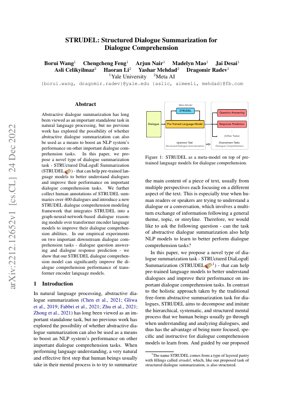
Figure 1 (Conceptual Diagram): This figure illustrates the core premise. It shows a pre-trained Language Model at the base. The STRUDEL module ("Upstream Task") acts as a meta-model on top of it. Arrows flow from STRUDEL down to two boxes labeled "Question Answering" and "Response Prediction" ("Downstream Tasks"). This visually communicates that STRUDEL's output is used to enhance performance on these primary tasks, rather than being an end product itself.
5. Analysis Framework & Case Study
Example Analysis Framework (Non-Code): Consider a customer service dialogue. A traditional summarizer might output: "The customer reported an issue with login, and the agent provided troubleshooting steps." A STRUDEL-style structured analysis would decompose this into:
- Participant Goals: Customer: resolve login failure. Agent: provide solution and maintain satisfaction.
- Key Actions: Customer describes error code. Agent requests password reset. Customer confirms reset attempt.
- Problem & Solution Flow: Problem: Authentication error. Diagnosed Cause: Cached credentials. Solution: Clear cache and reset password.
- Sentiment Arc: Customer: frustrated -> hopeful -> satisfied.
6. Future Applications & Directions
The STRUDEL paradigm opens several promising avenues:
- Long-Form Dialogue & Meeting Analysis: Scaling the structured approach to multi-party meetings (e.g., using frameworks like Longformer or BigBird) to track decisions, action items, and argument flow.
- Personalized Conversational Agents: Using the structured summary as a dynamic user state/memory, enabling agents to maintain context and personality over long interactions, akin to memory-augmented networks in chatbots.
- Cross-Modal Dialogue Comprehension: Extending the structure to include non-verbal cues in video or audio dialogues (e.g., linking tone shifts in sentiment arc), similar to multi-modal fusion techniques in models like CMU's Multimodal SDK.
- Low-Resource & Few-Shot Learning: The structured summaries could serve as a form of data augmentation or an intermediate reasoning step that improves model performance when labeled data for downstream tasks is scarce.
7. References
- Chen, Y., et al. (2021). DialogSum: A Real-Life Scenario Dialogue Summarization Dataset. Findings of ACL.
- Cui, Y., et al. (2020). MuTual: A Dataset for Multi-Turn Dialogue Reasoning. ACL.
- Fabbri, A., et al. (2021). ConvoSumm: Conversation Summarization Benchmark and Dataset. EMNLP.
- Gliwa, B., et al. (2019). SAMSum Corpus: A Human-annotated Dialogue Dataset for Abstractive Summarization. EMNLP Workshop.
- Rush, A. M., et al. (2015). A Neural Attention Model for Abstractive Sentence Summarization. EMNLP.
- See, A., et al. (2017). Get To The Point: Summarization with Pointer-Generator Networks. ACL.
- Sun, K., et al. (2019). DREAM: A Challenge Dataset and Models for Dialogue-Based Reading Comprehension. TACL.
- Zhang, J., et al. (2020). PEGASUS: Pre-training with Extracted Gap-sentences for Abstractive Summarization. ICML.
- Zhong, M., et al. (2021). QMSum: A New Benchmark for Query-based Multi-domain Meeting Summarization. NAACL.
- Zhu, C., et al. (2021). Enhancing Factual Consistency of Abstractive Summarization. NAACL.
8. Analyst's Perspective
Core Insight: STRUDEL isn't just another summarization model; it's a shrewd architectural hack. The authors have identified that the process
Logical Flow: The argument is compelling: 1) Humans use structured mental models to understand dialogue. 2) Current LMs lack this explicit structure. 3) Therefore, force the LM to produce that structure (STRUDEL task). 4) This forces internal representations to encode the structure. 5) These enriched representations directly benefit downstream QA/response tasks. The link between the upstream meta-task and downstream gains is logically sound and empirically validated.
Strengths & Flaws: The major strength is the novel re-purposing of summarization. The use of GNNs for explicit relational reasoning over dialogue turns is also a technically sound choice, addressing a known weakness of standard transformers in modeling long-range, structured dependencies—a point well-documented in literature on Graph Attention Networks (GATs). However, the paper's flaw is its dependency on a new, small (400 dialogues), human-annotated dataset. This raises immediate questions about scalability and cost. Can the structured summaries be generated weakly or self-supervised? The performance on the established MuTual and DREAM benchmarks is promising, but the true test will be zero-shot or few-shot transfer to entirely new dialogue domains, where the current approach might struggle without expensive annotation.
Actionable Insights: For practitioners, the takeaway is clear: injecting structured reasoning objectives is a high-leverage strategy for complex NLP tasks. Before fine-tuning your BERT on a dialogue QA dataset, consider pre-training or multi-task learning with an auxiliary task that requires decomposition and relational reasoning. The specific GNN approach may be heavy, but the principle is portable. For researchers, the next step is to decouple STRUDEL from human annotations. Exploring methods inspired by self-supervised learning in computer vision (like the contrastive learning principles in SimCLR) or unsupervised parsing to automatically induce dialogue structure could be the key to making this powerful paradigm scalable and widely applicable.