1. Introduction & Overview
Automated Essay Scoring (AES) has emerged as a pivotal tool in English as a Foreign Language (EFL) education, promising real-time feedback and scalable assessment. However, its practical adoption has been hampered by a critical bottleneck: the lack of high-quality, pedagogically relevant training data. Most existing datasets, such as the widely used ASAP dataset, provide only holistic scores or are annotated by non-experts, failing to capture the nuanced, multi-dimensional evaluation required in real classroom settings. This gap between research benchmarks and educational practice limits the development of truly effective AES systems.
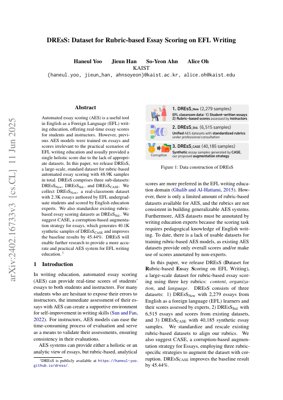
This paper introduces DREsS (Dataset for Rubric-based Essay Scoring on EFL Writing), a comprehensive resource designed to bridge this gap. DREsS addresses the core limitations of prior work by providing a large-scale, expert-annotated, and rubric-aligned dataset specifically tailored for EFL contexts.
Total Samples
48.9K
Real-Classroom Essays
2,279
Performance Gain
+45.44%
with CASE augmentation
2. The DREsS Dataset
DREsS is structured as a tripartite dataset, each component serving a distinct purpose in building robust AES models.
2.1 DREsS New: Real-Classroom Data
The cornerstone of DREsS is DREsS New, comprising 2,279 essays written by EFL undergraduate students. These essays were scored by English education experts using a consistent three-dimensional rubric:
- Content: Relevance, development, and depth of ideas.
- Organization: Logical structure, coherence, and paragraphing.
- Language: Grammar, vocabulary, and mechanics.
This dataset provides a gold standard for model training and evaluation, reflecting authentic learner errors and expert grading practices.
2.2 DREsS Std.: Standardized Benchmarks
To ensure comparability and extend the data pool, the authors created DREsS Std. by unifying and standardizing several existing public AES datasets (ASAP P7, P8; ASAP++ P1, P2; ICNALE EE). This involved mapping their original, often inconsistent, scoring rubrics onto the unified Content, Organization, and Language framework. DREsS Std. adds 6,515 standardized samples, providing a valuable bridge between previous research and the new rubric-based paradigm.
2.3 DREsS CASE: Synthetic Augmentation
A key innovation is DREsS CASE (Corruption-based Augmentation Strategy for Essays), a synthetically generated dataset of 40,185 samples. CASE employs rubric-specific corruption strategies to create plausible "lower-quality" essay variants from the existing data, effectively expanding the training set's diversity and difficulty range. For example, it might introduce logical fallacies (corrupting Content) or disrupt transitional phrases (corrupting Organization). This approach led to a remarkable 45.44% improvement in baseline model performance, demonstrating the power of targeted data augmentation.
3. Technical Framework & Methodology
3.1 Rubric Standardization
The core of DREsS's utility lies in its consistent three-rubric framework. Standardizing disparate datasets involved a meticulous process of expert consultation to map original scores (e.g., a single "style" score) onto the Content, Organization, and Language dimensions. This creates a common evaluation language for AES models, moving beyond holistic scores like those in the original ASAP dataset (Prompts 1-6).
3.2 CASE Augmentation Strategy
The CASE methodology is a rule-based corruption engine. For each rubric dimension, specific transformation rules are applied to original essays to generate lower-scoring counterparts. Mathematically, if an original essay $E$ has a score vector $S = (s_c, s_o, s_l)$ for content, organization, and language, CASE generates a corrupted essay $E'$ with a target lower score vector $S' = (s'_c, s'_o, s'_l)$, where $s'_i \leq s_i$. The corruption functions $f_i$ are dimension-specific:
- Content: $f_c(E)$ might replace key arguments with irrelevant or contradictory statements.
- Organization: $f_o(E)$ could randomize paragraph order or remove cohesive devices.
- Language: $f_l(E)$ may introduce grammatical errors or inappropriate word choices.
This controlled degradation creates a rich spectrum of essay quality, enabling models to learn more robust feature representations for scoring.
4. Experimental Results & Performance
The paper establishes strong baselines using regression models (e.g., Support Vector Regressors) and neural architectures (e.g., LSTMs, BERT-based models) trained on the DREsS components. Key findings include:
- Models trained solely on DREsS New (real data) showed high accuracy on that test set but limited generalizability to other prompts, highlighting the need for diverse data.
- Incorporating DREsS Std. improved cross-prompt robustness by exposing models to a wider variety of writing styles and topics.
- The inclusion of DREsS CASE provided the most significant boost, reducing mean squared error (MSE) by 45.44% compared to the baseline trained only on real data. This underscores the value of synthetic data in teaching models to recognize subtle quality distinctions, especially for lower-score ranges that may be underrepresented in human-written corpora.
Figure & Table Interpretation: The provided data statistics table (Table 1 in the PDF) clearly shows the composition and scale of DREsS. The bar chart (Figure 1) effectively visualizes the three-component construction pipeline, emphasizing that CASE generates the largest volume of data, which is strategically focused on the Organization rubric (31,086 samples), likely because structural flaws are both common in EFL writing and amenable to rule-based simulation.
5. Analysis Framework & Case Study
Framework for Evaluating AES Datasets: When assessing a new AES dataset like DREsS, researchers and practitioners should examine four pillars: Pedagogical Validity (expert annotations, relevant rubrics), Technical Utility (scale, consistency, task definition), Ethical & Practical Considerations (data provenance, bias, license), and Innovation (novel methodologies like CASE).
Case Study: Applying the Framework to DREsS
- Pedagogical Validity: High. DREsS New is sourced from real EFL classrooms and scored by experts using a standard tripartite rubric, directly aligning with instructional goals.
- Technical Utility: High. With ~49K total samples and standardized rubrics, it is large and consistent enough for training modern NLP models. The clear separation into three scoring tasks enables more granular model development.
- Ethical & Practical Considerations: Moderate to High. The real student data is ethically sourced, and the dataset is publicly available, promoting reproducibility. A potential limitation is the focus on a specific learner demographic (Korean undergraduates), which may affect generalizability.
- Innovation: High. The CASE augmentation strategy is a novel and demonstrably effective contribution to the field of educational data augmentation.
This framework confirms DREsS as a high-quality, innovative resource that significantly advances the field.
6. Critical Analysis & Industry Perspective
Core Insight: DREsS isn't just another dataset; it's a strategic intervention that re-centers AES research on pedagogical utility over benchmark performance. By prioritizing rubric-based scoring from expert annotators, the authors are forcing the NLP community to build models that teachers would actually trust. This shift mirrors the broader trend in AI towards human-aligned and domain-specific systems, as seen in efforts to make models more interpretable and fair.
Logical Flow & Strategic Positioning: The paper's logic is impeccable. It starts by diagnosing the field's ailment (lack of practical, rubric-based data), prescribes a three-part cure (New, Std., CASE), and provides overwhelming evidence of efficacy (45.44% gain). The inclusion of DREsS Std. is particularly shrewd—it doesn't discard previous work but co-opts and standardizes it, ensuring immediate relevance and easing adoption by researchers familiar with ASAP. This creates a seamless upgrade path for the entire research ecosystem.
Strengths & Flaws: The primary strength is the holistic solution: real data, standardized legacy data, and innovative synthetic data. The CASE methodology, while simple, is brilliantly effective and explainable—a virtue compared to "black-box" generative AI augmentation. The major flaw, however, is one of scope. The model's performance and the CASE augmentations are tightly coupled to the chosen three-rubric framework. What about creativity, argumentation strength, or disciplinary-specific writing (e.g., scientific reports)? As highlighted by the National Council of Teachers of English, writing assessment is multifaceted. DREsS solves one important slice but may inadvertently cement a narrow view of writing quality if adopted uncritically.
Actionable Insights: For EdTech companies, this is a blueprint. Investing in the creation of similar expert-annotated, rubric-specific datasets for other languages or subjects (e.g., coding assignments, legal writing) could be a massive moat. For researchers, the mandate is clear: stop fine-tuning on holistic ASAP scores. Use DREsS as the new baseline. Furthermore, explore extending the CASE paradigm—could similar corruption models be learned automatically via adversarial techniques, as explored in other areas of machine learning? The 45.44% improvement is a floor, not a ceiling.
7. Future Applications & Research Directions
DREsS opens several promising avenues for future work:
- Personalized Feedback Generation: Models trained on DREsS can be extended beyond scoring to generate specific, rubric-aligned feedback (e.g., "Your argument in paragraph two lacks supporting evidence" for Content).
- Cross-Lingual Transfer: Investigating whether models trained on DREsS can be adapted to score essays from learners with different first languages, potentially using techniques from multilingual NLP.
- Integration with Intelligent Tutoring Systems (ITS): Embedding DREsS-trained AES models into ITS to provide real-time, formative assessment during the writing process, not just a final score.
- Exploring Advanced Augmentation: Moving beyond rule-based corruption (CASE) to using large language models (LLMs) for more nuanced, context-aware generation of essay variations at different quality levels, while carefully controlling for bias.
- Expanding the Rubric Set: Collaborating with assessment experts to define and collect data for additional rubrics, such as Audience Awareness or Rhetorical Effectiveness, creating even more comprehensive datasets.
8. References
- Yoo, H., Han, J., Ahn, S., & Oh, A. (2025). DREsS: Dataset for Rubric-based Essay Scoring on EFL Writing. arXiv preprint arXiv:2402.16733v3.
- Shermis, M. D., & Burstein, J. (Eds.). (2013). Handbook of automated essay evaluation: Current applications and new directions. Routledge. (Seminal overview of AES field).
- National Council of Teachers of English (NCTE). (2022). Position Statement on Machine Scoring and Assessment of Student Writing. (Highlights ethical and pedagogical concerns with holistic AES).
- Taghipour, K., & Ng, H. T. (2016). A Neural Approach to Automated Essay Scoring. Proceedings of the 2016 Conference on Empirical Methods in Natural Language Processing (EMNLP). (Example of neural baseline for holistic AES).
- Zhu, J. Y., Park, T., Isola, P., & Efros, A. A. (2017). Unpaired Image-to-Image Translation using Cycle-Consistent Adversarial Networks. Proceedings of the IEEE International Conference on Computer Vision (ICCV). (Influential paper on unpaired data translation, conceptually analogous to the data augmentation challenge in AES).
- Kaggle. (2012). The Hewlett Foundation: Automated Essay Scoring. ASAP Dataset. (Source of the widely-used ASAP benchmark).