DREsS: A Comprehensive Dataset for Rubric-Based Automated Essay Scoring in EFL Education
Analysis of DREsS, a large-scale dataset for rubric-based automated essay scoring in English as a Foreign Language (EFL) education, featuring real-classroom data, standardized benchmarks, and a novel augmentation strategy.
Home »
Documentation »
DREsS: A Comprehensive Dataset for Rubric-Based Automated Essay Scoring in EFL Education
1. Introduction & Overview
Automated Essay Scoring (AES) has emerged as a pivotal tool in English as a Foreign Language (EFL) education, offering scalable, real-time feedback. However, its practical adoption has been hampered by the scarcity of high-quality, pedagogically relevant datasets. Most existing datasets provide only holistic scores or lack expert annotations, failing to capture the nuanced, rubric-based evaluation essential for formative assessment in real classroom settings. This gap between research benchmarks and educational practice limits the development of truly effective AES systems.
The DREsS (Dataset for Rubric-based Essay Scoring on EFL Writing) dataset, introduced by Yoo et al., directly addresses this critical bottleneck. It is a large-scale, multi-component resource designed to fuel the next generation of rubric-based AES models. DREsS's significance lies in its combination of authentic classroom data, standardized existing benchmarks, and a novel data augmentation strategy, creating a comprehensive foundation for both research and application.
2. The DREsS Dataset
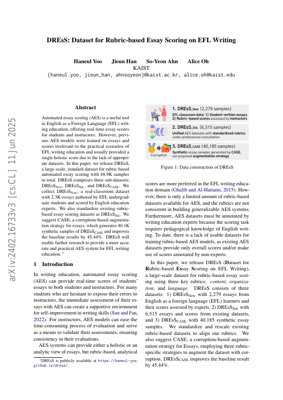
DREsS is structured as a tripartite dataset, each component serving a distinct purpose in advancing rubric-based AES.
Total Samples
48.9K
Real-Classroom Essays
2,279
Synthetic Samples
40.1K
Performance Gain
+45.44%
2.1 DREsS_New: Real-Classroom Data
This is the cornerstone of DREsS, comprising 2,279 essays written by EFL undergraduate students in authentic classroom environments. Each essay is scored by English education experts across three key rubrics:
Content: Relevance, development, and depth of ideas.
Organization: Logical structure, coherence, and paragraphing.
Language: Grammar, vocabulary, and mechanics.
This expert-annotated, rubric-specific data provides a gold standard for training models that understand pedagogical scoring criteria, moving beyond simple pattern recognition of text features.
2.2 DREsS_Std.: Standardized Benchmarks
To ensure comparability and extend utility, the authors standardized several existing AES datasets (ASAP, ASAP++, ICNALE) under a unified rubric framework. This process involved rescaling scores and aligning assessment criteria with the three core rubrics (Content, Organization, Language) through professional consultation. DREsS_Std. provides 6,515 standardized samples, creating a consistent and expanded benchmark for model training and evaluation.
2.3 DREsS_CASE: Synthetic Augmentation
Addressing the perennial issue of limited training data in specialized domains, the authors propose CASE (Corruption-based Augmentation Strategy for Essays). CASE intelligently generates synthetic essay samples by applying rubric-specific "corruptions" to existing essays. For example:
Content: Introducing irrelevant sentences or weakening arguments.
Organization: Disrupting paragraph order or logical flow.
Language: Injecting grammatical errors or inappropriate vocabulary.
This strategy generated 40,185 synthetic samples, dramatically increasing dataset size and diversity. Crucially, experiments showed that training with DREsS_CASE improved baseline model performance by 45.44%, demonstrating the efficacy of targeted, pedagogically-informed data augmentation.
3. Technical Framework & Methodology
3.1 Rubric Standardization
The unification of disparate datasets required a meticulous mapping and normalization process. Scores from original datasets were transformed to align with the defined scales for Content, Organization, and Language. This ensures that a score of "4" in Organization means the same thing across all samples in DREsS_Std., enabling robust cross-dataset model training.
3.2 CASE Augmentation Strategy
CASE operates as a rule-based or model-guided corruption engine. It takes a well-written essay and applies controlled degradations specific to a target rubric. The key innovation is that these corruptions are not random noise but are designed to simulate common errors made by EFL learners, making the augmented data pedagogically realistic and valuable for model learning.
4. Experimental Results & Analysis
The paper reports that models trained on the augmented DREsS dataset (particularly leveraging DREsS_CASE) showed a 45.44% improvement over baselines trained only on the original, non-augmented data. This result underscores two critical points:
Data Quality & Relevance: The expert-annotated, rubric-aligned data in DREsS_New provides a superior learning signal than generic essay-score pairs.
Augmentation Efficacy: The CASE strategy is highly effective. Unlike generic text augmentation techniques (e.g., synonym replacement, back-translation), CASE's rubric-specific corruptions directly address the model's need to learn the boundaries between score levels for each criterion. This is analogous to how targeted adversarial examples can strengthen model robustness, as discussed in the seminal work on adversarial training by Goodfellow et al. (2015).
The performance gain validates the core hypothesis: that increasing the volume and specificity of training data through pedagogically-grounded means is a powerful lever for improving AES model accuracy.
5. Key Insights & Implications
Bridging the Research-Practice Gap: DREsS shifts the focus from holistic scoring benchmarks to rubric-based assessment, which is the standard in actual EFL classrooms.
Expert Annotation is Non-Negotiable: The quality of DREsS_New highlights that for educational NLP tasks, domain expert (instructor) labels are crucial for building trustworthy and pedagogically sound models.
Smart Augmentation > More Data: The success of CASE demonstrates that generating pedagogically relevant synthetic data is more valuable than simply scraping more essays from the web.
Foundation for Explainable AES: By training models to predict scores for specific rubrics, DREsS facilitates the development of AES systems that can provide detailed, actionable feedback (e.g., "Your organization score is low because your conclusion does not summarize your main points"), not just a final grade.
Core Insight: The DREsS paper isn't just another dataset release; it's a strategic intervention aimed at recalibrating the entire AES research trajectory towards pedagogical utility over benchmark performance. The authors correctly identify that the field's stagnation stems from a misalignment between model training data (holistic, non-expert scores) and real-world application needs (analytic, expert-driven rubrics). Their solution is elegantly tripartite: provide the gold-standard real data (DREsS_New), harmonize the existing chaotic landscape (DREsS_Std.), and invent a scalable method to overcome data scarcity (DREsS_CASE). This mirrors the approach taken in foundational computer vision datasets like ImageNet, which combined careful curation with a clear taxonomy, but adds the crucial twist of domain-specific augmentation.
Logical Flow: The argument is compelling and well-structured. It starts by diagnosing the problem: AES models are not useful in real EFL classrooms due to poor data. It then prescribes a three-pronged solution (New, Std., CASE) and provides evidence of its efficacy (the 45.44% boost). The flow from problem identification to solution architecture to validation is seamless. The inclusion of related work effectively positions DREsS not as an incremental update, but as a necessary foundation for future work, much like how the WSJ corpus revolutionized speech recognition research.
Strengths & Flaws: The primary strength is the holistic design philosophy. DREsS doesn't just throw data over the wall; it provides a complete ecosystem for rubric-based AES development. The CASE augmentation strategy is particularly ingenious, demonstrating an understanding that in educational AI, data quality is defined by pedagogical fidelity. A potential flaw, common to many dataset papers, is the limited depth of model evaluation. While the 45.44% improvement is impressive, the analysis would be stronger with comparisons against state-of-the-art AES models and ablation studies detailing the contribution of each DREsS component. Furthermore, the paper hints at but does not fully explore the explainability potential of rubric-based scores. Future work could explicitly link scores to generated feedback, a direction suggested by research on "self-explaining" models in NLP.
Actionable Insights: For researchers, the mandate is clear: stop training on ASAP holistic scores alone. DREsS should become the new standard benchmark. The next wave of AES papers must report performance on its analytic rubrics. For EdTech companies, the insight is to invest in expert annotation pipelines. The ROI is evident in model performance. Building a proprietary dataset akin to DREsS_New, perhaps focused on a specific language exam (TOEFL, IELTS), could be a defensible moat. Finally, for educators, this work signals that useful, detailed automated feedback is on the horizon. They should engage with the research community to ensure these tools are developed in ways that truly support pedagogy, not replace it. The future lies in AI-augmented teaching, not AI-automated grading.
7. Technical Details & Mathematical Formulation
While the PDF does not present explicit neural network architectures, the core technical contribution lies in the data construction and augmentation methodology. The CASE strategy can be conceptualized as a function applied to an original essay $E$ to produce a corrupted version $E'$ for a target rubric $R \in \{Content, Organization, Language\}$.
$E' = C_R(E, \theta_R)$
Where $C_R$ is the corruption function for rubric $R$, and $\theta_R$ represents the parameters controlling the type and severity of corruption (e.g., number of sentences to make irrelevant, probability of grammatical error insertion). The goal is to generate a pair $(E', s_R')$ where the new score $s_R'$ for rubric $R$ is lower than the original score $s_R$, while scores for other rubrics may remain unchanged. This creates a rich training signal showing the model how specific degradations affect specific scores.
The standardization process for DREsS_Std. involves a linear scaling or mapping function to convert a score $x$ from an original dataset's range $[a, b]$ to the DREsS rubric's range $[c, d]$:
$x' = c + \frac{(x - a)(d - c)}{b - a}$
This is followed by expert review to ensure the mapped scores maintain pedagogical meaning across the unified scale.
8. Analysis Framework: Example Case Study
Scenario: An EdTech startup wants to build an AES system to provide detailed feedback on student practice essays for the IELTS Writing Task 2.
Framework Application using DREsS Principles:
Data Acquisition (DREsS_New Principle): Partner with language schools to collect 5,000+ student-written IELTS essays. Crucially, have each essay scored by multiple certified IELTS examiners across the official IELTS rubrics (Task Response, Coherence & Cohesion, Lexical Resource, Grammatical Range & Accuracy). This creates a high-quality, adjudicated dataset.
Benchmark Integration (DREsS_Std. Principle): Identify and standardize any publicly available essay data related to argumentative writing or standardized tests. Rescale scores to align with IELTS band descriptors (0-9).
Data Augmentation (DREsS_CASE Principle): Develop a "CASE-for-IELTS" module. For "Task Response," corruptions could involve shifting the essay's position to partially off-topic. For "Coherence & Cohesion," disrupt transitional phrases. This generates hundreds of thousands of additional training examples that teach the model the nuanced differences between, say, a Band 6 and Band 7 essay.
Model Training & Evaluation: Train a model (e.g., a fine-tuned Transformer like BERT or Longformer) to predict four separate rubric scores. Evaluate not just on score accuracy, but on the model's ability to generate the specific, rubric-aligned feedback that an examiner would give.
This case study illustrates how the DREsS framework provides a blueprint for building practical, high-stakes educational assessment tools.
9. Future Applications & Research Directions
The release of DREsS opens several promising avenues:
Personalized Feedback Generation: The logical next step is to use the rubric-based score predictions to drive automatic, personalized writing feedback. A model could identify the lowest-scoring rubric for a student and generate concrete suggestions for improvement (e.g., "To improve Organization, try adding a topic sentence at the start of your second paragraph").
Cross-Lingual & Multi-Modal AES: Can the rubric-based framework be applied to automated scoring in other languages? Furthermore, with the rise of multi-modal LLMs, future systems could assess essays that include diagrams, charts, or references to audio/video sources.
Integration with Intelligent Tutoring Systems (ITS): DREsS-powered AES models could become core components of ITS for writing. The system could track a student's progress across rubrics over time, recommending specific exercises or instructional content tailored to their weaknesses.
Bias Detection and Fairness: A rubric-based approach makes it easier to audit AES systems for bias. Researchers can analyze if score disparities exist across different rubrics for different demographic groups, leading to fairer models. This aligns with ongoing efforts in AI ethics, such as those highlighted by the MIT Media Lab's "Algorithmic Justice League."
Explainable AI (XAI) for Education: DREsS encourages the development of models whose scoring decisions are interpretable. Future work could involve highlighting the specific sentences or phrases that most influenced a low "Content" or "Language" score, increasing trust and transparency.
10. References
Yoo, H., Han, J., Ahn, S., & Oh, A. (2025). DREsS: Dataset for Rubric-based Essay Scoring on EFL Writing. arXiv preprint arXiv:2402.16733v3.
Goodfellow, I. J., Shlens, J., & Szegedy, C. (2015). Explaining and Harnessing Adversarial Examples. International Conference on Learning Representations (ICLR).
Deng, J., Dong, W., Socher, R., Li, L., Li, K., & Fei-Fei, L. (2009). ImageNet: A large-scale hierarchical image database. IEEE Conference on Computer Vision and Pattern Recognition (CVPR).
Attali, Y., & Burstein, J. (2006). Automated essay scoring with e-rater® V.2. The Journal of Technology, Learning and Assessment, 4(3).
Page, E. B. (1966). The imminence of grading essays by computer. The Phi Delta Kappan, 47(5), 238-243.
Buolamwini, J., & Gebru, T. (2018). Gender Shades: Intersectional Accuracy Disparities in Commercial Gender Classification. Proceedings of the 1st Conference on Fairness, Accountability and Transparency (FAT*).
Educational Testing Service (ETS). (2023). Research on Automated Scoring. Retrieved from https://www.ets.org/ai-research.