1. Introduction & Overview
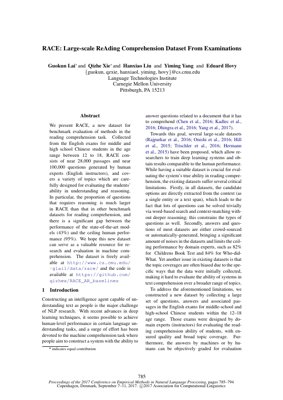
This document analyzes the seminal paper "RACE: Large-scale ReAding Comprehension Dataset From Examinations" presented at EMNLP 2017. The work introduces the RACE dataset, constructed to address critical limitations in existing machine reading comprehension (MRC) benchmarks. The core thesis is that prior datasets, often reliant on extractive or crowd-sourced questions, fail to adequately test a model's reasoning ability, leading to inflated performance metrics that do not reflect true language understanding.
Dataset Scale
~28,000 Passages
Question Count
~100,000 Questions
Human Performance
95% Accuracy Ceiling
State-of-the-Art (2017)
43% Model Accuracy
2. The RACE Dataset
2.1. Data Collection & Source
RACE is sourced from English examinations designed for middle and high school Chinese students (ages 12-18). The questions and passages are created by domain experts (English instructors), ensuring high quality and pedagogical relevance. This expert curation is a deliberate move away from the noise inherent in crowd-sourced or automatically generated datasets like SQuAD or NewsQA.
2.2. Dataset Statistics & Composition
- Passages: 27,933
- Questions: 97,687
- Format: Multiple-choice (4 options, 1 correct)
- Split: RACE-M (middle school), RACE-H (high school), with standard train/dev/test splits.
- Topic Coverage: Broad and diverse, as dictated by educational curricula, avoiding the topical biases of datasets drawn from single sources like news articles or children's stories.
2.3. Key Differentiators
RACE was designed to be a "harder" benchmark. Its primary differentiators are:
- Non-Extractive Answers: Questions and answer options are not text spans copied from the passage. They are paraphrased or abstracted, forcing models to perform inference rather than simple pattern matching. This directly counters a major flaw in datasets like SQuAD v1.1, where models could often locate answers via surface-level lexical overlap.
- High Reasoning Proportion: A significantly larger fraction of questions require logical reasoning, inference, synthesis, and understanding of cause-effect relationships compared to contemporaries like CNN/Daily Mail or Children's Book Test.
- Expert-Grounded Ceiling: The human performance ceiling, established by the exam creators and high-performing students, is 95%. This provides a clear, meaningful target for model performance, unlike datasets where human agreement is lower.
3. Technical Details & Methodology
3.1. Problem Formulation
The reading comprehension task in RACE is formalized as a multiple-choice question answering problem. Given a passage $P$ consisting of $n$ tokens $\{p_1, p_2, ..., p_n\}$, a question $Q$ with $m$ tokens $\{q_1, q_2, ..., q_m\}$, and a set of $k$ candidate answers $A = \{a_1, a_2, a_3, a_4\}$, the model must select the correct answer $a_{correct} \in A$.
The probability of an answer $a_i$ being correct can be modeled as a function of the joint representation of $P$, $Q$, and $a_i$: $$P(a_i \text{ is correct} | P, Q) = \text{Softmax}(f(\phi(P), \psi(Q), \omega(a_i)))$$ where $\phi, \psi, \omega$ are encoding functions (e.g., from RNNs or Transformers) and $f$ is a scoring function.
3.2. Evaluation Metrics
The primary evaluation metric is accuracy: the percentage of questions answered correctly. This straightforward metric aligns with the exam-based origin of the data and allows for direct comparison with human student performance.
4. Experimental Results & Analysis
4.1. Baseline Model Performance
The paper established strong baselines in 2017, including models like Sliding Window, Stanford Attentive Reader, and GA Reader. The best-performing baseline model achieved an accuracy of approximately 43% on the RACE test set. This was a stark contrast to models that were achieving near-human or super-human performance on simpler extractive datasets at the time.
4.2. Human Performance Ceiling
The human performance ceiling, derived from the performance of top students and experts, is 95%. This establishes a massive 52-percentage-point gap between the state-of-the-art (SOTA) models and human capability, highlighting the dataset's difficulty and the long road ahead for machine comprehension.
4.3. Performance Gap Analysis
The ~43% vs. 95% gap was the paper's most powerful argument. It visually demonstrated that existing MRC models, while successful on simpler tasks, lacked genuine reasoning and comprehension abilities. This gap served as a clear call to action for the NLP community to develop more sophisticated architectures.
Chart Description (Implied): A bar chart would show two bars: "Best Model (2017)" at ~43% and "Human Ceiling" at 95%, with a large, visually striking gap between them. A third bar for "Random Guess" at 25% would provide further context.
5. Analysis Framework & Case Study
Framework for Evaluating MRC Datasets: To assess the quality and difficulty of an MRC benchmark, analysts should examine:
- Answer Source: Are answers extractive (word spans from text) or abstractive/generated?
- Question Type: What proportion requires factual recall vs. inference (e.g., causal, logical, speculative)?
- Data Provenance: Is the data expert-curated, crowd-sourced, or synthetic? What is the noise level?
- Performance Gap: What is the delta between SOTA model performance and the human ceiling?
- Topic & Style Diversity: Is the dataset sourced from a narrow domain (e.g., Wikipedia) or multiple domains?
Case Study: RACE vs. SQuAD 1.1
Applying this framework: SQuAD 1.1 answers are strictly extractive spans, questions are largely factual, data is crowd-sourced (leading to some ambiguity), the 2017 SOTA (BiDAF) was approaching human performance (~77% vs. ~82% F1), and topics are limited to Wikipedia articles. RACE scores highly on difficulty (abstractive answers, high reasoning), quality (expert-curated), and diversity (educational texts), resulting in a large, meaningful performance gap that better diagnoses model weaknesses.
6. Critical Analysis & Expert Insight
Core Insight: The RACE paper wasn't just introducing another dataset; it was a strategic intervention that exposed a critical vulnerability in the NLP field's progress narrative. By 2017, headline-grabbing results on SQuAD were creating the illusion that machines were nearing human-level reading comprehension. RACE revealed this as a mirage, built on benchmarks that rewarded shallow pattern matching over deep understanding. Its 52-point performance gap was a sobering reality check, forcefully arguing that true machine reasoning remained a distant goal.
Logical Flow: The authors' logic is impeccable. 1) Identify flaw: existing datasets are too easy and noisy. 2) Propose solution: create a dataset from a source designed explicitly to test comprehension—standardized exams. 3) Validate hypothesis: show that SOTA models fail catastrophically on this new, rigorous test. This mirrors the methodology of creating "adversarial" datasets in computer vision to break overhyped models, as seen with the introduction of ImageNet-C for testing robustness to corruptions. RACE served a similar purpose for NLP.
Strengths & Flaws: RACE's greatest strength is its foundational premise: leveraging the decades of expertise embedded in pedagogical assessment. This gives it unparalleled construct validity for measuring comprehension. However, a key flaw, acknowledged even by its creators, is its cultural and linguistic specificity. The passages and reasoning patterns are filtered through the lens of Chinese English-language education. While this doesn't invalidate its utility, it may introduce biases not present in native English exams. Subsequent datasets like DROP (requiring discrete reasoning over paragraphs) or BoolQ (yes/no questions) have built on RACE's philosophy while seeking broader cultural grounding.
Actionable Insights: For practitioners and researchers, the lesson is clear: benchmark selection dictates progress perception. Relying solely on "solved" benchmarks leads to complacency. The field must continuously develop and prioritize "challenge sets" that probe specific capabilities, much like the HELM (Holistic Evaluation of Language Models) framework does today. When evaluating a new model, its performance on RACE (or its successors like RACE++, or contemporary reasoning benchmarks) should be weighted more heavily than its performance on extractive QA tasks. Investment should be directed towards architectures that explicitly model reasoning chains and world knowledge, moving beyond context-query matching. The enduring relevance of RACE, as cited in foundational works like the original BERT paper and beyond, proves that creating a hard, well-constructed benchmark is one of the most impactful contributions to AI research.
7. Future Applications & Research Directions
- Training for Robust Reasoning: RACE and its successors are ideal training grounds for developing models that perform robust, multi-step reasoning. This is directly applicable to legal document review, medical literature analysis, and technical support systems where answers are not verbatim in the text.
- Educational Technology: The most direct application is in intelligent tutoring systems (ITS). Models trained on RACE could provide personalized reading comprehension assistance, generate practice questions, or diagnose specific student weaknesses in reasoning.
- Benchmark for Large Language Models (LLMs): RACE remains a relevant benchmark for evaluating the reasoning capabilities of modern LLMs like GPT-4, Claude, or Gemini. While these models have surpassed the 2017 baselines by a large margin, analyzing their error patterns on RACE can reveal persistent gaps in logical deduction or understanding of implicit information.
- Cross-lingual & Multi-modal Extension: Future work involves creating RACE-style benchmarks in other languages and for multi-modal comprehension (text + diagrams, charts), further pushing the boundaries of machine understanding.
- Explainable AI (XAI): The complexity of RACE questions makes it an excellent testbed for developing models that not only answer correctly but also provide human-readable explanations or reasoning traces for their choices.
8. References
- Lai, G., Xie, Q., Liu, H., Yang, Y., & Hovy, E. (2017). RACE: Large-scale ReAding Comprehension Dataset From Examinations. In Proceedings of the 2017 Conference on Empirical Methods in Natural Language Processing (EMNLP) (pp. 785-794).
- Rajpurkar, P., Zhang, J., Lopyrev, K., & Liang, P. (2016). SQuAD: 100,000+ Questions for Machine Comprehension of Text. In Proceedings of the 2016 Conference on Empirical Methods in Natural Language Processing (EMNLP).
- Hermann, K. M., et al. (2015). Teaching Machines to Read and Comprehend. In Advances in Neural Information Processing Systems (NeurIPS).
- Devlin, J., Chang, M. W., Lee, K., & Toutanova, K. (2019). BERT: Pre-training of Deep Bidirectional Transformers for Language Understanding. In Proceedings of NAACL-HLT.
- Dua, D., et al. (2019). DROP: A Reading Comprehension Benchmark Requiring Discrete Reasoning Over Paragraphs. In Proceedings of NAACL-HLT.
- Hendrycks, D., & Dietterich, T. (2019). Benchmarking Neural Network Robustness to Common Corruptions and Perturbations. In International Conference on Learning Representations (ICLR). (Cited for analogy to ImageNet-C).
- Liang, P., et al. (2022). Holistic Evaluation of Language Models (HELM). arXiv preprint arXiv:2211.09110.