Table of Contents
1. Introduction & Overview
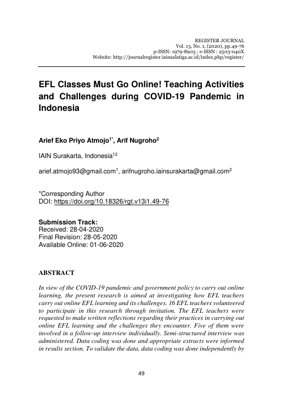
This research, published in Register Journal (Vol. 13, No. 1, 2020), investigates the implementation of online English as a Foreign Language (EFL) learning in Indonesia during the COVID-19 pandemic. Triggered by government mandates for remote education, the study explores the practical activities employed by EFL teachers and the multifaceted challenges they encountered in this abrupt transition.
The global COVID-19 pandemic, declared a public health emergency by the WHO in early 2020, forced educational institutions worldwide to suspend physical classes. In Indonesia, the Ministry of Education and Culture issued directives for nationwide online learning starting March 2020. This study positions itself within this critical context, aiming to document the on-the-ground reality of emergency remote teaching in the EFL sector.
Research Snapshot
- Journal: Register Journal
- Volume/Issue: Vol. 13, No. 1 (2020)
- Pages: 49-76
- DOI: https://doi.org/10.18326/rgt.v13i1.49-76
- Participants: 16 EFL Teachers
- Method: Qualitative (Reflections & Interviews)
2. Research Methodology
The study adopted a qualitative research design to gain in-depth insights into teachers' experiences.
2.1. Participants & Data Collection
Sixteen (16) EFL teachers from various institutions in Indonesia participated voluntarily. Primary data was collected through written reflections where teachers detailed their online teaching practices and challenges. Subsequently, five (5) teachers were selected for individual, semi-structured follow-up interviews to elaborate on their reflections.
2.2. Data Analysis & Validation
Data from reflections and interviews were coded thematically. To ensure reliability and validity, a rigorous process was employed:
- Independent Coding: Both researchers coded the data separately.
- Cyclical Discussion: Multiple rounds of discussion were held to reconcile coding differences and establish consensus on themes and extracts.
- Informed Reporting: Relevant and representative extracts from the data were selected to illustrate the findings in the results section.
3. Online EFL Teaching Activities
The study found that teachers engaged in a continuum of online activities, largely dictated by individual school policies.
3.1. Synchronous vs. Asynchronous Activities
Teaching activities spanned both synchronous (real-time) and asynchronous modes:
- Synchronous Activities: Live attendance checks, real-time video lectures, instant Q&A sessions, and live collaborative tasks.
- Asynchronous Activities: Assigning tasks via messaging apps, sharing pre-recorded video lessons, providing feedback on submitted work, and facilitating discussions on forums.
The choice between modes often depended on factors like internet stability, student access to devices, and school directives.
3.2. Technology & Platforms Used
Teachers utilized a diverse, often overlapping, ecosystem of digital tools:
- Learning Management Systems (LMS): Platforms like Google Classroom, Moodle, or school-specific portals for organizing content and assignments.
- Communication Tools: WhatsApp, Zoom, Google Meet, Skype for interaction and instruction.
- Content & Resource Platforms: YouTube, educational websites, and digital libraries for supplementary materials.
This "multi-app" approach was common but could lead to fragmentation and increased cognitive load for both teachers and students.
4. Challenges in Online EFL Learning
The research identified a triad of significant challenges, indicating that the transition was far from seamless.
4.1. Student-Related Challenges
- Limited Access & Infrastructure: Unreliable internet connectivity, lack of adequate devices (smartphones, laptops), and insufficient data quotas.
- Low Engagement & Motivation: Difficulty maintaining student focus and participation in a remote environment, leading to passive learning.
- Academic Honesty: Challenges in monitoring and preventing plagiarism or cheating during assessments.
4.2. Teacher-Related Challenges
- Digital Literacy Gap: Varying levels of proficiency in using online teaching tools and platforms effectively.
- Increased Workload: Time-consuming tasks of preparing digital materials, managing multiple platforms, and providing individualized feedback online.
- Pedagogical Adaptation: Difficulty translating effective face-to-face EFL teaching methods (e.g., communicative activities) into the online space.
4.3. Parent-Related & Systemic Challenges
- Parental Role & Support: Lack of parental understanding or ability to support their children's online learning, especially in lower socio-economic contexts.
- Lack of Systemic Preparation: The overarching finding was that online learning was implemented without adequate preparation, planning, training, or resource allocation from institutional and governmental levels.
5. Results & Key Findings
The core results indicate that while Indonesian EFL teachers actively attempted to deliver instruction online using available tools, the process was severely hampered by systemic and practical issues.
Primary Conclusion: Online learning during this period did not run optimally due to a fundamental lack of preparation and planning at multiple levels. The shift was reactive (emergency remote teaching) rather than proactive (designed online learning).
The study highlights the gap between policy mandate and practical execution, underscoring the need for structured support systems for teachers, students, and parents in digital learning environments.
6. Discussion & Implications
The discussion emphasizes that merely moving instruction online is insufficient. For online EFL learning to be effective, it must be pedagogically sound, well-supported, and equitable.
Key Implications:
- Teacher Training: Investment in comprehensive professional development for digital pedagogy and tool mastery is non-negotiable.
- Infrastructure & Equity: Addressing the digital divide is crucial for inclusive education. This includes internet access, device provision, and affordable data.
- Blended Learning Models: The future likely lies in flexible blended models that combine the best of online and face-to-face instruction, requiring careful instructional design.
- Policy & Support Frameworks: Educational policies need to be accompanied by detailed implementation guidelines, funding, and continuous support mechanisms.
7. Original Analysis & Expert Commentary
Core Insight: The Indonesian EFL case study is a global microcosm, exposing the profound difference between emergency remote teaching and intentionally designed online learning. The former, as Hodges et al. (2020) aptly defined, is a temporary shift due to crisis, often lacking the robust design, support, and resources of the latter. This research confirms that the pandemic forced the former, with predictable struggles.
Logical Flow: The study's logic is sound: mandate → implementation → observation of activities → identification of friction points. The findings flow from infrastructural barriers (the "hardware" of internet and devices) to pedagogical and human challenges (the "software" of engagement, literacy, and support). The ultimate bottleneck, correctly identified, is systemic unpreparedness—a failure at the planning and resource allocation layer.
Strengths & Flaws: The strength lies in its timely, grounded, qualitative approach, giving voice to teachers' lived experiences—a perspective often missing from top-down policy reports. However, its flaw is its limited scale (16 teachers) and lack of longitudinal data. It captures the initial "shock phase" but doesn't track adaptation over time. Comparing these 2020 findings with later studies, such as those synthesized in the International Journal of Educational Technology in Higher Education, shows that while tools became more familiar, core issues of equity, engagement, and teacher workload persisted, evolving rather than disappearing.
Actionable Insights: For stakeholders, this isn't just a post-mortem of 2020. It's a playbook for future-proofing education. First, invest in teacher capacity, not just tools. Training must focus on pedagogical redesign, not button-clicking. Second, adopt a hybrid-by-design model. As suggested by models like the Community of Inquiry (Garrison et al., 2000), successful online learning requires careful cultivation of teaching, social, and cognitive presence—elements haphazardly addressed in emergency mode. Third, leverage asynchronous strengths. The research hints at but under-explores asynchronous potential. Well-designed asynchronous activities (e.g., collaborative documents, discussion forums, peer review) can mitigate sync challenges and promote deeper reflection, a principle supported by the Online Learning Consortium's best practices. Finally, deploy simple, integrated tech stacks. The observed "app overload" increases friction. Recommending a core, interoperable suite of tools (e.g., an LMS + a video platform + a communication tool) can reduce cognitive load and streamline processes.
8. Technical Framework & Analysis Model
To analyze the effectiveness and challenges of the described online teaching, we can propose a simple conceptual framework. Let the overall teaching effectiveness $E$ be a function of key interdependent variables:
$E = f(T, S, P, I, R)$
Where:
- $T$: Teacher Digital Pedagogy & Readiness
- $S$: Student Access & Readiness
- $P$: Parental/Home Support Environment
- $I$: Institutional Policy & Infrastructure Support
- $R$: Resource & Platform Integration
The study's findings suggest that during the initial pandemic phase in Indonesia, the variables $S$ (due to the digital divide), $T$ (due to training gaps), and $I$ (due to lack of preparation) were critically low, acting as limiting factors. Thus, even if $R$ (resources) was moderately high due to available apps, the overall effectiveness $E$ was constrained by the weakest links, as per Liebig's law of the minimum. This can be modeled as:
$E \propto \min(T, S, P, I, R)$
Analysis Framework Example: A school administrator can use this model to diagnose their online learning ecosystem. By rating each variable (T, S, P, I, R) on a scale (e.g., 1-5) through surveys or audits, they can identify the primary constraint (the lowest score). For instance, if the audit reveals $S=2$ (poor student access) and $I=2$ (weak institutional support), while $T=4$ (teachers are ready), investment must first target $S$ and $I$ (e.g., providing devices/data and clear support guidelines) before advanced teacher training ($T$) can yield full returns. This moves planning from a scattergun approach to a constraint-based, systemic one.
9. Future Applications & Research Directions
Building on this study, several future directions are critical:
- Longitudinal & Comparative Studies: Tracking the evolution of the same teachers' practices and challenges over 2-3 years post-pandemic to map adaptation trajectories. Comparing Indonesian experiences with other Global South contexts to identify universal vs. context-specific challenges.
- Focus on Learning Outcomes & Equity: Moving beyond describing activities to rigorously measuring the impact of different online/hybrid models on actual EFL proficiency gains. Special focus on interventions that successfully bridge the digital divide for disadvantaged students.
- AI-Enhanced Language Learning Tools: Investigating the role of emerging technologies like AI-powered conversational agents for speaking practice, automated writing evaluation tools for feedback, and adaptive learning platforms that personalize content—all while considering their accessibility and ethical implementation.
- Design-Based Research (DBR): Partnering with teachers to co-design, implement, and iteratively improve specific online EFL modules based on frameworks like the Community of Inquiry, then studying their effectiveness. This shifts research from observation to collaborative solution-building.
- Policy Analysis & Implementation Science: Studying how national and local education policies regarding digital learning are translated (or lost in translation) into school-level practices and classroom realities, identifying key leverage points for effective implementation.
10. References
- Atmojo, A. E. P., & Nugroho, A. (2020). EFL Classes Must Go Online! Teaching Activities and Challenges during COVID-19 Pandemic in Indonesia. Register Journal, 13(1), 49-76. https://doi.org/10.18326/rgt.v13i1.49-76
- Cao, W., Fang, Z., Hou, G., Han, M., Xu, X., Dong, J., & Zheng, J. (2020). The psychological impact of the COVID-19 epidemic on college students in China. Psychiatry Research, 287, 112934.
- Garrison, D. R., Anderson, T., & Archer, W. (2000). Critical inquiry in a text-based environment: Computer conferencing in higher education. The Internet and Higher Education, 2(2-3), 87-105.
- Gonzalez, D., & Louis, R. St. (2018). Online Learning. In J. I. Liontas (Ed.), The TESOL Encyclopedia of English Language Teaching. Wiley.
- Hodges, C., Moore, S., Lockee, B., Trust, T., & Bond, A. (2020). The Difference Between Emergency Remote Teaching and Online Learning. Educause Review.
- McAleer, M. (2020). Prevention is better than the cure: Risk management of COVID-19. Journal of Risk and Financial Management, 13(3), 46.
- Moorhouse, B. L. (2020). Adaptations to a face-to-face initial teacher education course ‘forced’ online due to the COVID-19 pandemic. Journal of Education for Teaching, 46(4), 609-611.
- Sun, S. Y. H. (2014). Learner perspectives on fully online language learning. Distance Education, 35(1), 18-42.
- Velavan, T. P., & Meyer, C. G. (2020). The COVID-19 epidemic. Tropical Medicine & International Health, 25(3), 278.
- World Health Organization (WHO). (2020). Coronavirus disease (COVID-2019) situation reports.