Table of Contents
1 Introduction
The rapid advancement of neural language models (LMs) has sparked interest in their potential as cognitive models of human language acquisition. However, significant methodological gaps exist between LM evaluation paradigms and established linguistic research practices. This paper critically examines whether current benchmarking approaches adequately capture the structural complexity of human language and whether LMs trained on child-scale data can genuinely inform our understanding of language acquisition.
Data Scale Comparison
BERT: 3.3B tokens vs. Child: 10M words/year
Evaluation Gap
Template-based vs. Human-evaluated benchmarks
2 Methodological Limitations of Current Benchmarks
2.1 Template-Based Benchmark Deficiencies
Current syntactic evaluation benchmarks suffer from structural homogeneity that fails to represent the diversity found in theoretical linguistics. Template-based approaches in benchmarks like BLiMP and SyntaxGym lack the nuanced grammatical constructions that characterize natural language acquisition. The authors demonstrate that when tested on small-scale data modeling child language acquisition, LMs perform no better than simple baseline models, raising questions about their true linguistic capabilities.
2.2 Data Scale Mismatch Issues
The training data discrepancy between LMs and human learners presents a fundamental challenge. While models like BERT are trained on billions of tokens, children acquire language with exposure to approximately 10 million words per year, with vocabulary measured in hundreds at age three. This scale mismatch undermines direct comparisons between LM performance and human language acquisition.
3 Experimental Framework and Results
3.1 LI-Adger Dataset Evaluation
The study employs the LI-Adger dataset, a carefully curated collection evaluated for gradient acceptability by native speakers and specifically designed to probe structural grammatical knowledge. This dataset provides a more rigorous testing ground than template-based benchmarks, offering insights into whether LMs capture the subtle grammatical judgments that characterize human language competence.
3.2 Performance Comparison Analysis
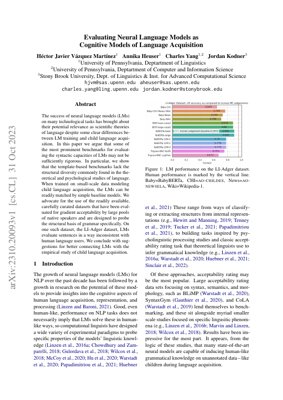
Experimental results reveal that LMs evaluate sentences in ways inconsistent with human language users on the LI-Adger dataset. As shown in Figure 1, models including BabyBERTa, AO-CHILDES, AO-NEWSELA, and Wikipedia-1 all demonstrate significant deviations from human performance patterns, indicating fundamental differences in how these models represent and process syntactic information.
Key Insights
- Current LM benchmarks lack structural diversity for proper cognitive evaluation
- Template-based approaches fail to capture nuanced grammatical knowledge
- Human-evaluated datasets like LI-Adger reveal LM-human performance gaps
- Data scale mismatches undermine direct acquisition comparisons
4 Technical Framework and Mathematical Foundations
The evaluation of language models relies on probability-based metrics that assess how well models predict grammatical structures. The core mathematical framework involves calculating the probability of sentence sequences:
$P(w_1, w_2, ..., w_n) = \prod_{i=1}^n P(w_i | w_1, w_2, ..., w_{i-1})$
Where $w_i$ represents words in a sequence, and the model's ability to assign higher probabilities to grammatical sentences versus ungrammatical ones serves as the basis for evaluating syntactic knowledge. However, this approach has limitations in capturing the nuanced acceptability judgments that characterize human linguistic competence.
5 Analysis Framework: Case Study Example
Case: Evaluating Subject-Verb Agreement
The analysis framework involves comparing LM performance on minimal pairs that test specific grammatical phenomena. For example, evaluating the model's probability assignments to:
- Grammatical: "The cats on the table are sleeping"
- Ungrammatical: "The cats on the table is sleeping"
The framework assesses whether the model consistently assigns higher probabilities to grammatical constructions across diverse syntactic environments, moving beyond simple template-based evaluations to test genuine grammatical knowledge.
6 Future Applications and Research Directions
Future research should focus on developing evaluation frameworks that better align with human language acquisition processes. Key directions include:
- Creating benchmarks with human-evaluated gradient acceptability judgments
- Developing models trained on child-scale data with realistic input limitations
- Incorporating multimodal learning to better simulate human language acquisition
- Establishing evaluation metrics that capture developmental trajectories
Expert Analysis: Core Insight, Logical Flow, Strengths & Flaws, Actionable Insights
Core Insight
The paper delivers a devastating critique of current LM evaluation practices, exposing how template-based benchmarks create an illusion of linguistic competence that collapses under rigorous testing. The authors reveal that what we're measuring isn't genuine grammatical knowledge but pattern recognition on artificially constrained datasets.
Logical Flow
The argument progresses with surgical precision: first demonstrating benchmark inadequacies, then showing how simple baselines match LMs on child-scale data, and finally revealing the performance gap on human-evaluated datasets. The logical chain is unbreakable - if LMs can't outperform simple models on acquisition-scale data and fail on human-judged grammaticality, their value as cognitive models is fundamentally questionable.
Strengths & Flaws
Strengths: The methodological critique is brilliant and long overdue. By exposing the structural poverty of current benchmarks, the authors force the field to confront uncomfortable truths. Their use of human-evaluated datasets represents a crucial step toward more meaningful evaluation.
Flaws: The paper stops short of proposing concrete alternative benchmarks, leaving researchers with criticism but limited constructive guidance. Additionally, while they identify the data scale problem, they don't adequately address whether current architectures could ever learn from child-scale data, regardless of evaluation methods.
Actionable Insights
Research teams must immediately abandon template-based benchmarks for syntactic evaluation and transition to human-judged datasets. The field needs standardized, large-scale collections of gradient acceptability judgments similar to the LI-Adger approach. More fundamentally, we must reconsider whether current LM architectures are even capable of capturing human-like grammatical knowledge, or if we need entirely different approaches to computational cognitive modeling.
7 References
- Warstadt, A., et al. (2020). BLiMP: The Benchmark of Linguistic Minimal Pairs. arXiv:1912.00582
- Linzen, T., & Baroni, M. (2021). Syntactic Structure from Deep Learning. Annual Review of Linguistics
- Huebner, P. A., et al. (2021). BabyBERTa: Learning More Grammar With Small-Scale Child-Directed Language. arXiv:2106.02144
- Chowdhury, S. R., & Zamparelli, R. (2018). RNN Simulations of Grammaticality Judgments on Long-distance Dependencies. Proceedings of COLING
- Goodfellow, I., et al. (2014). Generative Adversarial Networks. Advances in Neural Information Processing Systems