1. Introduction & Overview
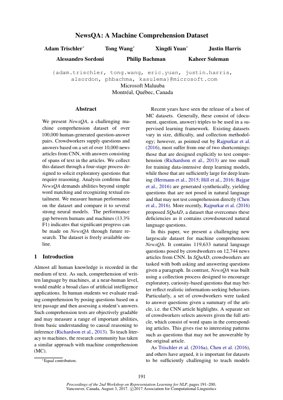
This document analyzes the research paper "NewsQA: A Machine Comprehension Dataset" presented at the 2nd Workshop on Representation Learning for NLP in 2017. The paper introduces a novel, large-scale dataset designed to push the boundaries of machine reading comprehension (MRC). The core premise is that existing datasets were either too small for modern deep learning or synthetically generated, failing to capture the complexity of natural human questioning. NewsQA, with over 100,000 human-generated question-answer pairs based on CNN news articles, was created to address this gap, explicitly focusing on questions that require reasoning beyond simple lexical matching.
2. The NewsQA Dataset
NewsQA is a supervised learning corpus consisting of (document, question, answer) triples. Answers are contiguous spans of text from the source article.
2.1 Dataset Creation & Methodology
The dataset was built using a sophisticated four-stage crowdsourcing process designed to elicit exploratory and reasoning-intensive questions:
- Question Generation: Workers were shown only the highlights/summary of a CNN article and asked to formulate questions they were curious about.
- Answer Span Selection: A separate set of workers, given the full article, identified the text span that answered the question, if it existed.
- This decoupling encourages questions that are lexically and syntactically divergent from the answer text.
- It naturally leads to a subset of questions that are unanswerable given the full article, adding another layer of difficulty.
2.2 Key Characteristics & Statistics
Scale
119,633 Q-A pairs
Source
12,744 CNN articles
Article Length
~6x longer than SQuAD articles on average
Answer Type
Text spans (not entities or multiple choice)
Distinguishing Features: Longer context documents, lexical divergence between Q&A, a higher proportion of reasoning questions, and the presence of unanswerable questions.
3. Technical Analysis & Design
3.1 Core Design Philosophy
The authors' goal was explicit: to construct a corpus that necessitates reasoning-like behaviors, such as synthesis of information across different parts of a long article. This is a direct response to the criticism that many MC datasets, like those generated by the CNN/Daily Mail cloze-style method, primarily test pattern matching rather than deep understanding [Chen et al., 2016].
3.2 Comparison with SQuAD
While both are span-based and crowdsourced, NewsQA differentiates itself:
- Domain & Length: News articles vs. Wikipedia paragraphs; significantly longer documents.
- Collection Process: Decoupled Q&A generation (NewsQA) vs. same-worker generation (SQuAD), leading to greater divergence.
- Question Nature: Designed for "exploratory, curiosity-based" questions vs. questions directly from the text.
- Unanswerables: NewsQA explicitly includes questions with no answer, a realistic and challenging scenario.
4. Experimental Results & Performance
4.1 Human vs. Machine Performance
The paper establishes a human performance baseline on the dataset. The key result is a 13.3% F1 score gap between human performance and the best neural models tested at the time. This significant gap was presented not as a failure, but as evidence that NewsQA is a challenging benchmark where "significant progress can be made."
4.2 Model Performance Analysis
The authors evaluated several strong neural baselines (architectures like Attentive Reader, Stanford Attentive Reader, and the AS Reader). The models struggled particularly with:
- Long-distance dependencies in the lengthy articles.
- Questions requiring synthesis of multiple facts.
- Correctly identifying unanswerable questions.
Chart Implication: A hypothetical performance chart would show Human F1 at the top (~80-90%), followed by a cluster of neural models significantly lower, with the gap visually emphasizing the dataset's difficulty.
5. Critical Analysis & Expert Insights
Core Insight: NewsQA wasn't just another dataset; it was a strategic intervention. The authors correctly identified that the field's progress was being gated by benchmark quality. While SQuAD [Rajpurkar et al., 2016] solved the scale/naturalness problem, NewsQA aimed to solve the reasoning-depth problem. Its four-stage, decoupled collection process was a clever hack to force crowdworkers into an information-seeking mindset, mimicking how a person might read a news summary and then dive into the full article for details. This methodology directly attacked the lexical bias plaguing earlier models.
Logical Flow: The paper's argument is airtight: 1) Prior datasets are flawed (too small or synthetic). 2) SQuAD is better but questions are too literal. 3) Therefore, we design a process (summary-first Q generation) to create harder, more divergent questions. 4) We validate this by showing a large human-machine gap. The logic serves the clear product goal: creating a benchmark that would remain relevant and unsolved for years, thereby attracting research and citations.
Strengths & Flaws: The major strength is the dataset's enduring difficulty and its focus on real-world complexity (long docs, unanswerable questions). Its flaw, common to the era, was the lack of multi-hop or explicit compositional reasoning questions that later datasets like HotpotQA [Yang et al., 2018] would introduce. Furthermore, the news domain, while rich, introduces biases in style and structure that may not generalize to other text types. The 13.3% F1 gap was a compelling headline, but it also reflected the limitations of 2017-era models more than an intrinsic property of the data.
Actionable Insights: For practitioners, NewsQA's legacy is a masterclass in benchmark design. If you want to advance a field, don't just make a bigger dataset; engineer its creation to target specific model weaknesses. For model builders, NewsQA signaled the need for architectures with better long-context reasoning (a need later addressed by transformers) and robust handling of "no answer" scenarios. The dataset effectively forced the community to move beyond bag-of-words similarity models towards ones that could perform genuine discourse-level understanding.
6. Technical Details & Mathematical Framework
The core task is defined as: Given a document $D$ consisting of tokens $[d_1, d_2, ..., d_m]$ and a question $Q$ consisting of tokens $[q_1, q_2, ..., q_n]$, the model must predict the start index $s$ and end index $e$ (where $1 \leq s \leq e \leq m$) of the answer span in $D$, or indicate that no answer exists.
The standard evaluation metric is the F1 score, which measures the harmonic mean of precision and recall at the word level between the predicted span and the ground truth span(s). For unanswerable questions, a prediction of "no answer" is considered correct only if the question truly has no answer.
A typical neural model from that era (e.g., the Attentive Reader) would:
- Encode the question into a vector $\mathbf{q}$.
- Encode each document token $d_i$ into a context-aware representation $\mathbf{d}_i$, often using a BiLSTM: $\overrightarrow{\mathbf{h}_i} = \text{LSTM}(\overrightarrow{\mathbf{h}_{i-1}}, \mathbf{E}[d_i])$, $\overleftarrow{\mathbf{h}_i} = \text{LSTM}(\overleftarrow{\mathbf{h}_{i+1}}, \mathbf{E}[d_i])$, $\mathbf{d}_i = [\overrightarrow{\mathbf{h}_i}; \overleftarrow{\mathbf{h}_i}]$.
- Compute an attention distribution over document tokens conditioned on the question: $\alpha_i \propto \exp(\mathbf{d}_i^\top \mathbf{W} \mathbf{q})$.
- Use this attention to compute a question-aware document representation and predict start/end probabilities via softmax classifiers.
7. Analysis Framework & Case Study
Case Study: Analyzing a Model's Failure on NewsQA
Scenario: A strong SQuAD model is applied to NewsQA and shows a significant performance drop.
Framework for Diagnosis:
- Check for Lexical Overlap Bias: Extract failed examples where the question and correct answer share few keywords. High failure rate here indicates the model relied on superficial matching, which NewsQA's design punishes.
- Analyze Context Length: Plot model accuracy (F1) vs. document token length. A sharp decline for longer articles points to a model's inability to handle long-range dependencies, a key feature of NewsQA.
- Evaluate on Unanswerables: Measure the model's precision/recall on the subset of unanswerable questions. Does it hallucinate answers? This tests a model's calibration and ability to know what it doesn't know.
- Reasoning Type Classification: Manually label a sample of failed questions into categories: "Multi-sentence synthesis," "Coreference resolution," "Temporal reasoning," "Causal reasoning." This pinpoints the specific cognitive skills the model lacks.
Example Finding: Applying this framework might reveal: "Model X fails on 60% of questions requiring synthesis across paragraphs (Category 1) and has a 95% false positive rate on unanswerable questions. Its performance decays linearly with document length beyond 300 tokens." This precise diagnosis directs improvements towards better cross-paragraph attention mechanisms and confidence thresholding.
8. Future Applications & Research Directions
The challenges posed by NewsQA directly informed several major research thrusts:
- Long-Context Modeling: NewsQA's lengthy articles highlighted the limitations of RNNs/ LSTMs. This demand helped drive the adoption and refinement of Transformer-based models like Longformer [Beltagy et al., 2020] and BigBird, which use efficient attention mechanisms for documents of thousands of tokens.
- Robust QA & Uncertainty Estimation: The unanswerable questions forced the community to develop models that could abstain from answering, improving the safety and reliability of real-world QA systems in customer service or legal document review.
- Multi-Source & Open-Domain QA: The "information-seeking" nature of NewsQA questions is a stepping stone to open-domain QA, where a system must retrieve relevant documents from a large corpus (like the web) and then answer complex questions based on them, as seen in systems like RAG (Retrieval-Augmented Generation) [Lewis et al., 2020].
- Explainability & Reasoning Chains: To tackle NewsQA's reasoning questions, future work moved towards models that generate explicit reasoning steps or highlight supporting sentences, making model decisions more interpretable.
The dataset's core challenge—understanding lengthy, real-world narratives to answer nuanced questions—remains central to applications in automated journalism analysis, academic literature review, and enterprise knowledge base interrogation.
9. References
- Trischler, A., Wang, T., Yuan, X., Harris, J., Sordoni, A., Bachman, P., & Suleman, K. (2017). NewsQA: A Machine Comprehension Dataset. Proceedings of the 2nd Workshop on Representation Learning for NLP.
- Rajpurkar, P., Zhang, J., Lopyrev, K., & Liang, P. (2016). SQuAD: 100,000+ Questions for Machine Comprehension of Text. Proceedings of the 2016 Conference on Empirical Methods in Natural Language Processing (EMNLP).
- Chen, D., Bolton, J., & Manning, C. D. (2016). A Thorough Examination of the CNN/Daily Mail Reading Comprehension Task. Proceedings of the 54th Annual Meeting of the Association for Computational Linguistics (ACL).
- Hermann, K. M., Kocisky, T., Grefenstette, E., Espeholt, L., Kay, W., Suleyman, M., & Blunsom, P. (2015). Teaching Machines to Read and Comprehend. Advances in Neural Information Processing Systems (NeurIPS).
- Richardson, M., Burges, C. J., & Renshaw, E. (2013). MCTest: A Challenge Dataset for the Open-Domain Machine Comprehension of Text. Proceedings of the 2013 Conference on Empirical Methods in Natural Language Processing (EMNLP).