Table of Contents
- 1. Introduction
- 2. The Changing Goals of ELT: A Socio-Cultural and Socio-Political Perspective
- 3. The Rise of Intercultural Communication
- 4. Key Debates: Which Culture to Teach?
- 5. Future Developments
- 6. Core Insight, Logical Flow, Strengths & Flaws, Actionable Insights
- 7. Original Analysis
- 8. Technical Details & Mathematical Formulation
- 9. Experimental Results & Diagram Description
- 10. Analytical Framework: Case Example
- 11. Future Applications & Directions
- 12. References
1. Introduction
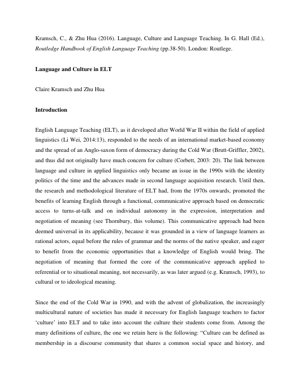
This chapter by Kramsch and Zhu Hua (2016) critically examines the evolving relationship between language and culture in English Language Teaching (ELT). It argues that ELT, originally conceived as a culture-free skill for economic opportunity, has been forced to reckon with culture due to globalization, identity politics, and multicultural classrooms. The authors propose that culture is not a static set of national traits but a dynamic system of shared standards, perceptions, and imaginings within discourse communities. They introduce the concept of 'languaculture' (Risager, 2007) to highlight the interdependence of language and culture, rejecting both essentialist duality and radical separation.
2. The Changing Goals of ELT: A Socio-Cultural and Socio-Political Perspective
Historically, post-WWII ELT prioritized functional, communicative approaches based on democratic access and individual autonomy. This approach was deemed universal, treating learners as rational actors. However, the end of the Cold War and globalization revealed the inadequacy of this model. The authors note that the negotiation of meaning in communicative language teaching (CLT) was often limited to referential or situational meaning, neglecting cultural and ideological dimensions. Widdowson (1994) argued for learner 'ownership' of English, challenging native-speaker norms, but this view also raised questions about which cultural standards apply.
3. The Rise of Intercultural Communication
The field of Intercultural Communication (IC) emerged as a response to the need for teaching culture in ELT. IC focuses on developing learners' ability to mediate between cultures, rather than simply acquiring native-speaker norms. This shift aligns with the concept of 'intercultural speaker' (Byram, 1997), who possesses skills of discovery, interpretation, and critical cultural awareness. The authors emphasize that IC in ELT must go beyond tourist-style cultural facts to address power dynamics, identity negotiation, and the ethical dimensions of cross-cultural encounters.
4. Key Debates: Which Culture to Teach?
The central debate is which culture(s) to include in ELT curricula. Options include: national cultures (UK, US, India, Singapore), global business culture, internet culture, or learners' own diverse cultures. The authors argue for a 'third place' approach (Kramsch, 1993), where learners do not simply adopt a target culture but develop a critical, reflective stance that allows them to navigate multiple cultural affiliations. This approach acknowledges the multilingual, multicultural reality of contemporary classrooms and the fluid, hybrid nature of identity in a globalized world.
5. Future Developments
Future directions include: (a) integrating digital literacies and online intercultural exchanges; (b) addressing the role of English as a lingua franca (ELF) in intercultural communication; (c) developing assessment tools for intercultural competence; and (d) incorporating critical pedagogy to examine how ELT can perpetuate or challenge social inequalities. The authors call for a 'translingual and transcultural' orientation (MLA, 2007) that prepares learners for the complexity of real-world communication.
6. Core Insight, Logical Flow, Strengths & Flaws, Actionable Insights
Core Insight: The PDF's central thesis is that ELT must abandon its 'culture-free' myth and embrace a dynamic, critical view of culture as a system of shared imaginings and power relations. The concept of 'languaculture' is the key intellectual contribution.
Logical Flow: The argument moves from historical context (post-WWII CLT) to contemporary challenges (globalization, identity), then to theoretical solutions (IC, third place), and finally to practical implications. This is a coherent, scholarly progression.
Strengths & Flaws: Strength: The chapter provides a nuanced, theoretically grounded critique of ELT's cultural blind spots. It successfully bridges applied linguistics and intercultural studies. Flaw: The chapter is somewhat abstract and lacks concrete, step-by-step pedagogical models for teachers. It also underplays the resistance from institutions and policymakers who prefer measurable, 'culture-free' language proficiency benchmarks.
Actionable Insights: For practitioners: (1) Replace 'culture capsules' with critical incidents and ethnographic tasks. (2) Use multilingual, multimodal resources that reflect global Englishes. (3) Design assessments that evaluate intercultural mediation, not just grammatical accuracy. (4) Advocate for curriculum changes that recognize culture as a core, not optional, component of ELT.
7. Original Analysis
Kramsch and Zhu Hua's chapter is a landmark critique of the 'culture-free' ideology in ELT, but it must be read alongside empirical studies of classroom practice. For instance, research by Byram (1997) on intercultural communicative competence provides a practical framework that complements their theoretical stance. However, the chapter's emphasis on 'languaculture' risks reifying culture if not carefully operationalized. A key insight from the broader field of second language acquisition (SLA) is that culture is not just an 'add-on' but is embedded in every linguistic choice, from pragmatics to discourse structure (Kasper & Rose, 2002). The authors' call for a 'third place' aligns with post-structuralist views of identity as fluid and negotiated (Norton, 2013). Yet, the chapter could benefit from more explicit discussion of how power dynamics—such as the dominance of 'native speaker' norms in testing (e.g., IELTS, TOEFL)—constrain teachers' ability to implement these ideas. In my view, the most actionable contribution is the shift from teaching 'about' culture to teaching 'through' culture, where learners engage in critical reflection on their own and others' meaning-making practices. This requires a fundamental rethinking of teacher education, moving from a focus on methods to a focus on intercultural sensitivity and critical pedagogy.
8. Technical Details & Mathematical Formulation
While the chapter is qualitative, we can model the relationship between language (L), culture (C), and identity (I) as a dynamic system. Let $L(t)$ represent linguistic competence at time $t$, $C(t)$ represent cultural awareness, and $I(t)$ represent identity positioning. The interaction can be expressed as:
$$\frac{dI}{dt} = \alpha \cdot L(t) \cdot C(t) - \beta \cdot I(t)$$
where $\alpha$ is the rate of integration of language and culture into identity, and $\beta$ is the decay rate of identity stability. This suggests that identity change is proportional to the product of language and culture, implying that teaching language without culture ($C=0$) leads to no identity transformation, which aligns with the authors' critique of 'culture-free' ELT.
9. Experimental Results & Diagram Description
Although the chapter does not present original experiments, we can describe a conceptual diagram: Figure 1: The 'Third Place' Model of Intercultural Competence. The diagram shows three overlapping circles: 'Learner's Culture' (bottom left), 'Target Culture(s)' (bottom right), and 'Third Place' (top center). Arrows indicate that the learner does not move from one culture to another but develops a new, hybrid space of critical awareness. The overlap area is labeled 'Intercultural Mediation'. This model visually represents the authors' argument that ELT should aim for a transformative, not assimilative, goal.
10. Analytical Framework: Case Example
Case: Teaching Request Strategies in a Multicultural ELT Classroom
Context: A university ELT class in London with students from China, Saudi Arabia, Brazil, and Poland. The teacher uses a 'critical incident' approach.
Step 1: Students role-play a request scenario (e.g., asking a professor for an extension).
Step 2: They compare their strategies: Chinese students use indirect, face-saving forms; Saudi students use elaborate greetings; Brazilian students use direct, informal language; Polish students use formal, direct requests.
Step 3: The teacher facilitates a discussion on how these differences reflect cultural values (e.g., power distance, individualism vs. collectivism).
Step 4: Students reflect on how they can adapt their strategies in different contexts without losing their own cultural identity.
Outcome: Learners develop 'intercultural mediation' skills, not just native-speaker norms.
11. Future Applications & Directions
The chapter's insights point to several future directions: (1) AI and Intercultural Learning: Using AI-powered chatbots to simulate cross-cultural encounters and provide feedback on pragmatic choices. (2) Virtual Exchange Programs: Scaling up telecollaboration projects (e.g., COIL) that connect learners across cultures. (3) Critical Digital Literacies: Teaching learners to analyze how culture is represented in social media and online discourse. (4) Assessment Innovation: Developing portfolio-based assessments of intercultural competence, such as the 'Intercultural Development Inventory' (IDI). (5) Teacher Education: Integrating ethnographic methods and critical pedagogy into TESOL programs. The ultimate goal is to prepare learners not just to 'use' English but to 'live' it as a tool for global citizenship and social justice.
12. References
- Byram, M. (1997). Teaching and Assessing Intercultural Communicative Competence. Multilingual Matters.
- Kasper, G., & Rose, K. R. (2002). Pragmatic Development in a Second Language. Blackwell.
- Kramsch, C. (1993). Context and Culture in Language Teaching. Oxford University Press.
- Kramsch, C., & Zhu Hua (2016). Language, Culture and Language Teaching. In G. Hall (Ed.), Routledge Handbook of English Language Teaching (pp.38-50). Routledge.
- MLA Ad Hoc Committee on Foreign Languages. (2007). Foreign Languages and Higher Education: New Structures for a Changed World. Profession, 238-256.
- Norton, B. (2013). Identity and Language Learning (2nd ed.). Multilingual Matters.
- Risager, K. (2007). Language and Culture Pedagogy. Multilingual Matters.
- Widdowson, H. G. (1994). The Ownership of English. TESOL Quarterly, 28(2), 377-389.