Table of Contents
1. Introduction & Overview
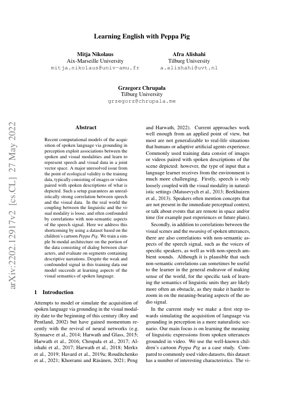
This research tackles a fundamental flaw in contemporary computational models of language acquisition: the unrealistic perfection of training data. Most models are trained on neatly paired images/videos with descriptive captions, creating an artificially strong correlation between speech and visual context. The real-world language learning environment, especially for children, is far messier. Speech is often loosely coupled with the immediate visual scene, filled with displaced language (talking about the past/future), non-semantic audio correlations (specific voices, ambient sounds), and confounders.
The authors' ingenious solution is to use episodes of the children's cartoon Peppa Pig as a dataset. This choice is strategic: the language is simple, the visuals are schematic, but crucially, the dialogue is naturalistic and often not directly descriptive of the on-screen action. The model is trained on character dialog segments and evaluated on the narrator's descriptive segments, simulating a more ecologically valid learning scenario.
2. Methodology & Model Architecture
2.1 The Peppa Pig Dataset
The dataset is derived from the cartoon Peppa Pig, known for its simple English, making it suitable for beginner learners. The key differentiator is the data split:
- Training Data: Segments containing dialog between characters. This speech is noisy, often displaced, and only loosely correlated with visuals.
- Evaluation Data: Segments containing descriptive narrations. These provide a cleaner, more grounded signal for testing semantic understanding.
2.2 Bi-modal Neural Architecture
The model employs a simple bi-modal architecture to learn joint embeddings in a shared vector space. The core idea is contrastive learning:
- Audio Stream: Processes raw speech waveforms or spectrograms through a convolutional neural network (CNN) or similar feature extractor.
- Visual Stream: Processes video frames (likely sampled at key intervals) through a CNN (e.g., ResNet) to extract spatial and temporal features.
- Joint Embedding Space: Both modalities are projected into a common D-dimensional space. The learning objective is to minimize the distance between embeddings of corresponding audio-video pairs while maximizing the distance for non-matching pairs.
2.3 Training & Evaluation Protocol
Training: The model is trained to associate dialog audio with its concurrent video scene, despite the loose coupling. It must filter out non-semantic correlations (e.g., character voice identity) to find the underlying visual semantics.
Evaluation Metrics:
- Video Fragment Retrieval: Given a spoken utterance (narration), retrieve the correct video segment from a set of candidates. Measures coarse-grained semantic alignment.
- Controlled Evaluation (Preferential Looking Paradigm): Inspired by developmental psychology (Hirsh-Pasek & Golinkoff, 1996). The model is presented with a target word and two video scenes—one matching the word's meaning, one distractor. Success is measured by the model's "attention" (embedding similarity) being higher for the matching scene. This tests fine-grained word-level semantics.
3. Experimental Results & Analysis
3.1 Video Fragment Retrieval Performance
The model demonstrated a significant, above-chance ability to retrieve the correct video segment given a narration query. This is a non-trivial result given the noisy training data. Performance metrics like Recall@K (e.g., Recall@1, Recall@5) would show how often the correct video is in the top K retrieved results. The success here indicates that the model learned to extract robust semantic representations from speech that generalize to the cleaner narration context.
3.2 Controlled Evaluation via Preferential Looking Paradigm
This evaluation provided deeper insight. The model showed a preferential "looking" (higher similarity score) towards the video scene that semantically matched the target word versus a distractor scene. For example, when hearing the word "jump," the model's embedding for a video showing jumping aligned more closely than for a video showing running. This confirms that the model acquired word-level visual semantics, not just scene-level correlations.
Key Insight
The model's success proves that learning from noisy, naturalistic data is possible. It effectively disentangles semantic signal from non-semantic confounders (like speaker voice) present in the dialog, validating the approach's ecological promise.
4. Technical Details & Mathematical Formulation
The core learning objective is based on a contrastive loss function, such as a triplet loss or InfoNCE (Noise Contrastive Estimation) loss, commonly used in multimodal embedding spaces.
Contrastive Loss (Conceptual): The model learns by comparing positive pairs (matching audio $a_i$ and video $v_i$) against negative pairs (non-matching $a_i$ and $v_j$).
A simplified triplet loss formulation aims to satisfy: $$\text{distance}(f(a_i), g(v_i)) + \alpha < \text{distance}(f(a_i), g(v_j))$$ for all negatives $j$, where $f$ and $g$ are the audio and video embedding functions, and $\alpha$ is a margin. The actual loss minimized during training is: $$L = \sum_i \sum_j \max(0, \, \text{distance}(f(a_i), g(v_i)) - \text{distance}(f(a_i), g(v_j)) + \alpha)$$
This pushes the embeddings of corresponding audio-video pairs closer together in the shared space while pushing non-corresponding pairs apart.
5. Analysis Framework: Core Insight & Critique
Core Insight: This paper is a necessary and bold corrective to the field's obsession with clean data. It demonstrates that the real challenge—and the true test of a model's cognitive plausibility—isn't achieving SOTA on curated datasets, but robust learning from the messy, confounded signal of real experience. Using Peppa Pig isn't a gimmick; it's a brilliantly pragmatic simulation of a child's linguistic environment, where dialogue is rarely a perfect audio description.
Logical Flow: The argument is elegantly simple: 1) Identify a critical flaw (lack of ecological validity). 2) Propose a principled solution (noisy, naturalistic data). 3) Implement a straightforward model to test the premise. 4) Evaluate with both applied (retrieval) and cognitive (preferential looking) metrics. The flow from problem definition to evidence-based conclusion is airtight.
Strengths & Flaws:
- Strength: The methodological innovation is profound. By separating training (dialog) and evaluation (narration) data, they create a controlled yet realistic testbed. This design should become a benchmark.
- Strength: Bridging computational modeling with developmental psychology (preferential looking paradigm) is a best practice that more AI research should adopt.
- Flaw: The "simple bi-modal architecture" is a double-edged sword. While it proves the point that the data matters most, it leaves open whether more advanced architectures (e.g., transformers, cross-modal attention) would yield qualitatively different insights or much higher performance. The field, as seen in works like Radford et al.'s CLIP, has moved towards scaling up both data and model size.
- Critical Flaw: The paper hints at but doesn't fully grapple with the temporal misalignment problem. In dialog, a character might say "I was scared yesterday" while smiling on screen. How does the model handle this severe temporal disconnect? The evaluation on descriptive narrations sidesteps this harder problem.
Actionable Insights:
- For Researchers: Abandon the crutch of perfectly aligned data. Future datasets for grounded learning must prioritize ecological noise. The community should standardize on evaluation splits like the one proposed here (noisy train / clean test).
- For Model Design: Invest in mechanisms for confounder disentanglement. Inspired by work in fair ML or domain adaptation, models need explicit inductive biases or adversarial components to suppress nuisance variables like speaker identity, as suggested in the seminal work on domain-adversarial training (Ganin et al., 2016).
- For the Field: This work is a stepping stone towards agents that learn in the wild. The next step is to incorporate an active component—allowing the model to influence its input (e.g., asking questions, focusing attention) to resolve ambiguity, moving from passive observation to interactive learning.
6. Future Applications & Research Directions
1. Robust Educational Technology: Models trained on this principle could power more adaptive language learning tools for children, capable of understanding learner speech in noisy, everyday environments and providing contextual feedback.
2. Human-Robot Interaction (HRI): For robots to operate in human spaces, they must understand language grounded in a shared, messy perceptual world. This research provides a blueprint for training such robots on natural human-robot or human-human dialog recordings.
3. Cognitive Science & AI Alignment: This line of work serves as a testbed for theories of human language acquisition. By scaling up the complexity (e.g., using longer-form narratives), we can probe the limits of distributional learning and the need for innate biases.
4. Advanced Multimodal Foundation Models: The next generation of models like GPT-4V or Gemini need training data that reflects real-world looseness of association. Curating large-scale, "noisy-grounded" datasets following the Peppa Pig paradigm is a crucial direction.
5. Integration with Large Language Models (LLMs): A promising direction is to use the grounded embeddings from a model like this one as an interface between perception and an LLM. The LLM could reason over the disentangled semantic embeddings, combining perceptual grounding with strong linguistic prior knowledge.
7. References
- Nikolaus, M., Alishahi, A., & Chrupała, G. (2022). Learning English with Peppa Pig. arXiv preprint arXiv:2202.12917.
- Roy, D., & Pentland, A. (2002). Learning words from sights and sounds: a computational model. Cognitive science.
- Harwath, D., & Glass, J. (2015). Deep multimodal semantic embeddings for speech and images. IEEE Workshop on ASRU.
- Radford, A., et al. (2021). Learning transferable visual models from natural language supervision. International Conference on Machine Learning (ICML).
- Ganin, Y., et al. (2016). Domain-adversarial training of neural networks. Journal of Machine Learning Research.
- Hirsh-Pasek, K., & Golinkoff, R. M. (1996). The intermodal preferential looking paradigm: A window onto emerging language comprehension. Methods for assessing children's syntax.
- Matusevych, Y., et al. (2013). The role of input in learning the semantic aspects of language: A distributional perspective. Proceedings of the Annual Meeting of the Cognitive Science Society.