1. Introduction & Overview
This study investigates the discourse of 3rd-grade English Language Learners (ELLs) as they engage in scientific inquiry to understand how the physical properties of a string—specifically its length and tension—affect the sound it produces. Despite the recognized importance of inquiry and argumentation in physics education, these practices are often absent in classrooms serving ELL populations. The research addresses a critical gap by exploring how ELLs utilize everyday language and multiple reasoning strategies (experiential, imaginative, mechanistic) to make sense of physics concepts, and how this process simultaneously fosters both conceptual understanding and English language competence.
The central research questions are: (i) How do ELLs use everyday language to understand physics? (ii) How do everyday and academic language interact during the students' meaning-making and concept formation?
2. Research Context & Methodology
The study was conducted in a linguistically diverse urban public school.
2.1. Participant Demographics
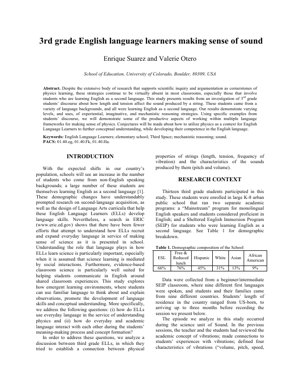
Thirteen 3rd-grade students participated. They were enrolled in a Sheltered English Immersion Program (SEIP). The school's demographic breakdown is summarized below:
School Demographic Snapshot
- ESL Students: 66%
- Free & Reduced Lunch: 76%
- Hispanic: 45%
- White: 31%
- Asian: 13%
- African American: 9%
The specific classroom featured nine different first languages among students, who came from nine different countries. Length of residence in the U.S. varied from being U.S.-born to having arrived just three months prior to the study.
2.2. Classroom Setting & Data Collection
Data were collected during a science unit on Sound. Prior activities included reviewing the concept of vibrations, connecting it to personal experiences, defining characteristics of sound (volume, pitch, speed, size), and introducing related academic terminology. The analyzed episode involved students discussing observations from an experiment where they flicked rulers to investigate sound.
3. Theoretical Framework & Key Concepts
3.1. The Third Space in Learning
The study is grounded in the concept of the "Third Space," a hybrid discourse that emerges when students' everyday, familiar language and experiences intersect with the formal, academic language of school science. This space is productive for learning as it allows for negotiation of meaning and identity.
3.2. Reasoning Strategies in Science
The analysis focuses on three reasoning strategies observed in student discourse:
- Experiential Reasoning: Drawing on personal, lived experiences (e.g., "It sounds like my guitar when...").
- Imaginative Reasoning: Using metaphor, analogy, or narrative to explain phenomena.
- Mechanistic Reasoning: Attempting to describe cause-and-effect relationships and underlying processes (e.g., linking tension to vibration speed).
4. Analysis of Student Discourse
4.1. Everyday Language in Physics Sense-Making
Students initially used rich, descriptive everyday language to articulate their observations about pitch and volume. For example, instead of "high frequency," a student might say, "It sounds squeaky, like a mouse." This familiar lexicon served as a crucial scaffold, providing initial access to the complex physics concept.
4.2. Interaction of Language Frameworks
The discourse analysis revealed a dynamic interplay. Students did not simply replace everyday terms with academic ones. Instead, they used both in tandem, refining and clarifying meanings. The teacher's role was pivotal in strategically introducing formal terms (e.g., "frequency," "amplitude") at moments when students' everyday descriptions had laid a concrete foundation for understanding.
5. Technical Details & Conceptual Model
The core physics concept explored is the relationship between a string's properties and the sound it produces, governed by the wave equation for a string under tension. The fundamental frequency $f$ is given by:
$f = \frac{1}{2L} \sqrt{\frac{T}{\mu}}$
Where:
- $L$ is the length of the string,
- $T$ is the tension in the string,
- $\mu$ is the linear mass density.
This formula shows that pitch (frequency $f$) increases with tension $T$ and decreases with length $L$. The students' task was to reason towards these qualitative relationships through experimentation and discourse, building an intuitive grasp that precedes formal mathematical representation.
6. Results & Findings
6.1. Key Insights from Discourse
- Productive Use of Multiple Languages: Students fluidly used words from their first languages, gestures, and onomatopoeia alongside English to construct explanations.
- Reasoning as a Bridge: Experiential and imaginative reasoning often preceded and facilitated the development of more mechanistic explanations.
- Physics as a Language Context: The shared, concrete experience of the sound experiment provided a meaningful and low-anxiety context for practicing English communication.
6.2. Statistical Overview
While the PDF does not provide extensive quantitative data, the demographic statistics (66% ESL, 76% on free/reduced lunch) highlight the study's relevance to high-need, linguistically diverse classrooms. The diversity of first languages (9) and countries of origin (9) within a single classroom underscores the complexity and importance of the research context.
7. Analytical Framework & Case Example
Framework for Discourse Analysis: The study employs a qualitative, interpretative framework. Transcripts of student discussions are analyzed line-by-line to code for:
- Language Source: Everyday vs. academic lexicon, use of L1.
- Reasoning Type: Experiential, imaginative, or mechanistic.
- Conceptual Shift: Moments where language or understanding becomes more precise or formal.
Case Example (Hypothetical based on described study):
Student A: "When I pull it tight [demonstrates tension on a rubber band], it goes 'twang!' really high, like my sister's voice." (Experiential/Imaginative)
Teacher: "Yes, you increased the tension. When tension is higher, the vibrations happen much faster. That faster vibration makes a higher pitch." (Introducing mechanistic cause-and-effect & academic terms: tension, vibration, pitch)
Student B: "So more tightness is more fast vibrations is high pitch." (Student synthesizes everyday and academic language into a nascent mechanistic rule).
This exchange illustrates the co-construction of understanding in the "Third Space."
8. Industry Analyst's Perspective
Core Insight: This research delivers a powerful, counter-intuitive punch: the perceived "language barrier" for ELLs in science is not just a hurdle to overcome, but can be a catalytic asset. By legitimizing everyday language and hybrid reasoning, educators can unlock deeper conceptual engagement than with rigid, vocabulary-first approaches. It reframes physics not as a subject ELLs aren't ready for, but as an ideal training ground for language itself.
Logical Flow: The argument is elegantly simple. 1) Start with a tangible, investigable phenomenon (sound from strings). 2) Elicit student descriptions using any communicative means available. 3) Treat these descriptions as valid intellectual resources, not deficits. 4) Strategically layer formal terminology onto this rich descriptive foundation. The result is dual-focus learning: concept and language develop synergistically.
Strengths & Flaws: The study's strength is its grounded, empirical look at real classroom talk, moving beyond theoretical platitudes about "hands-on" learning. It shows the how. The glaring flaw, typical of small-scale qualitative work, is scalability. The teacher's skill in facilitating this "Third Space" discourse is paramount—this isn't a plug-and-play curriculum. Without expert pedagogical sensitivity, the approach could devolve into unstructured chatter. Furthermore, the study hints at but doesn't fully grapple with assessment: how do we measure the "mechanistic reasoning" of a student still mastering English syntax?
Actionable Insights: For curriculum developers: stop creating "ELL-friendly" materials that are just simplified texts. Instead, design prompts that explicitly elicit experiential and imaginative reasoning. For professional development: train teachers in discourse analysis—to listen for and build upon the "seeds" of mechanistic reasoning in students' everyday talk. For researchers: Partner with ed-tech to develop AI tools (inspired by the analysis frameworks of large language model research) that can provide real-time feedback to teachers on the quality of student reasoning in classroom dialogue, helping scale the expert teacher's ear.
9. Future Applications & Research Directions
- Integrated STEM+Language Curriculum Design: Developing project-based learning units where the need to design, build, and explain a device (e.g., a simple musical instrument) drives authentic language use and physics understanding.
- Teacher Support Tools: Creating video libraries and annotated transcripts exemplifying effective "Third Space" facilitation, similar to resources developed by the STEM Teaching Tools initiative.
- Cross-Linguistic Studies: Investigating if certain first languages offer syntactic or metaphorical structures that particularly facilitate understanding of specific physics concepts (e.g., spatial relations, force).
- Longitudinal Tracking: Research to determine if early, discourse-rich science experiences for ELLs lead to stronger long-term STEM identity and achievement, compared to traditional skill-and-drill language instruction.
- Technology Integration: Exploring the use of multimodal digital notebooks where students can record video, audio, drawings, and text in multiple languages to document and explain their scientific inquiries.
10. References
- Suarez, E., & Otero, V. (Year). 3rd grade English language learners making sense of sound. Journal Name, Volume(Issue), pages. (Source PDF)
- Moje, E. B., et al. (2004). Working toward third space in content area literacy: An examination of everyday funds of knowledge and discourse. Reading Research Quarterly, 39(1), 38-70.
- National Academies of Sciences, Engineering, and Medicine. (2018). English Learners in STEM Subjects: Transforming Classrooms, Schools, and Lives. The National Academies Press.
- Lee, O., & Buxton, C. A. (2013). Integrating science and English proficiency for English language learners. Theory Into Practice, 52(1), 36-42.
- Russ, R. S., Scherr, R. E., Hammer, D., & Mikeska, J. (2008). Recognizing mechanistic reasoning in student scientific inquiry: A framework for discourse analysis developed from philosophy of science. Science Education, 92(3), 499-525.
- Stanford Graduate School of Education. (n.d.). Understanding Language. https://ul.stanford.edu/