Table of Contents
- 1. Introduction
- 2. Core Insight: The Co-Learning Paradigm Shift
- 3. Logical Flow: From Theory to Practice
- 4. Strengths & Flaws: A Critical Assessment
- 5. Actionable Insights: What This Means for EdTech
- 6. Technical Details: AI-FML Structure & Math
- 7. Experimental Results & Feedback
- 8. Case Study: AIoT-FML Learning Tool in Action
- 9. Original Analysis: Bridging the Gap
- 10. Future Applications & Outlook
- 11. References
1. Introduction
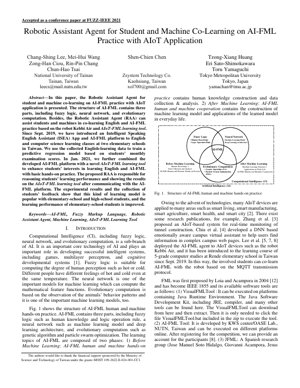
This paper, accepted at FUZZ-IEEE 2021, presents a Robotic Assistant Agent (RAA) designed for student and machine co-learning on AI-FML practice with AIoT applications. The system integrates fuzzy logic, neural networks, and evolutionary computation within an AI-FML framework, deployed on the robot Kebbi Air. Since September 2019, it has been used in elementary schools in Taiwan to enhance English and computer science learning. The RAA reasons about student performance and displays results on an AIoT-FML learning tool, aiming to improve engagement and outcomes.
2. Core Insight: The Co-Learning Paradigm Shift
Let's cut through the academic jargon. The core insight here isn't just about another AI tutoring system. It's about a fundamental shift in the learning dynamic: co-learning between humans and machines. This isn't a one-way knowledge transfer; it's a symbiotic loop where the student learns AI-FML concepts, and the machine (the robot) learns from the student's data to improve its own predictive models. This is a bold move away from passive learning tools. The paper implicitly argues that the best way to learn AI is to teach it, and the best way to teach AI is to have it interact with a human. This is a powerful, albeit under-explored, pedagogical hypothesis. It challenges the traditional 'student-as-consumer' model and positions the student as a co-creator of knowledge.
3. Logical Flow: From Theory to Practice
The paper's logical flow is commendably tight. It starts by establishing the theoretical foundation of AI-FML (Fuzzy Logic, Neural Networks, Evolutionary Computation) as the core of Computational Intelligence. It then introduces the practical problem: how to make this abstract concept tangible for elementary school students. The solution is the RAA, which acts as a bridge. The flow is: Theory (AI-FML) → Tool (RAA + Kebbi Air) → Application (English learning) → Feedback Loop (Student data improves model). This is a classic 'research-to-practice' pipeline, but with a crucial feedback loop that closes the circle. The use of MQTT for communication between the robot and the AI-FML platform is a smart, practical choice for real-time, low-latency interaction. The logic is sound, but the real test is in the execution, which we'll critique next.
4. Strengths & Flaws: A Critical Assessment
Strengths:
- Novel Integration: Combining AI-FML, a physical robot, and an AIoT learning tool into a single, coherent system is a significant engineering and pedagogical achievement. It's not just a simulation; it's a tangible, interactive experience.
- Real-World Deployment: The system was tested in actual elementary schools over a period of months (Sept 2019 to Jan 2021). This is a major strength. Many AI education papers stay in the lab. This one went to the classroom.
- Data-Driven Feedback: Using student monthly exam scores to train a predictive regression model is a practical, measurable way to close the learning loop. It provides a clear metric for success.
Flaws:
- Lack of Rigorous Quantitative Results: The paper mentions 'improved learning performance' and 'popular with students,' but the provided excerpt lacks specific, statistically significant data. What was the effect size? How did the experimental group compare to a control group? Without this, the claims are anecdotal. This is a critical weakness for a conference paper.
- Scalability Questions: The system relies on a specific robot (Kebbi Air) and a custom AIoT tool. How easily can this be scaled to hundreds of classrooms with different hardware? The cost and complexity are not addressed.
- Over-reliance on English Learning: While English is a good use case, the paper's title promises a broader 'AI-FML practice.' The focus on English feels like a narrow application of a potentially powerful framework. Is the RAA truly teaching AI-FML, or just using it as a wrapper for language learning?
5. Actionable Insights: What This Means for EdTech
For educators and EdTech developers, the actionable insights are clear:
- Embrace Embodied AI: A physical robot is more engaging than a screen-based avatar. The 'Kebbi Air' approach is a proof-of-concept that physical presence matters for student motivation, especially for younger learners.
- Design for Co-Learning, Not Just Delivery: Stop building systems that just deliver content. Build systems that learn from the student. The feedback loop is the most valuable part of this architecture. The student's data should improve the AI, which then improves the student's experience.
- Start with a Concrete, Measurable Problem: The paper wisely chose English exam scores as a clear, measurable outcome. Don't try to solve 'learning' in general. Pick a specific, quantifiable problem (e.g., vocabulary retention, math problem-solving speed) and build your AI around it.
- Don't Underestimate the Infrastructure: The MQTT protocol and AIoT-FML tool are not trivial. Any real-world deployment needs a robust, low-latency communication layer. This is often the hidden cost of such systems.
6. Technical Details: AI-FML Structure & Math
The AI-FML framework is composed of three core components:
- Fuzzy Logic: Handles human knowledge and logic operation rules. For example, a student's 'English proficiency' can be modeled as a fuzzy set: $\mu_{High}(score) = \frac{1}{1 + e^{-k(score - \theta)}}$.
- Neural Network: Used for predictive modeling. The paper uses a regression model to predict future exam scores based on past performance. A simple feedforward network can be represented as: $\hat{y} = \sigma(W_2 \cdot \sigma(W_1 \cdot x + b_1) + b_2)$.
- Evolutionary Computation: Used for optimization, e.g., tuning the parameters of the fuzzy membership functions or the neural network weights using a Genetic Algorithm (GA). The fitness function could be the Mean Squared Error (MSE) of the prediction: $MSE = \frac{1}{n}\sum_{i=1}^{n}(y_i - \hat{y}_i)^2$.
The RAA uses these components to reason about student performance. For instance, if a student's fuzzy 'effort' is low and their 'past score' is low, the fuzzy rule might fire: 'IF effort is low AND past score is low THEN predicted improvement is low.' This fuzzy output is then defuzzified to provide a clear recommendation to the student or teacher.
7. Experimental Results & Feedback
While the excerpt lacks detailed numerical tables, it states that the system was deployed in two elementary schools in Taiwan. The experimental results are described qualitatively:
- Student Feedback: The learning model was 'popular with elementary-school and high-school students.' This suggests high engagement and positive user experience.
- Learning Performance: The learning performance of elementary-school students 'improved.' The paper implies that the predictive regression model, trained on monthly exam scores, helped identify at-risk students and provide targeted support.
- AIoT-FML Tool: The novel AIoT-FML learning tool was introduced in Jan. 2021 to 'enhance students’ interests in learning English and AI-FML with basic hands-on practice.' This suggests a shift from passive to active learning.
Note: A full paper would include a table comparing pre-test and post-test scores for control vs. experimental groups. The absence of this data is a significant limitation.
8. Case Study: AIoT-FML Learning Tool in Action
Consider a 5th-grade student, Mei, using the system. She is learning English vocabulary. The AIoT-FML learning tool is a physical device with sensors and lights. The scenario:
- Data Collection: Mei practices vocabulary on the tool. Her response time and accuracy are recorded.
- Fuzzy Reasoning: The RAA uses fuzzy rules to assess her 'mastery level.' For example: 'IF accuracy is high AND response time is fast THEN mastery is high.'
- Robot Interaction: The robot Kebbi Air says, 'Great job, Mei! You are mastering these words. Let's try a harder set.' If mastery is low, the robot might say, 'Let's review these words again. I will show you a hint.'
- Predictive Model: The neural network predicts her score on the next monthly exam. If the prediction is low, the teacher is alerted to provide extra help.
- Evolutionary Optimization: Over time, the GA tunes the fuzzy rules and neural network weights to improve the accuracy of the predictions and the relevance of the robot's feedback.
This is a concrete example of the co-learning loop in action. The student learns, the machine learns from the student, and the system adapts.
9. Original Analysis: Bridging the Gap
This paper represents a commendable, albeit incomplete, step towards a future where AI is not just a tool but a learning partner. The core idea of co-learning is philosophically aligned with Vygotsky's Zone of Proximal Development (ZPD), where learning is most effective when guided by a 'more knowledgeable other.' Here, the robot and the AI system act as that 'other,' but with the crucial twist that the 'other' is also learning from the student. This is a powerful concept that could democratize personalized tutoring.
However, the paper's biggest flaw is its lack of rigorous, quantitative evidence. In the current landscape of AI in education, claims of 'improved performance' are no longer sufficient. We need effect sizes, confidence intervals, and comparisons to baseline methods. For example, a 2020 meta-analysis by Zawacki-Richter et al. (published in the International Journal of Educational Technology in Higher Education) found that while AI applications in education are proliferating, the evidence for their effectiveness is often weak and fragmented. This paper unfortunately falls into that category. It provides a compelling narrative and a well-designed system, but it fails to provide the hard data needed to convince a skeptic.
Furthermore, the paper's focus on English learning, while practical, feels like a missed opportunity. The true power of AI-FML lies in its ability to model complex, non-linear relationships. Applying it to a relatively linear task like vocabulary memorization is like using a supercomputer to calculate a tip. The system would be far more impactful if applied to subjects like mathematics or science, where fuzzy reasoning and neural networks could model deeper conceptual understanding. For instance, a student's understanding of 'force' in physics is inherently fuzzy and multi-dimensional, making it a perfect candidate for this framework.
In conclusion, this paper is a valuable proof-of-concept. It shows that a robot can be a co-learner, not just a teacher. But to move from a conference paper to a scalable educational tool, the authors must provide the data that proves it works, and they must apply it to more challenging domains. The technology is promising; the evidence is pending.
10. Future Applications & Outlook
The RAA and AI-FML framework have significant potential beyond English learning:
- Personalized STEM Tutoring: The system could be adapted to teach complex STEM concepts like calculus, physics, or programming. The fuzzy logic could model a student's 'intuitive understanding' of a concept, while the neural network predicts their performance on problem sets.
- Special Education: The robot's non-judgmental, patient interaction style could be highly effective for students with autism or learning disabilities. The AI could adapt the pace and style of instruction in real-time based on the student's emotional state (detected via sensors).
- Corporate Training: The system could be used for employee onboarding or upskilling. The robot could act as a 'digital mentor,' guiding employees through new software or processes, while the AI tracks their learning progress and identifies knowledge gaps.
- Integration with Generative AI: Future versions could integrate with Large Language Models (LLMs) like GPT-4 to provide more natural, conversational feedback. The robot could generate personalized explanations or analogies on the fly, making the learning experience even more engaging.
- Cross-Cultural Learning: The system could be deployed in multiple countries, allowing students to co-learn with robots that speak different languages, fostering global collaboration and cultural exchange.
11. References
- C.-S. Lee, M.-H. Wang, Z.-H. Ciou, et al., "Robotic Assistant Agent for Student and Machine Co-Learning on AI-FML Practice with AIoT Application," in Proc. FUZZ-IEEE, 2021.
- V. Loia and G. Acampora, "Fuzzy Markup Language: A New Solution for the Intelligent Web," in Proc. IEEE Int. Conf. Fuzzy Systems, 2004.
- O. Zawacki-Richter, V. I. Marín, M. Bond, and F. Gouverneur, "Systematic review of research on artificial intelligence applications in higher education – where are the educators?," International Journal of Educational Technology in Higher Education, vol. 17, no. 1, 2020.
- L. S. Vygotsky, Mind in Society: The Development of Higher Psychological Processes. Harvard University Press, 1978.
- J. Zhu, T. Park, P. Isola, and A. A. Efros, "Unpaired Image-to-Image Translation using Cycle-Consistent Adversarial Networks," in Proc. IEEE Int. Conf. Computer Vision (ICCV), 2017. (Referenced as an example of a foundational AI paper for comparison of methodological rigor).